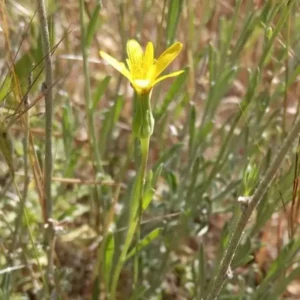
Υποχοιρίς η λεία
Etymology of Hypochaeris glabra
The name Hypochaeris glabra comes from Greek origins, but the genus name "Hypochaeris" is debated. It is said to be derived from the Ancient Greek "ὑποχοιρίς", from the combination of the words "ὑπό" (hypo), meaning "under," and "χοῖρος" (choiros), meaning "pig". The precise reasoning behind this name is debated, but one theory suggests it refers to pigs' affinity for the plant's edible roots. Another perspective links it to Theophrastus, a Greek philosopher, who used the name for this or a similar plant.
As a Greek-speaker, though, I can't figure out how "choiros" can be converted to "chaeris"; the correct translation of the Greek alphabet to Latin is "choeris", thus Hypochoeris, not Hypochaeris. There are actually listings on the internet of this genus with the correct translation, as Hypochoeris. The name Hypochaeris, though, was formally published and accepted in botanical literature. Under the rules of the International Code of Nomenclature for algae, fungi, and plants (ICN), once a genus name is validly published and widely used, it is preserved for the sake of nomenclatural stability, even if it contains a small etymological inaccuracy. So even if Hypochoeris might be a more literal rendering of "under-pig," the accepted name is Hypochaeris, and it cannot be arbitrarily changed now.
Another debated etymological explanation is the following: The genus name comes from the combination of the words "ὑπό" (hypo), meaning "under," and "χάρις" (charis), meaning "grace," "kindness," or "favour." Thus, the name is supposed to be interpreted as “less than graceful” or “under grace,” allegedly about the plant’s modest or humble appearance compared to showier relatives. This interpretation is consistent with a common tradition in botanical Latin where names subtly describe visual or ecological traits. But, this translation of the Greek alphabet to Latin also doesn't make sense, as "charis" has nothing to do with "chaeris", this would normally derive from "χαίρω" (chaero) in Greek, meaning "I'm glad".
The specific epithet, glabra, comes from the Latin adjective "glaber," which means "smooth," "hairless," or "bald." Botanists chose this epithet to distinguish this particular species within the genus Hypochaeris due to its characteristic lack of hairiness on its leaves and stems, which contrasts with other species, such as Hypochaeris radicata, that are typically bristly or hairy.
Thus, the name Hypochaeris glabra collectively describes a "pig's ear" plant that is notably smooth.
Key morphological characteristics of Hypochaeris glabra
Hypochaeris glabra is an annual herbaceous plant belonging to the Asteraceae (daisy or sunflower) family. It is recognized by its generally low-growing rosette of basal leaves and its slender, often branching flowering stems. Its morphology, particularly the absence of hairs, is a key diagnostic feature, reflected in its specific epithet "glabra."
General Habit and Size
Hypochaeris glabra typically grows as an erect annual herb, forming a basal rosette of leaves from which one or several flowering stems emerge. These stems are usually slender, branched, and can reach heights ranging from a few centimeters up to about 50 centimeters, though often shorter. The overall appearance is generally delicate compared to some of its more robust relatives.
Leaves
The leaves of Hypochaeris glabra are a primary identifying feature. They are predominantly found in a basal rosette, lying flat or nearly flat against the ground. These leaves are typically glabrous (smooth and hairless) on both surfaces, distinguishing them from the hairy or bristly leaves of other Hypochaeris species. The leaf blades are oblanceolate to spatulate in shape, often with toothed or pinnately lobed margins, but the lobing can vary. Stem leaves, if present, are few, much smaller, and often scale-like.
Stem
The flowering stems are erect, slender, and typically branched in the upper part. Like the leaves, the stems of Hypochaeris glabra are also glabrous (hairless), providing a smooth texture. They are hollow and may have a slightly reddish tinge, especially towards the base. Each branch usually terminates in a single flower head.
Flowers and Inflorescence
The plant produces solitary, dandelion-like flower heads at the end of each stem branch. These heads are relatively small, typically 1-2.5 cm in diameter. The flowers are entirely ligulate, meaning they are composed solely of ray florets, which are bright yellow. The involucral bracts (the modified leaves surrounding the base of the flower head) are arranged in several rows and are also generally glabrous or very sparsely hairy. The blooming period usually occurs from spring to early summer.
Fruits (Achenes)
Following flowering, Hypochaeris glabra produces achenes, which are the dry, single-seeded fruits characteristic of the Asteraceae family. Each achene is topped with a pappus, a tuft of bristles that aids in wind dispersal. In Hypochaeris glabra, the pappus consists of two types of hairs: an outer row of short, simple bristles and an inner row of longer, feathery (plumose) bristles. The achenes themselves are often dark, ribbed, and may be beaked, though the beak length can vary.
Habitat of Hypochaeris glabra
Hypochaeris glabra, commonly known as Smooth Cat's-ear, is an annual herbaceous plant with a wide native distribution across Europe, North Africa, and parts of Asia. It is also an introduced species in many other temperate regions worldwide. Its habitat preferences generally reflect its ability to thrive in open, often disturbed, and typically dry environments.
This species is frequently found in open, sunny habitats where competition from taller or more robust vegetation is limited. Common locations include grasslands, dry meadows, and heathlands, particularly those with poorer, well-drained soils. Its preference for low nutrient conditions allows it to colonize areas where many other plants might struggle.
Hypochaeris glabra is also a common sight in disturbed ground and cultivated or previously cultivated areas. This includes roadsides, paths, fallow fields, field margins, vineyards, and gardens. Its annual life cycle and efficient seed dispersal allow it to quickly colonize such temporary or frequently disturbed niches.
Hypochaeris glabra in Cyprus
In Cyprus, where Hypochaeris glabra is native, it is an uncommon plant found from sea level up to approximately 1525 meters in elevation, typically in open, dry, and often sandy or stony locations. Its flowering period is between March and May.