Λακτούκη η ιτεόφυλλη
Etymology of Lactuca saligna
''Lactuca'' is derived from the Latin verb ''lacto'', meaning "contain milk", hence "lactuca" is a "milky plant", referring to the white, milky juice of the root and stems of the plant. The specific epithet "saligna" comes from the Latin word salignus, which means "of willow" or "willow-like." This name was given to the plant by Carl Linnaeus, the father of modern taxonomy, because of its long, narrow, and unlobed leaves, which he saw as resembling the leaves of a willow tree (Salix species).
Overview of Lactuca saligna
Lactuca saligna, commonly known as willowleaf lettuce or least lettuce, is a species of wild lettuce belonging to the family Asteraceae. It is native to parts of Europe, western Asia, and North Africa, but it has also been introduced to other regions, including North America and Australia. Unlike the cultivated lettuce (Lactuca sativa), this species is wild and typically not used for human consumption due to its bitter taste and tough texture.
Physical Characteristics
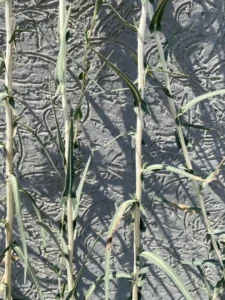
Lactuca saligna, commonly known as willowleaf lettuce or least lettuce, is an annual or biennial plant that can reach a height of up to 1 meter (3.3 feet), and occasionally even taller. It's possible to see specimens exceeding 150 cm in height, especially in favorable conditions (where there is the presence of water during the summer). Its stem is generally stiff, erect, and whitish, often with branches (but not always). A key distinguishing feature of Lactuca saligna is its long and narrow, willow-like leaves, which are typically unlobed or only slightly lobed, and have smooth margins. Unlike prickly lettuce (Lactuca serriola), Lactuca saligna generally does not have prominent spines along the midrib or margins of its leaves, though some sources mention that the lower midrib can occasionally have some bristles. The lower leaves may be somewhat broader, but they are not typically deeply lobed like those of some other Lactuca species. The upper leaves are narrower and clasp the stem at their base with pointed auricles. The plant produces a panicle or spike-like inflorescence of numerous, small, pale yellow flowers. The fruits are achenes with a long, slender beak and a white pappus.
Habitat and Ecology
This plant typically thrives in dry, open, and disturbed habitats, such as concrete cracks, field margins, wastelands, roadsides, and coastal dunes. It prefers well-drained soils and can tolerate a range of conditions, including poor and sandy substrates. Being adapted to dry climates, it is often found in sunny, exposed areas and has a high tolerance for drought. Its ability to grow in disturbed sites makes it a resilient colonizer in both natural and human-altered landscapes.
Uses and Significance
While it has limited economic use compared to cultivated lettuce, Lactuca saligna plays a role in biodiversity by providing nectar for insects and seeds for certain birds. Historically, related lettuce species have been used medicinally for their latex, which contains compounds with mild sedative effects, though L. saligna itself is not a significant medicinal plant. Its close relationship to cultivated lettuce also makes it of occasional interest in plant breeding and botanical research, particularly in studies of disease resistance and adaptation to arid environments.
Lactuca saligna in Cyprus
Lactuca saligna is native to Cyprus, particularly found in the central mountains and northern parts of the island. It occurs across a wide environmental range, typically from sea level up to around 1680 meters. On the island, this species tends to inhabit open, sunny, and often dry or slightly saline environments, such as field margins, disturbed soils, and coastal banks. It favors alkaline, mesotrophic substrates and thrives in low-moisture settings. Its adaptability allows it to colonize areas with moderate disturbance. Its flowering period in Cyprus is usually between July and October.
Key morphological characteristics of Lactuca saligna
Leaves
Leaves are notably very long and narrow (linear to narrowly lanceolate), giving it the "willowleaf" common name.
They are typically entire (without lobes) or only slightly toothed, and generally lack the prominent prickles found on the midrib of L. serriola
Growth Habit and Stem
An annual or biennial, generally slenderer than Lactuca serriola, growing to heights of 0.5-1 meter, occasionally taller.
Why do Lactuca saligna flowers often appear closed or rarely open?
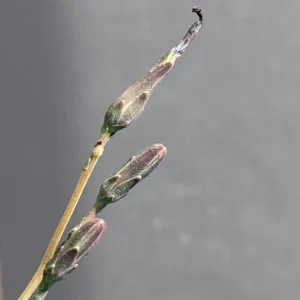
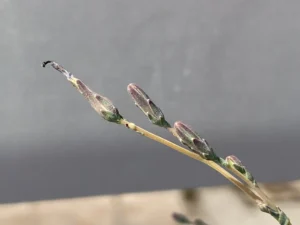
Lactuca saligna produces small pale yellow flower heads that often seem closed because they are only open for a short period during the day, usually in the morning under sunny conditions. This species shows a pattern of diurnal flowering in which the heads may remain closed in cloudy, cool, or late-day conditions to protect the reproductive structures and conserve resources. In hot and dry environments such as much of its range, rapid opening and closing also help reduce water loss and prevent the pollen from drying out. If the plant is observed outside its brief flowering window, the involucre bracts are usually tightly wrapped, giving the impression that the flowers are always closed.