Date Created: 10.02.2023
Last Modified: 11.04.2026
Senecio glaucus subsp. cyprius is a resilient annual herb belonging to the Asteraceae family. This taxon is a specialized endemic of the island. A frequent synonym often encountered in botanical literature for this specific plant is Senecio cyprius, which highlights its distinct status within the regional flora of the Eastern Mediterranean.
Cypriot Names
The official Latin name translated into Greek is Σενέκιο το γλαυκό υποείδος το κυπριακό. Locally, it is known as Μαρουλλίτζι της θάλασσας [maroullitzi tis thalassas], which translates to "little sea lettuce" due to its succulent leaves and coastal habitat.
Common English Names
- Cypriot Groundsel
- Glaucous Groundsel
- Cyprus Ragwort
Etymology of Senecio glaucus subsp. cyprius
The etymology of the genus name Senecio originates from the Latin word senex, meaning "old man," referring to the white, hair-like pappus of the seeds. The specific epithet glaucus comes from the Ancient Greek γλαυκός [glaukos], meaning "bluish-grey," describing the waxy coating on the leaves and stems.
The subspecific epithet cyprius is derived from the Ancient Greek Κύπρος [Kypros], the name of the island of Cyprus. This designation signifies that this particular subspecies is native and restricted to the geographical boundaries of the island, distinguishing it from other variations of the species found across the broader Mediterranean and Middle Eastern regions.
Synonyms
- Senecio cyprius
- Senecio joppensis var. cyprius
- Senecio coronopifolius subsp. cyprius
Key Characteristics for Diagnostic Identification
According to the definitive botanical keys established by Robert Desmond Meikle in his comprehensive Flora of Cyprus (1977, 1985), this species is distinguished by several specific morphological features:
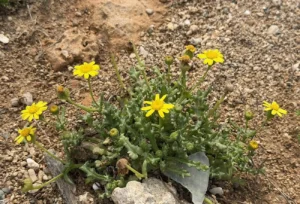
- Growth Habit: It is a dwarf, often tufted, glaucous annual herb, typically 5–15 cm high (rarely up to 45 cm), maintaining a much more compact and lower stature than the taller, erect Senecio vulgaris.
- Foliage: The leaves are distinctly fleshy and deeply pinnatisect with a glaucous hue, which separates it from Senecio vulcanicus whose leaves are generally thinner and more sharply toothed rather than rounded-lobed.
- Involucre: The bracts surrounding the flower head are linear-lanceolate with blackish tips, similar to Senecio vernalis, but Senecio glaucus subsp. cyprius is distinguished by having much fewer and shorter outer bracteoles (calyculus).
- Flower Heads: The radiate capitula feature yellow ray florets about 5–8 mm long, which differentiates it immediately from Senecio vulgaris, which is typically discoid and lacks these conspicuous ray florets.
- Achenes: The cylindrical fruits are roughly 2–3 mm long and pubescent, being slightly more robust than the more slender, often glabrous achenes found in some variations of Senecio bicolor.
- Pappus: It consists of numerous white, silky bristles that facilitate wind dispersal, providing a fluffy appearance to the seed head that is characteristic of the genus but more persistent than in some smaller annuals.
Botanical Structure and Floral Details of Senecio glaucus subsp. cyprius
Vegetative Morphology
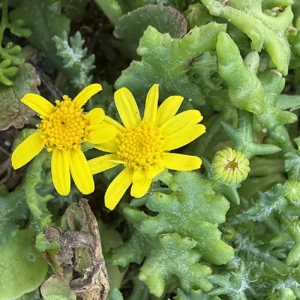
The stems of Senecio glaucus subsp. cyprius are typically smooth and hairless. The succulent nature of the leaves is an evolutionary adaptation to salt spray and arid conditions. These leaves are divided into narrow, lobed segments, providing a delicate, feathery appearance despite their fleshy and durable texture.
Reproductive Organs
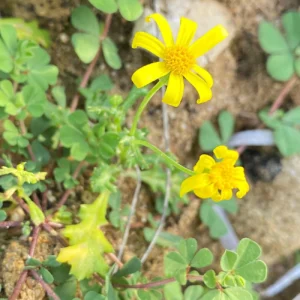
The inflorescence is a loose cyme containing several bright yellow flower heads. Each head measures approximately 1.5 to 2 centimeters in diameter. The ray florets are spreading and vivid, while the central disc florets are densely packed, ensuring high visibility for pollinators such as bees and small beetles.
Geographical Distribution and Habitat of Senecio glaucus subsp. cyprius
The broader Senecio glaucus species complex is distributed throughout the Mediterranean, North Africa, and Western Asia. In Cyprus, this specific subspecies is an endemic plant. It thrives primarily in littoral zones, colonizing sandy shores, maritime rocks, and stabilized sand dunes.
Distribution in Cyprus
This subspecies is restricted to the western and southwestern coastal regions, specifically in the Paphos district and the Akamas Peninsula. It is primarily found colonizing sandy shores, maritime rocks, and stabilized sand dunes. This localized range highlights its dependency on specific maritime conditions found in the west.
Flowering Period
The flowering period of this endemic plant typically occurs between January and March, occasionally extending into April. During these months, the plant produces its characteristic yellow blooms, utilizing the winter rainfall and moderate coastal temperatures to complete its reproductive cycle before the intense heat of the summer arrives.
Conservation Status
According to the Red Data Book of the Threatened Plants of Cyprus, this taxon is categorized as Least Concern (LC). While it is an endemic with a specialized coastal habitat, its populations in the Paphos and Akamas regions are currently considered stable enough not to meet the criteria for "Threatened" status.
Is Senecio glaucus subsp. cyprius Suitable for Gardens?
While beautiful, this herb is rarely cultivated in traditional gardens due to its specialized maritime requirements. However, it is an excellent candidate for coastal rock gardens or native xeriscaping. It requires excellent drainage, full sun, and minimal intervention, providing a splash of gold against sea-facing landscapes.
Toxicity and Safety
Like many members of its genus, Senecio glaucus subsp. cyprius contains pyrrolizidine alkaloids. These chemical compounds are toxic to livestock and humans if ingested in significant quantities, as they can cause cumulative liver damage. Consequently, it is not used for culinary purposes and should be avoided in grazing areas.
Medicinal Properties
In traditional herbal medicine, some species within this genus have been used topically for their anti-inflammatory properties. However, due to the presence of hepatotoxic alkaloids in this plant, its medicinal use is highly discouraged. There are no confirmed safe pharmaceutical applications for this specific subspecies in modern medicine.
Fascinating Insights About Senecio glaucus subsp. cyprius
Evolutionary Isolation and Coastal Specialization
One of the most remarkable insights into this plant is its high level of coastal specialization as an island endemic. It has evolved to thrive in environments where salt concentrations and constant wind would wither most other flora. The glaucous waxy coating on its leaves acts as a sophisticated physiological barrier.
Nectar Resource in Early Spring
Despite its chemical toxicity to mammals, the flowers of this subspecies serve as a vital early-season energy source for the island's invertebrate population. Because it blooms in the heart of winter, it provides a critical nectar bridge for pollinators during a period when very few other maritime species are active.
Genetic Resilience of the Glaucous Trait
The "glaucous" shimmering appearance of the plant is not just aesthetic but represents a complex genetic adaptation. This waxy layer reflects high-intensity ultraviolet radiation and prevents water loss, allowing the plant to survive on sun-scorched maritime rocks where the soil is often thin and unable to retain significant moisture.