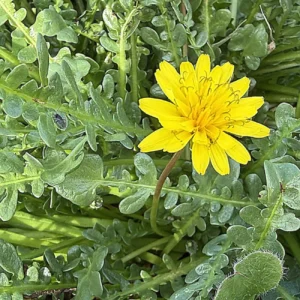
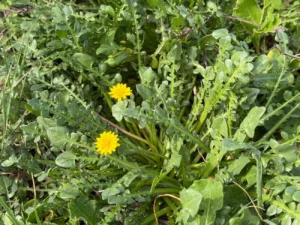
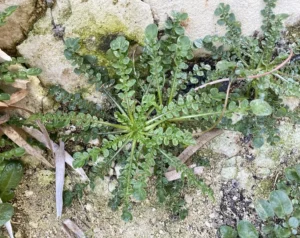
Taraxacum aphrogenes is a rare, endemic herbaceous perennial that is perfectly adapted to the harsh, salty environment of the Cypriot coastline. This specialist plant is restricted entirely to the sea spray zone, forming compact rosettes in the cracks of maritime rocks and on sandy seashores where few other plants can survive.
Cypriot Names
Ταράξακον το αφρογενές, Πικροράδικο της θάλασσας.
Common English Names
The primary name is the Paphos Dandelion, highlighting its endemic status within the Paphos District. It is also sometimes referred to as the Coastal Dandelion, emphasizing its specialized seaside habitat. This rugged beauty is a signature species of the sandy and rocky Mediterranean littoral zones of Cyprus.
Etymology of Taraxacum aphrogenes
The name of the genus "Taraxacum" derives from the Arabic word "tarakhshaqūn" for a "bitter herb". "Aphrogenes" derives from compount Ancient Greek, from "αφρογενές" [afrogenes], meaning "born on/from the foam (of the sea)", as it is a species that grows by the sea (zero altitudes).
Synonyms and Taxonomic History
Taraxacum aphrogenes is recognized as a distinct endemic species within the Asteraceae family. It was formally described by the botanist Robert Desmond Meikle. While closely related to other dandelion species, its adaptation to maritime conditions has led to its recognition as a separate entity rather than just a variety of a common dandelion.
Key Characteristics vs Other Mediterranean Dandelions
To correctly identify Taraxacum aphrogenes, one must look at the specific features that distinguish it from inland dandelions. These bullet points highlight the essential differences:
- Maritime Fissure Habitat: It grows almost exclusively in the cracks of maritime rocks or sandy beaches, not in inland grasslands.
- Leaf Texture: The leaves are distinctly fleshy and glossy, adapting to minimize water loss from sea spray and sun.
- Flower Color: The ligulate florets are a intense, golden-yellow color.
- Flower Timing: It typically flowers from October to March, often in advance of the leaves.
- Stem Characteristics: The scapes are slender, rarely exceeding 11 cm in height, and the apex is glabrous (hairless).
Botanical Structure and Adaptations
Growth Habit and Stature
Taraxacum aphrogenes is a low-growing, stemless herb that forms a dense basal rosette. The entire plant rarely exceeds twelve centimeters in height, allowing it to stay close to the ground to avoid strong coastal winds. It features a thick, blackish taproot that anchors it firmly into rock fissures.
Foliage Characteristics
The leaves are arranged in a flat rosette, measuring three to eight centimeters in length. They are divided almost to the midrib into numerous small, unequal, and bluntish lobes. This specialized foliage is fleshy and glossy, an essential adaptation to survive in arid, salty environments with limited freshwater.
Floral Features and Appearance
The bright golden-yellow flowers are solitary and borne on slender, hollow scapes. The flower heads are composed of many ligulate florets. These blossoms appear late in the year, providing a crucial, late-season nectar source for coastal pollinators when few other plants are in bloom.
Reproductive Structure and Seed
Following flowering, Taraxacum aphrogenes produces a distinctive globe-shaped seed head. Each seed is attached to a feathery white pappus, acting as a parachute that allows the seed to be carried by the wind and sea breezes to new coastal locations.
Geographical Distribution and Ecological Niche
Endemic Range
Taraxacum aphrogenes is endemic to Cyprus and has a restricted distribution. It is primarily found along the coastline of the Paphos District, especially in the Akamas Peninsula, from Ayios Yeorgios Peyias to Karavopetres. Smaller populations exist near Kato Paphos, Yeroskipou, and Petra tou Romiou.
Maritime Environment and Habitat
This species is found exclusively in the halophytic zone, within the reach of sea spray. It thrives on rocky coastal cliffs, in rock fissures, and on stabilized sandy beaches. The plant plays a role in stabilizing these fragile environments by binding the soil and sand with its deep root system.
Is Taraxacum aphrogenes Suitable For Gardens?
When considering "Is Taraxacum aphrogenes Suitable For Gardens?", the answer is generally no for typical garden settings. It requires very specific conditions, such as high salinity, full sun, and excellent drainage, making it unsuitable for standard soil or inland environments.
Life Cycle and Survival
Flowering Season and Cycle
Taraxacum aphrogenes has a unique seasonal cycle, flowering primarily in the autumn months from October to December. It often produces flowers before the new leaves appear in the winter. This timing allows it to maximize moisture availability during the rainy season.
Salinity and Stress Tolerance
The Paphos Dandelion is exceptionally tolerant of high salinity and nutrient-poor, sandy soils. Its fleshy leaves are designed to store water and resist salt burn. Its deep taproot allows it to survive the severe drought conditions of the Mediterranean summer, during which the plant often becomes dormant.
Exciting Facts About Taraxacum aphrogenes
Born from Sea Foam
The species name aphrogenes literally means "born of the foam," a fitting name for a plant that thrives in the spray zone of the Mediterranean sea, directly referencing its birthplace near the shore.
Specialist of the Cracks
Unlike common dandelions that prefer soft soil, this species has adapted specifically to live in the tight, hard fissures of maritime rocks, using its strong taproot to slowly break apart the rock to make more space.
Late Season Rescuer
While most coastal plants bloom in the spring, this endemic species blooms in the late autumn and early winter, providing a crucial food source for late-season bees and insects when other resources have dried up.
How to recognize Taraxacum aphrogenes in Cyprus
In Cyprus, only Taraxacum aphrogenes and Taraxacum cyprium can be found near the sea (aphrogenes only in the Paphos district). Taraxacum cyprium's flowering period, though is only between September and November, aphrogenes's extends until March and also includes October.
The best feature that differentiates them is the leaf; Taraxacum aphrogenes has leaves pinnatisect almost to the midrib, with numerous small, oblong-acuminate or suborbicular lateral lobes, separated by smaller lobules. Taraxacum cyprium has leaves runcinate-pinnatifid with broad, deltoid, entire or toothed lateral lobes, occasionally subentire or broadly and irregularly lobed.