Αγριοράδικο, Ταραξάκο του Χόλμποε
Etymology of Taraxacum holmboei
The name of the genus "Taraxacum" derives from the Arabic word "tarakhshaqūn" for a "bitter herb". Its epithet "holmboei'' means "of (Jens) Holmboe", the Norwegian botanist (1880 – 1943) from whom the name is inherited.
The Taraxacum genus in Cyprus
Four Taraxacum species are said to exist in the Cypriot habitat. Taraxacum sect. Taraxacum, additionally, was first recorded in one Cypriot location in 2015 by R. Hand (elevation of 1318 metres, Kykkos monastery).
Taraxacum holmboei in Cyprus
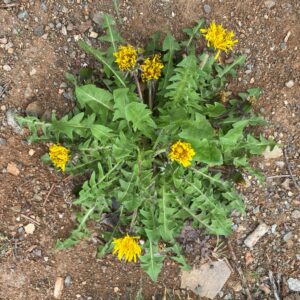
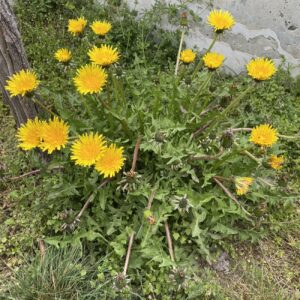
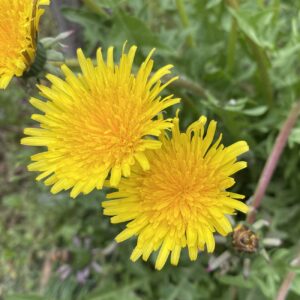
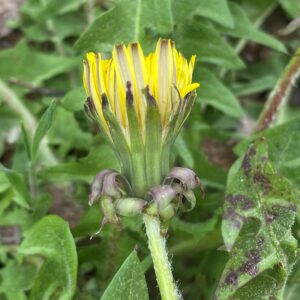
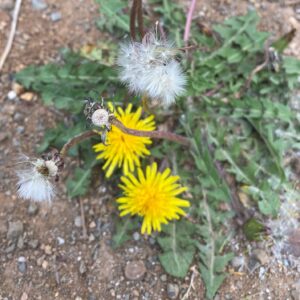
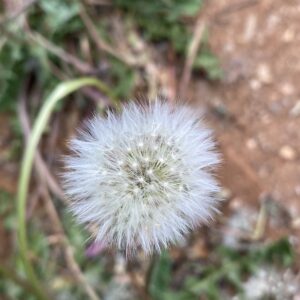
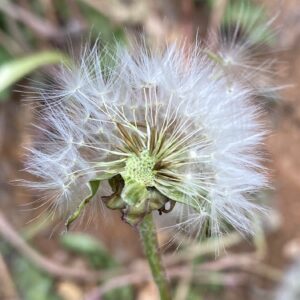
Taraxacum holmboei is an indigenous, endemic and simultaneously vulnerable species in the Cypriot habitat. It grows at a high altitude between 1225–1950 metres on the Troodos Mountains range - exclusively. Its flowering period is only during April and May. The specimens of the pictures were photographed in Troodos Square (1700 metres).
How to identify Taraxacum holmboei
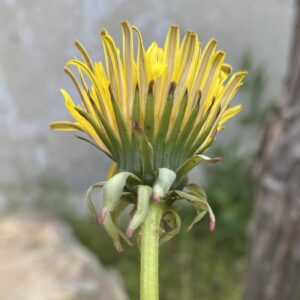
The main difference of Taraxacum holmboei from the other Taraxacums of Cyprus is the phyllaries. Only Taraxacum holmboei and Taraxacum sect. Taraxacum, have their outer phyllaries patent or reflexed. Taraxacum sect. Taraxacum was first recorded by R. Hand in 2015 at an altitude of 1318 metres at the Kykkos monastery garden (it seems like it was introduced there somehow, as this pink and white Convolvulus arvensis variation that appears in the same garden - only). It seems that it does not exist elsewhere in Cyprus, thus, making the identification of T. holmboei easier.
The differences of the two are the following
Taraxacum holmboei has achenes bright, rusty-red; the beak of the achene is 6-7 mm long, and its involucre is 8-10 mm long. Taraxacum sect. Taraxacum has achenes brownish; the beak of its achene is 7-15 mm long, and its involucre is 12-25 mm long.
The phyllaries of Taraxacum holmboei
The phyllaries of Taraxacum holmboei are the small, leaf-like parts that surround the base of the flower head, what you might think of as the "green cup" holding the yellow dandelion bloom. In this species, the phyllaries are divided into outer and inner layers. The outer phyllaries are usually about 8 to 12 in number, and they are narrow, pointed, and often curve backwards away from the flower head (a trait botanists call "reflexed"). These outer bracts can be slightly hairy and sometimes have a dark or reddish tip. Their shape and behaviour (like bending back) are useful traits for identifying the species.
The inner phyllaries, usually numbering around 12 to 18, are longer and more upright. They form the main green covering under the flower and stay closer to the head rather than bending back. These inner bracts are often pale green with a narrow, often dark-colored stripe along the centre. In Taraxacum holmboei, which is endemic to Cyprus, these features, especially the combination of reflexed, narrow outer phyllaries and more upright inner ones, help distinguish it from other dandelions.