Τολπίς η λεπτόκλαδη υποείδος η λεπτόκλαδη
Etymology of Tolpis virgata subspecies virgata
The name Tolpis virgata subsp. virgata has Latin and Greek roots, reflecting botanical descriptive practices. The genus name Tolpis is thought to come from the ancient Greek word "τολύπη" (tolýpē), meaning "clew" or "ball of wool." It's generally stated that the genus name refers to the mature fruiting capitula as a whole, often described as resembling a "clew or ball of wool". This implies the overall effect of the mature flower head, where the pappus bristles would be a significant component contributing to that "woolly" look.
The specific epithet virgata is derived from the Latin word virgatus, meaning "twiggy" or "made with twigs," which in turn comes from virga, meaning "wand" or "twig." This part of the name refers to the plant's growth habit, characterized by its long, slender stems or branches, giving it a twig-like appearance.
"Subspecies virgata" is the nominate or typical subspecies, which is the most widespread. So, Tolpis virgata subsp. virgata essentially describes a plant with flower heads resembling balls of wool and possessing long, slender, twiggy stems.
Geographical Distribution of Tolpis virgata subspecies virgata
The geographical expansion of Tolpis virgata subsp. virgata, the nominate subspecies, is vast and broadly mirrors the wider species' distribution across the Mediterranean Basin and Northeast Tropical Africa. It is the prevalent form found across Southern Europe (including France, Italy, Greece, the Balkan Peninsula, and Turkey-in-Europe), North Africa (Algeria, Libya, Tunisia), and the Middle East (such as Cyprus, Lebanon-Syria, and the wider Levant). Its range also extends into Northeast Tropical Africa, encompassing countries like Eritrea, Ethiopia, and Sudan-South Sudan.
Habitat of Tolpis virgata subspecies virgata
Tolpis virgata subspecies virgata thrives in diverse habitats such as seasonally damp meadows, scrubland, and disturbed areas like fields and roadsides, often found from sea level up to 800 meters, occasionally higher.
Tolpis virgata subsp. virgata in Cyprus
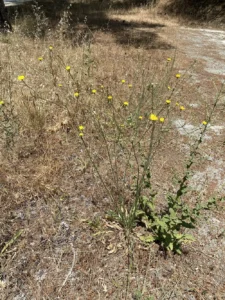
Tolpis virgata subps. virgata is a well-established and native species in Cyprus, forming an integral part of the island's flora. It is widespread across the majority of the island (excluded mostly in the Mesaoria plains), found from sea level up to elevations of approximately 1200 meters, with some sources indicating it can reach 1500-1600 meters. It thrives on various soil types, including stony hillsides, and it is primarily spotted on roadsides. The plant is a biennial or perennial, often growing quite tall, up to 1.75 meters or more, with its characteristic slender, "twiggy" stems. Its flowering period in Cyprus generally runs from May to July.
Key morphological characteristics of Tolpis virgata subps. virgata
Tolpis virgata subps. virgata can be distinguished from other Tolpis species and similar-looking plants within the Asteraceae family by a combination of key morphological characteristics:
Stem Habit and Branching
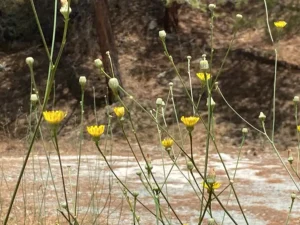
Its name, "virgata" (twiggy), is a strong indicator. It typically has long, slender, erect stems that are often branched, with the branches making a narrow angle with the main stem and often overtopping the central capitulum. The stems can be somewhat pubescent (hairy) at the base and become more glabrous (smooth) towards the top. This tall, slender, and often openly branched appearance is a significant distinguishing feature.
Leaves
The lower leaves are generally larger, oblong-lanceolate to elliptical, and can be entire, serrate, or deeply dentate. Upper cauline (stem) leaves are similar but progressively smaller and fewer. The leaves are typically thinly pilose (hairy) or becoming glabrous.
Capitula (Flower Heads)
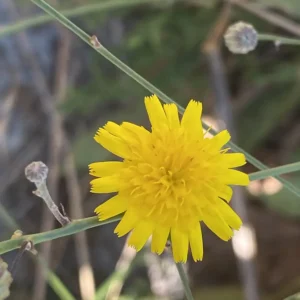
Tolpis virgata subspecies virgata typically produces numerous capitula. The capitula are relatively large for a plant of its overall slender habit, usually measuring between 1.7 to 3 cm (or even up to 3.5 cm) in diameter. They are not solitary but borne in a corymbose or paniculiform arrangement (meaning they form a flat-topped or pyramid-shaped cluster), with the individual flower stalks (peduncles) branching off. The fact that the side branches often overtop the central capitulum is also a subtle but consistent trait. The florets are yellow.
Involucre and Bracts
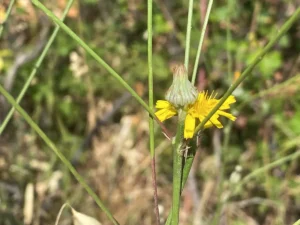
The involucre (the ring of bracts surrounding the flower head) is typically 6-8 mm long. The involucral bracts are linear-lanceolate and appressed (lying flat against the flower head). Importantly, the outer involucral bracts are shorter than the inner ones, and supplementary bracts are either absent or few, small, and usually appressed. This contrasts with some other Tolpis species or genera that might have more prominent or numerous outer bracts.
Pappus
The achenes (fruits) all have a dimorphic pappus, meaning it consists of two distinct types of hairs. Specifically, it comprises 4-12 long, scabrid (rough) hairs or bristles mixed with much shorter hairs or minute scales. The presence and specific structure of this pappus are critical for identification, especially when differentiating it from other Tolpis species, where the pappus can vary in the number and type of bristles.
Distinguishing differences of other Tolpis virgata subspecies
Tolpis virgata subsp. grandiflora is found in parts of the Mediterranean, and it is often distinguished by larger flower heads.
Tolpis virgata subsp. quadriaristata was named after the characteristics of its pappus (four awns/bristles).
Tolpis virgata subsp. sexaristata was also named after the characteristics of its pappus (six awns/bristles).
Tolpis virgata subsp. apolloniae has significantly smaller flower heads compared to the nominate subspecies (virgata) and other subspecies.