Ουρόσπερμο το πικροειδές
Etymology of Urospermum picroides
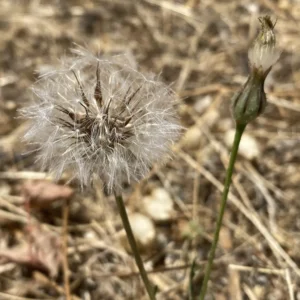
The etymology of Urospermum picroides reflects both its botanical features and its resemblance to other plant species. The genus name Urospermum comes from the Greek words oura (οὐρά), meaning "tail", and sperma (σπέρμα), meaning "seed", referring to the plant’s distinctive seeds that have a tail-like pappus used for wind dispersal.
The species epithet picroides derives from Picris, a related genus, and the Greek suffix -oides (-οειδής), meaning "resembling" or "like", thus translating to "Picris-like". Altogether, Urospermum picroides means "tailed-seed plant resembling Picris", a nod to both its reproductive morphology and its visual similarity to members of the Picris genus.
Distinguishing characteristics of Urospermum picroides
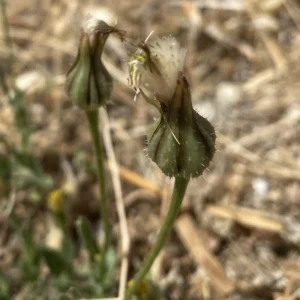
Urospermum picroides, commonly known as prickly goldenfleece, is an annual herb characterized by its bristly leaves, which are often deeply lobed and sharp-toothed. Its flower heads are typically 1-2 cm long, filled with pale yellow ray florets, and enveloped by bristly phyllaries. A key distinguishing feature is its achene, which is often beaked and tipped with a pappus of bristles.
Achenes
Urospermum picroides' achene is often beaked and tipped with a pappus of bristles. A beaked achene simply means that this little dry fruit has a distinct, slender, pointed extension or "nose" at one end, almost like a little spout or a bird's beak. This "beak" is often where the feathery pappus (the parachute-like hairs that help with wind dispersal, like on a dandelion) would attach. So, it's an achene with a little pointy "tail."
In stark contrast, Sonchus species generally have flattened or somewhat ribbed achenes that lack this prominent, hollow beak, though they do possess a pappus for wind dispersal.
Leaves
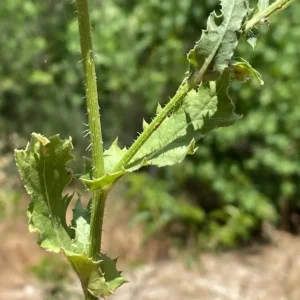
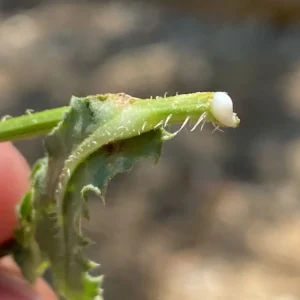
Urospermum picroides, commonly known as prickly goldenfleece, lives up to its name with noticeably bristly leaves that are often deeply lobed and sharply toothed, feeling distinctly rough to the touch.
Bracts (Phyllaries)
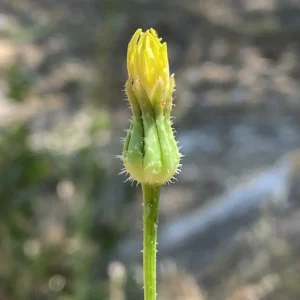
The phyllaries (the bracts surrounding the flower head) of Urospermum picroides are also typically covered in these same bristly hairs. While some Sonchus species, like Sonchus asper (prickly sow-thistle), also have spiny leaves, their leaves clasp the stem differently (with rounded or pointed auricles depending on the species), and their phyllaries usually lack the coarse, bristly hairs found on Urospermum picroides. Many Sonchus species, such as Sonchus oleraceus (smooth sow-thistle), have much softer, less spiny leaves altogether.
Urospermum picroides typically has flower heads enveloped by a single series of phyllaries that are fused at their bases and are of approximately the same length. In contrast, many Sonchus species have multiple series of phyllaries of different lengths surrounding their flower heads. Although both genera exude a milky sap when cut, and share a general "weed-like" appearance in disturbed habitats, the combination of its uniquely beaked achenes, its consistently bristly foliage and phyllaries, and the single series of fused phyllaries sets Urospermum picroides apart from the diverse range of Sonchus species.
Urospermum picroides (Prickly Goldenfleece) has bracts with varying colors, specifically with one color for the main part and another for the margins, which is a key characteristic. Its involucral bracts (the leaf-like structures that enclose the flower head before it opens and support it afterwards) are typically described as green, but often with a distinct dark violet or dark brown margin. These margins can also be described as white-scarious (thin and dry).
This bicolored or margined appearance of the involucral bracts is a very useful feature for identifying Urospermum picroides in the field and helps distinguish it from other similar yellow-flowered Asteraceae.
It is absolutely normal to find Urospermum picroides plants with involucral bracts that appear solely light green, with no noticeable dark violet or brown margins, even though the dark margins are a very commonly cited and helpful diagnostic feature.
Here's why this light green bract variation occurs on Urospermum picroides
Maturity and Age: The dark or purplish margins tend to become more pronounced as the plant and its bracts mature. Younger, fresher bracts, or those on newly opened flower heads, might be entirely green.
Environmental Factors: Factors like sunlight exposure, nutrient availability in the soil, and temperature can influence pigment development. Plants growing in less direct sunlight or under specific nutrient conditions may produce less of the darker anthocyanin pigments responsible for the violet or brown colouration.
Individual Variation: Like all living organisms, there's natural genetic variation within a species. While the dark margin is typical, not every single individual plant will express it to the same degree, or at all.
So, while the dark-margined bracts are a textbook characteristic often highlighted for easy identification, solely light green bracts are a valid and common natural variation within Urospermum picroides. It doesn't mean it's a different species; it just means that particular diagnostic feature isn't expressed in all individuals or at all stages of development.
Geographical Distribution of Urospermum picroides
Urospermum picroides, commonly known as prickly goldenfleece, is native to a broad region encompassing the Mediterranean Basin and extending into parts of Western Asia and the Arabian Peninsula. This native range includes countries across Southern Europe (e.g., Spain, France, Italy, Greece, Portugal, Albania, Bulgaria, Cyprus), North Africa (e.g., Morocco, Algeria, Tunisia, Egypt, Libya), and the Middle East (e.g., Lebanon, Syria, Israel, Palestine, Iran, Iraq, Saudi Arabia, Kuwait, Oman).
Beyond its native distribution, Urospermum picroides has become widely introduced and naturalized in numerous other regions globally, establishing itself as a common weed in disturbed habitats. These introduced populations are found in diverse areas, including parts of North America (e.g., California), South America (e.g., Uruguay), Australia (particularly Western Australia and New South Wales), and Southern Africa (e.g., Cape Provinces, KwaZulu-Natal).
It thrives in various environments, including roadsides, cultivated ground, dry grasslands, sand dunes, and waste places.
Plant identification of Urospermum picroides from other look-alike Sonchus taxa that exist in Cyprus
Among the Sonchus species, several can bear a superficial resemblance to Urospermum picroides due to their shared characteristics of yellow dandelion-like flowers and often lobed or toothed leaves. However, careful examination of specific features helps differentiate them.
Sonchus asper subsp. asper
Sonchus asper subsp. asper (Prickly Sow-thistle) can appear similar, especially in its leaf morphology. Like Urospermum picroides, its leaves are spiny, but S. asper subsp. asper typically has more aggressively spiny, often unlobed or less lobed leaves with a shiny green upper surface. The leaves of S. asper strongly clasp the stem with rounded auricles. A significant difference lies in the achenes: S. asper subsp. asper has compressed achenes without a winged margin, and its phyllaries and flower stalks are often covered in dark reddish-brown sticky glandular hairs, which are generally absent in Urospermum picroides.
Sonchus asper subsp. glaucescens
Sonchus asper subsp. glaucescens is closely related to S. asper subsp. asper and thus shares some similarities with Urospermum picroides in terms of its prickly nature. However, S. asper subsp. glaucescens is distinguished by its generally glaucescent (bluish-grey) leaves, in contrast to the typically vivid green leaves of S. asper subsp. asper and the often pale green of Urospermum picroides. More importantly, its achenes are almost flattened with a distinct marginal wing, and their margins and ribs are ciliolate with minute retrorse bristles, features not typically found in Urospermum picroides.
Sonchus oleraceus
Sonchus oleraceus (Smooth Sow-thistle) can be mistaken for Urospermum picroides from a distance due to its yellow flowers. However, S. oleraceus has leaves that are weakly and softly spiny, usually deeply lobed, and notably less prickly to the touch compared to the distinctly bristly Urospermum picroides. The leaves of S. oleraceus also clasp the stem with pointed auricles, but they do not typically continue down the stem as wings. Its flower stalks are usually hairless, and its achenes are wrinkled between their ribs, lacking the prominent beak and the coarse bristly hairs on the phyllaries characteristic of Urospermum picroides.
Sonchus tenerrimus
Sonchus tenerrimus can also have somewhat similar overall appearance. However, generally, Sonchus tenerrimus tends to have more delicate, finely divided leaves compared to the broader, often more coarsely toothed leaves of Urospermum picroides. Distinguishing features would likely include differences in achene morphology and the presence or absence of specific types of hairs or bristles on the plant parts.
Sonchus bulbosus
Sonchus bulbosus is a tuberous geophyte, which immediately sets it apart from the annual Urospermum picroides. While both can have yellow flowers, their growth habit and root structure are fundamentally different. Sonchus bulbosus would possess an underground tuber, which Urospermum picroides lacks entirely, growing instead from a taproot.
To quickly distinguish Urospermum picroides from Sonchus bulbosus without disturbing their root systems, focus on their above-ground characteristics: Urospermum picroides is identifiable by its bristly, often deeply lobed and sharply toothed leaves, which give it a distinctly prickly feel, and its flower heads are surrounded by bristly phyllaries; conversely, Sonchus bulbosus has smoother, less spiny leaves and, crucially, its flower heads exhibit distinctive red, glandular hairs on the outside, often imparting a reddish or purplish hue, a feature absent in Urospermum picroides.
Sonchus asper subsp. glaucescens × oleraceus
Finally, the hybrid Sonchus asper subsp. glaucescens × oleraceus would exhibit a combination of traits from its parent species. This could lead to a plant with varying degrees of prickliness, leaf lobing, and hairiness. However, it would still possess the general characteristics of Sonchus in terms of achene structure (lacking the prominent beak of Urospermum picroides) and the typical auricles that clasp the stem, albeit potentially with intermediate forms between the rough and smooth sow-thistles. The distinctly bristly nature of the Urospermum picroides flower heads and its beaked achenes remain key identifiers that differentiate it from this Sonchus hybrid.
Urospermum picroides in Cyprus
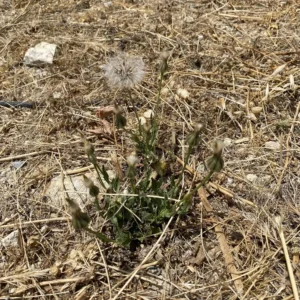
Urospermum picroides is an annual herbaceous member of the Asteraceae family that blooms from March to June, reaching up to 50 cm in height. It thrives in disturbed habitats and can be found across altitudes from sea level up to around 1,225 meters. The plant is widely established throughout Cyprus and is considered native to its Eurasian range.