Date Created: 07.05.2026
Last Modified: 12.05.2026
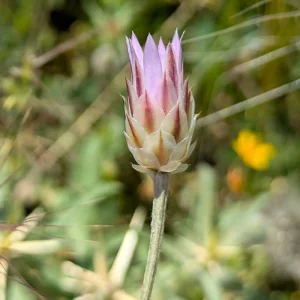
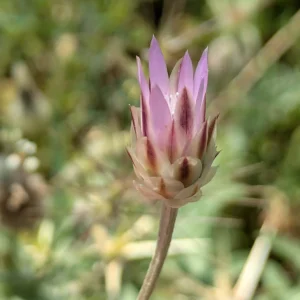
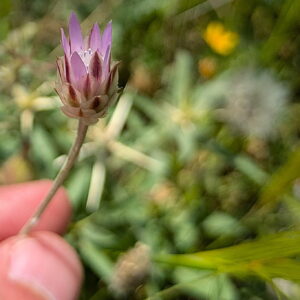
Xeranthemum inapertum (L.) Mill., commonly known as the Everlasting, is a slender, silver-grey annual herb belonging to the Asteraceae family. This Mediterranean native is prized for its papery floral heads that retain their color and shape long after drying, making it a staple in traditional floral displays and dry rocky habitats across the island of Cyprus.
Common Cypriot Names
The formal translation of the botanical name in Modern Greek is Ξηράνθεμο το κλειστό [Xeranthemo-to-klisto]. Locally, in the high-altitude villages of the Troodos range, it is often called Αθάνατος [Athanatos], meaning "immortal." This name is attributed to the plant’s ability to maintain its structural integrity and vibrant pinkish hues even during the scorching heat of the Cypriot summer.
Common English Names
- Everlasting
- Immortelle
- Closed Everlasting
- French Everlasting
Etymology of Xeranthemum inapertum
The etymology of the genus name "Xeranthemum" derives from the Ancient Greek "ξηρός" [xiros], meaning "dry" and "άνθεμον" [anthemon], which means "flower," referring to the dry, papery texture of the floral bracts. "Inapertum" is the neutral Latin for "not open" or "closed," referring to the characteristic appearance of the flower heads, which remain relatively constricted compared to other species.
Synonyms
- Xeranthemum cylindraceum
Botanical Structure and Floral Details of Xeranthemum inapertum
Stem and Foliage
The plant typically reaches a height of 15-40 cm. Its leaves are linear-oblong, entire, and sessile. The upper surface of the leaf is often less hairy than the underside, which remains silvery-white due to the dense tomentum, an adaptation for moisture retention.
Geographical Distribution and Habitat of Xeranthemum inapertum
This species is widely distributed across Southern Europe, North Africa, and Southwest Asia. It prefers dry, sunny locations, specifically calcareous grasslands, rocky slopes, and open pine forests where competition from taller vegetation is minimal.
Distribution in Cyprus
In Cyprus, it is well-documented in the Troodos Range, the Akamas Peninsula, and the Pentadaktylos. It is particularly frequent in the igneous rocks of the central massif and the limestone formations of the northern range.
Elevation Range in Cyprus
This taxon occupies a broad altitudinal gradient on the island, typically found from 200 meters up to 1,600 meters above sea level.
Flowering Period in Cyprus
The flowering period for the Everlasting in Cyprus occurs between May and July, often persisting into August in higher elevations.
Conservation Status in Cyprus
Based on the Red Data Book of the Flora of Cyprus, this species is classified as Least Concern (LC). It is not currently threatened, as its preferred rocky habitats are extensive and under low developmental pressure.
Is Xeranthemum inapertum Suitable for Gardens?
Yes, it is highly suitable for xeriscaping and rock gardens. While seeds are available in the international specialist market, it is important to note that collecting seeds from the wild in State Forest lands is strictly prohibited under Cypriot Forestry Law.
Toxicity and Safety
There is no evidence in toxicological literature, including reports from the European Food Safety Authority (EFSA), suggesting that this plant is toxic to humans or common livestock. It is generally handled safely, though its dry, stiff bracts can be sharp and may cause minor mechanical irritation to sensitive skin.
Medicinal Properties
Traditional Respiratory Uses
In traditional Levantine medicine, closely related species have been used in infusions for respiratory ailments. However, specific documentation for this taxon is sparse. Ethnobotanical surveys in the Mediterranean region sometimes mention the use of the dried flower heads as a mild sedative tea, though scientific validation is lacking.
Antioxidant Potential
A study by Ghorbani et al. (2005) on Mediterranean Asteraceae suggests that members of the Xeranthemum genus contain flavonoids with antioxidant properties. While promising, these findings are based on laboratory extracts and have not been developed into standardized pharmaceutical applications.
Fascinating Insights About Xeranthemum inapertum
The Physics of Immortality
The "immortal" quality of the flowers is due to the low moisture content and high silica levels in the involucral bracts. Unlike true petals, these bracts are modified leaves that do not rely on turgor pressure to stay upright, allowing them to remain beautiful for years.
Pollinator Dynamics
Research published in Plant Biology indicates that the Everlasting is a crucial nectar source for solitary bees (Megachilidae). These bees are among the few insects strong enough to probe the stiff, papery flower heads that effectively guard the nectar from smaller, less efficient thieves.