Date Created: 29.08.2022
Last Modified: 09.04.2026
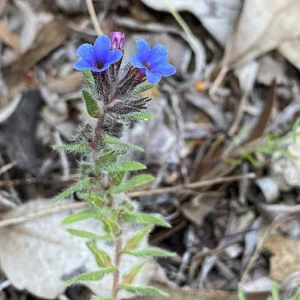
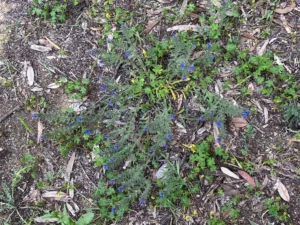
Alkanna tinctoria (L.) Tausch, known as Dyer's Alkanet, is a distinctive perennial herb of the Boraginaceae family. It is also frequently identified by its synonym Lithospermum tinctorium L. This species is easily recognized in the field by its prostrate growth habit and the intense, ruby-red dye produced within its woody roots.
Cypriot Names
Αλκάννα η βαφική [Alkanna tinctoria]. In the local dialect, it is widely known as Βαφφόριζα [Vaffóriza], meaning "dye-root".
Common English Names
- Dyer's Alkanet
- Alkanet
- Spanish Bugloss
- Orchanet
Etymology of Alkanna tinctoria
"Alkanna" comes from the Medieval Latin "alcanna" (with Spanish origin) which means "henna". "Tinctor" in Latin means "dyer" because its roots were used as a red dye.
Synonyms
- Lithospermum tinctorium L.
- Anchusa tinctoria (L.) L.
- Alkanna lehmannii (Tineo) A.DC.
- Alkanna tinctoria subsp. tinctoria
Key Characteristics for Diagnostic Identification
According to the definitive botanical keys established by Robert Desmond Meikle (1923–2021) in his comprehensive Flora of Cyprus, this species is the sole representative of its genus on the island and is distinguished by:
- Nutlet Attachment: Unlike the genus Anchusa, where the nutlets have a basal attachment with a ring-like rim, Alkanna tinctoria has nutlets with a lateral or nearly basal attachment, lacking a prominent thickened rim.
- Corolla Throat: While Nonea and Anchusa species in Cyprus typically possess prominent hairy scales (fornices) in the throat, Alkanna tinctoria is distinguished by a naked throat or one with very inconspicuous folds.
- Root Bark: The root of this species is unique among Cypriot Boraginaceae for its thick, purplish-black bark which contains a red, oil-soluble pigment that stains the skin upon contact.
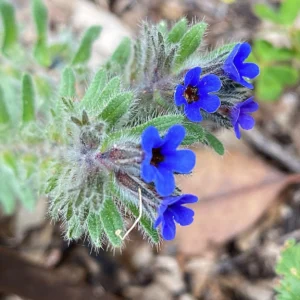
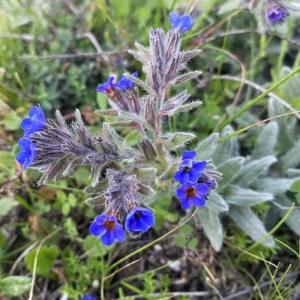
- Inflorescence Bracts: The flowering spikes are leafy, with bracts that are much longer than the calyx, a feature that separates it from the more compact, less leafy inflorescences of Lithospermum.
- Flower Color: The corolla is a deep, pure blue, which is generally more intense and consistent than the variable blue-to-purple shades found in Anchusa strigosa or Nonea ventricosa.
Botanical Structure and Floral Details of Alkanna tinctoria
The Inflorescence
The flowers are arranged in terminal, leafy, one-sided cymes that are initially coiled, a structure known as a scorpioid cyme. As the blossoms mature, the axis straightens out. This ensure that flowers are presented sequentially, providing a steady supply of nectar for local pollinators over several weeks.
Corolla and Stamens
The corolla is funnel-shaped with five spreading lobes. The stamens are included within the tube and are attached at varying heights. Because the throat lacks large scales, the internal structure of the flower is more accessible to smaller insects compared to other complex-flowered borage relatives.
Foliage and Habit
The plant features several decumbent or ascending stems that reach up to 30 cm in length. The leaves are covered in a dense indumentum of bristly, tubercle-based hairs. These hairs provide a physical barrier against the abrasive salt-laden winds often present in its preferred coastal habitats.
Geographical Distribution and Habitat of Alkanna tinctoria
This species is a specialist of sandy Mediterranean environments. It thrives in littoral sands, stabilized dunes, and dry, open phrygana. It is highly adapted to nutrient-poor soils and is frequently found in association with other sand-loving species like Medicago littoralis and Silene colorata.
Distribution in Cyprus
In Cyprus, the Dyer's Alkanet is an indigenous species found primarily in coastal regions. It is well-documented in the sandy areas of the Akamas peninsula, Limassol, and Larnaca. It is strictly a lowland plant, occurring almost exclusively from sea level up to roughly 300 meters.
Flowering Period in Cyprus
The flowering period in Cyprus occurs from February to May. During these months, the vivid blue flowers provide a sharp contrast to the pale sands. By late spring, the plant begins to wither as it puts its remaining energy into maturing its hard, tuberculate nutlets.
Conservation Status in Cyprus
This species is not included in the Red Data Book of the Flora of Cyprus. It is categorized as "Least Concern" (LC) due to its broad distribution in suitable habitats. However, its coastal niche is under constant pressure from tourism infrastructure and beach erosion.
Is Alkanna tinctoria Suitable for Gardens?
It is an excellent choice for specialized rock gardens or coastal landscapes. It requires full sun and extremely well-drained, sandy soil. It is exceptionally drought-tolerant but resents being moved; therefore, it should be sown directly where it is intended to grow to protect the taproot.
Medicinal and Practical Properties
The root bark is rich in alkannin, a pigment used since antiquity. It was the primary source for "Greek lacquer" and was used to color oils, waxes, and wines. In ancient times, it served as a natural cosmetic, used by women to redden their lips and cheeks.
In traditional Cypriot medicine, the roots were sometimes crushed and applied to wounds. Modern pharmacological studies indicate that alkannin has significant wound-healing and antimicrobial properties. However, because the plant contains pyrrolizidine alkaloids, internal consumption is strictly discouraged due to the risk of cumulative liver toxicity.
Fascinating Insights About Alkanna tinctoria
The Red-Bleeding Root
The most striking feature is the root's ability to "bleed." While the flowers are blue, the root bark is saturated with red pigment. In historical texts, this contrast between the blue of the sky (flower) and the red of the earth (root) gave the plant a mystical reputation.
Oil-Soluble Secret
Unlike most floral dyes which dissolve in water, alkannin is fat-soluble. This made it a prized ingredient for ancient pharmacists making salves and ointments. If you drop a piece of the root into olive oil, the oil will turn a brilliant ruby-red within minutes.
Strategic Bracts
The large bracts that surround the flowers are not just for show; they provide a micro-climate of humidity around the developing seeds. In the windy, drying conditions of the Cypriot dunes, these leafy structures prevent the delicate reproductive parts from desiccating before fertilization is complete.
Desert Resilience
Dyer's Alkanet is a master of survival in "shifting" environments. Its deep, woody taproot allows it to reach moisture deep below the sand while holding the plant in place during winter storms. This makes it an important pioneer species for stabilizing loose coastal substrates.
A Link to Antiquity
Using this plant connects modern users to the cosmetic habits of the ancient world. From the Bronze Age through the Roman period, the roots were traded across the Mediterranean. The women of ancient Cyprus likely gathered these same blue flowers to produce the rouge for their vanity.