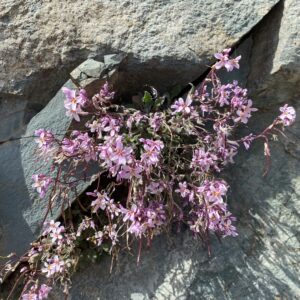
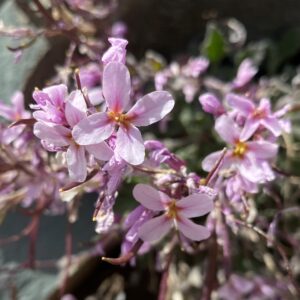
Arabis purpurea is a stunning, perennial herb that is strictly endemic to the island of Cyprus. A member of the Brassicaceae (mustard) family, it is one of the most iconic sights of the Troodos mountains. Its vibrant purple flowers and silver-grey foliage make it a true botanical jewel of the high-altitude rocky landscape.
Cypriot names
Αραβίς η μωβ, Κλάματα της Παναγίας
Common English Names
In English-speaking botanical circles, this plant is known as the Purple Rockcress or the Cypriot Purple Arabis. These names reflect its preferred habitat - stony ground and rock crevices - and its striking floral color. To the people of Cyprus, it is simply the "purple flower of the rocks," representing the resilience of island life.
Taxonomy and Scientific Classification
Taxonomically, Arabis purpurea is part of the tribe Arabideae. It is closely related to other alpine rockcresses found throughout Europe, but its long isolation on Cyprus has resulted in distinct genetic markers. It is a classic example of island speciation, where a plant evolves uniquely to fit a specific geographical niche.
Etymology of Arabis purpurea
The etymology of the genus "Arabis" derives from Ancient Greek "ἀραβίς" [aravis] which literally means "arabic" and at that time it was a synonym of "draba". Draba in Ancient Greek is "δράβη" [dravi] and it was a name used for Lepidium draba. The name Arabis may refer to Arabia where both Arabis species and Lepidium draba are found. Latin "purpurea" means "purple, dark red" but this Latin word also included other colourations such as reddish. Purpurea in Latin also means "beautiful, brilliant". The epithet clearly refers to its flowers.
Botanical Structure and Morphology
Cushion-Like Growth Habit
Arabis purpurea typically forms low, dense cushions or "mats" that cling to the earth. It reaches a height of 5 to 15 centimeters, keeping a low profile to avoid damage from mountain winds. How to recognize its growth? Look for its semi-woody base, which allows the plant to survive for many years in the same crevice.
Silver-Grey Foliage and Hairs
The leaves of Arabis purpurea are small, spoon-shaped, and covered in a dense layer of fine, stellate (star-shaped) hairs. These hairs give the foliage a beautiful silver-grey or glaucous appearance. This adaptation is crucial for reflecting intense UV radiation at high altitudes and for trapping a layer of moist air near the leaf surface.
Floral Clusters and Color
The inflorescence consists of small clusters of four-petaled flowers, typical of the cabbage family. The color is a rich, vibrant purple or violet, which often fades to a lighter lavender as the flower ages. A fascinating fact is that these flowers are often so numerous they completely hide the foliage during peak bloom.
Habitat and Island Distribution
High-Altitude Rocky Crevices
This plant is a specialist of the igneous (volcanic) rocks of the Troodos range. It is almost exclusively found in rock fissures, scree slopes, and stone walls. How to find its habitat? You must climb to elevations between 600 and 1,900 meters, where the air is cool and the terrain is rugged and steep.
Strict Endemism to Cyprus
Arabis purpurea is found nowhere else in the world except on the island of Cyprus. While it is localized, it is relatively common within its specific mountain range. It is one of the "high-altitude elite" plants that define the unique botanical character of the Troodos National Forest Park.
Flowering Period in Cyprus
In the Cypriot climate, Arabis purpurea begins to bloom in February at lower altitudes, continuing through May at the highest peaks. This staggered blooming window is a direct response to the melting snow on Mount Olympus. As the winter chill recedes, these purple cushions burst into life across the grey mountain stones.
Ecology and Survival Strategies
Reproductive Success and Seeds
After flowering, the plant produces long, narrow seed pods known as "siliques." These pods stand upright and eventually split to release tiny, wind-dispersed seeds. This method allows Arabis purpurea to colonize distant rock faces, ensuring the species spreads across the vertical landscape where competition for space is less intense.
Resistance to Extreme Cold
Living at the top of Cyprus means enduring frost and heavy snow during the winter months. Arabis purpurea is perfectly adapted to these freezing conditions, entering a state of semi-dormancy under the snowpack. Its high sugar content in its cells acts like a natural antifreeze, preventing ice crystals from damaging its vital tissues.
Drought Tolerance in Summer
Once the spring rains end, the plant must endure the long, hot Cypriot summer. Its deep root system penetrates deep into rock cracks to find hidden pockets of moisture. The silver hairs on its leaves become even more prominent during this time, serving as a protective shield against the desiccating summer sun.
Human Interaction and Conservation
A Favorite for Nature Photography
Because of its striking color and dramatic mountain backdrop, Arabis purpurea is a favorite subject for nature photographers in Cyprus. It is often used in tourism materials to showcase the island's natural beauty. It serves as a visual reminder of the incredible biodiversity hidden within the pine forests of the interior.
Cultivation in Rock Gardens
How to grow this endemic beauty? Arabis purpurea is highly prized by alpine garden enthusiasts. It requires extremely sharp drainage and a sunny, open position. In lowland gardens, it often struggles with high humidity, so it is best grown in raised troughs or specialized rockeries that mimic its mountain home.
Protection and Conservation Status
Although it is not currently listed as endangered, its status as a strict endemic means it is protected by Cypriot law. The main threats are habitat degradation from road construction and intensive trampling by hikers. Maintaining the integrity of the Troodos rock faces is essential for the continued survival of this purple treasure.
Scientific and Biological Facts
Biological Importance of Hairs
Scientists study the stellate hairs of Arabis purpurea to understand plant adaptation to extreme environments. These hairs are not just for show; they can actually help the plant absorb trace amounts of moisture from mountain mists. This "fog-harvesting" ability is a sophisticated evolutionary trick for surviving in dry climates.
Fascinating Evolutionary History
A fascinating fact is that Arabis purpurea likely survived on the high peaks of Cyprus during the last Ice Age while other species vanished. Its isolation on the island has allowed it to remain relatively unchanged for millennia. It is a living link to the ancient floral history of the Mediterranean basin.
Future Research and Monitoring
Ongoing botanical surveys in the Troodos help monitor the health of Arabis purpurea populations. As temperatures rise due to climate change, researchers are watching to see if the plant moves even higher up the slopes. Protecting this species ensures that the "Purple of the Troodos" remains a permanent part of the Cypriot heritage.
How to identify Arabis purpurea
Arabis purpurea is similar to cypria. Purpurea has leaves 0.8-2(-4) cm long, densely tomentose with short hairs, indumentum less than 0.2 mm thick; its petals can be pink, lilac or purplish, and rarely white. Cypria has leaves 2-8 cm long, softly tomentose with long hairs, indumentum more than 0.3 mm, often up to 0.5 mm thick; its petals can be white or pale pink or pink-tinged.