Date Created: 15.03.2023
Last Modified: 10.04.2026
Biscutella didyma subsp. dunensis Mach.-Laur., the Dune Buckler-mustard, is an annual herb within the Brassicaceae family. It is also frequently identified by its synonym Biscutella didyma var. dunensis (Mach.-Laur.) Brook. This subspecies is a highly specialized colonizer of the coastal sands, distinguished by its unique fruit structure and resilient growth form.
Cypriot Names
Μπισκουτέλλα η δίδυμη υπόειδος η αμμοθίνουσα
Common English Names
- Dune Buckler-mustard
- Spectacle Mustard
- Two-fold Mustard
- Sandy Biscutella
Etymology of Biscutella didyma subsp. dunensis
The etymology of the genus name Biscutella comes from the Latin bi-, meaning two, and scutella, meaning a small shield, referring to the spectacle-shaped seed pods. The species name didyma comes from the Ancient Greek δίδυμος [dídymos], which is read as [dídymos] and means twin or twofold. The subspecies name dunensis is Latin for "belonging to the dunes."
Synonyms
- Biscutella didyma var. dunensis (Mach.-Laur.) Brook
- Biscutella dunensis (Mach.-Laur.) Guinea
- Biscutella didyma subsp. applanata Mach.-Laur.
- Biscutella columnaris Ten.
Key Characteristics for Diagnostic Identification
According to the definitive botanical keys established by Robert Desmond Meikle in his two-volume Flora of Cyprus (1977, 1985) -the most exhaustive taxonomic treatment of the island's plants based on decades of research at the Royal Botanic Gardens, Kew - this subspecies is distinguished by:
- Stature and Height: Subsp. dunensis is a smaller, more compact plant, typically ranging from 5–15 cm in height. In contrast, the typical subsp. didyma is more robust, often reaching 15–40 cm or more.
- Fruit Indumentum: The valves of the fruit in subsp. dunensis are consistently and densely covered in short, spreading hairs. In the typical subspecies, the valves are usually glabrous (hairless) and measure approximately 5–7 mm in diameter.
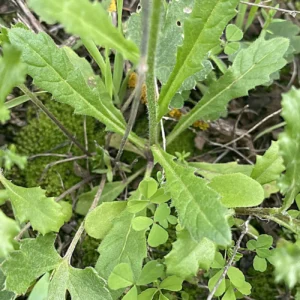
- Leaf Size and Texture: Basal leaves are smaller, usually 2–5 cm long, and more densely grey-canescent than those of subsp. didyma, which has larger leaves that can reach 10–12 cm in length.
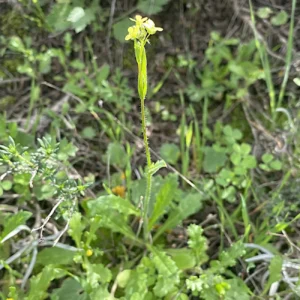
- Growth Habit: This taxon is characteristically prostrate or strongly ascending, often branched from the base to withstand coastal winds, while the typical subspecies is generally erect with a dominant central stem.
- Habitat Specificity: Subsp. dunensis prefers sandy ground, whereas subsp. didyma is found in diverse habitats including dry hillsides, fields, and rocky ground up to 1,500 m altitude.
Botanical Structure and Floral Details of Biscutella didyma subsp. dunensis
The Floral Display
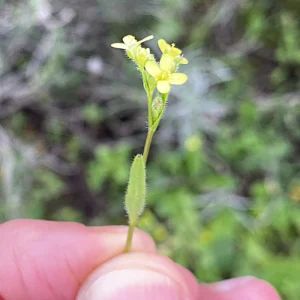
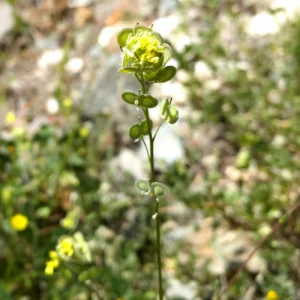
The flowers are arranged in terminal racemes that elongate as the plant matures. Each flower features four bright yellow petals, approximately 3–5 mm long, and four sepals that are not hooded. The vibrant yellow coloration is a primary attractor for early spring pollinators along the Cypriot coastline.
The Spectacle-Shaped Fruit
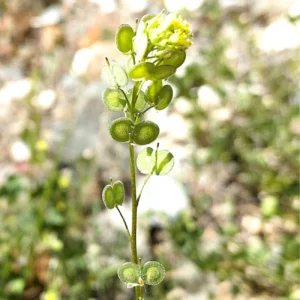
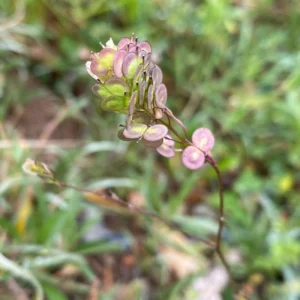
The fruit is a silicula consisting of two flat, circular valves joined at a central axis, measuring about 4–6 mm in diameter. In this subspecies, the valves are notably flattened and covered in fine hairs. This unique "spectacle" shape allows the seeds to be easily dispersed by coastal breezes.
Foliage and Stem Adaptations
The leaves are primarily basal, forming a rosette, and are deeply toothed or pinnatifid. The dense covering of hairs serves to protect the plant tissues from the desiccating effect of salt spray and reflects intense sunlight, a necessary adaptation for surviving the porous, sandy substrates.
Geographical Distribution and Habitat of Biscutella didyma subsp. dunensis
The Dune Buckler-mustard is a strict psammophile. It is found exclusively on stabilized dunes, sandy maritime heaths, and the upper fringes of sandy beaches. It thrives in areas where the salt concentration is high and the soil is unstable, acting as a pioneer of the littoral zone.
Distribution in Cyprus
In Cyprus, this subspecies is an indigenous plant limited to coastal sandy belts. It is frequently recorded in the Akamas peninsula, the sandy shores of Ayia Napa and Protaras, and the dunes of Limassol and Larnaca. It rarely occurs more than a few hundred meters from the high-tide mark.
Flowering Period in Cyprus
The flowering period in Cyprus typically begins in February and lasts through April. It is one of the earliest spring flowers to brighten the coastal sands. By the time the summer heat arrives in May, the plant has usually completed its life cycle and released its spectacle-shaped seeds.
Conservation Status in Cyprus
This subspecies is not listed in the Red Data Book of the Flora of Cyprus. It is classified as "Least Concern" (LC) as it remains frequent in its specialized niche. However, coastal development and mechanical beach cleaning pose significant threats to its remaining natural habitats.
Is Biscutella didyma subsp. dunensis Suitable for Gardens?
While not commonly cultivated, it is a fascinating subject for specialized coastal or rock gardens. It requires absolute full sun and a substrate consisting primarily of coarse sand. Its unique fruit shape and bright yellow blooms make it a conversation piece for those interested in native maritime flora.
Medicinal and Practical Properties
There are no major commercial medicinal uses for this subspecies. However, like many members of the Brassicaceae family, it contains glucosinolates. In traditional folk medicine, related species were sometimes used as diuretics, though no specific tradition is recorded for this dune-dwelling taxon in Cyprus.
The primary value of the Dune Buckler-mustard is ecological. As a pioneer species on sandy substrates, its rosette of leaves helps to anchor loose sand, providing a micro-habitat for other smaller organisms and contributing to the gradual stabilization of the dune system against wind erosion.
Fascinating Insights About Biscutella didyma subsp. dunensis
Nature’s Spectacles
The most fascinating aspect of this plant is undoubtedly its fruit. When viewed from above, the two circular valves look exactly like a pair of antique spectacles. This has led to many imaginative common names across the Mediterranean, making it one of the most easily identified plants by non-botanists.
Built for the Breeze
The flat, shield-like valves of the fruit are expertly engineered for the coastal environment. Their lightness allows them to be caught by the constant sea breezes, "skimming" across the surface of the sand until they settle in a sheltered depression or are buried by shifting dunes, ready to germinate.
Sand-Proofing with Hairs
The dense grey hairiness of subsp. dunensis is a masterclass in coastal survival. These hairs trap a layer of still air against the leaf surface, which prevents the sand from physically "sandblasting" the plant's delicate tissues during winter storms and summer gales.
A Salt-Tolerant Pioneer
While many plants would die from the salt levels found in the Ayia Napa dunes, this Biscutella thrives. It has evolved to handle high salinity, allowing it to bloom in a zone where it has very little competition from other flowering plants, ensuring it gets the full attention of pollinators.
Hidden Underground
The plant invests significantly in a deep taproot relative to its small size. This root allows it to access moisture that has percolated deep into the sand, far below the surface layer that is dried out by the sun. This "hidden" infrastructure is the secret to its early spring success.