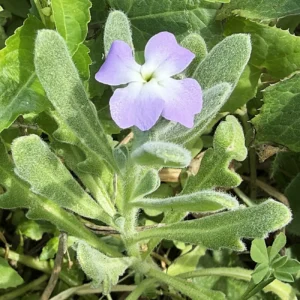
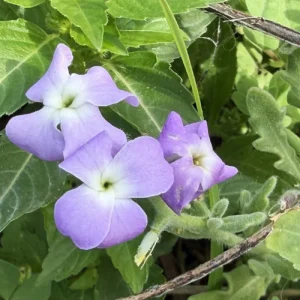
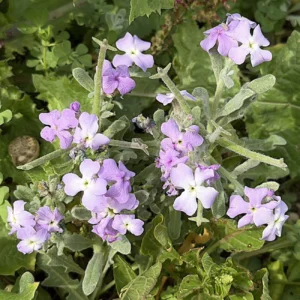
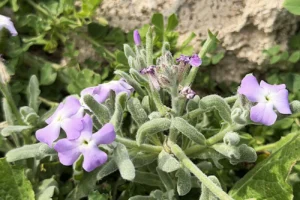
Matthiola tricuspidata, a member of the Brassicaceae family, is a resilient annual herb perfectly adapted to the salty, sandy coastlines of the Mediterranean. This species typically grows in low-lying cushions, adding a delicate mauve or lilac touch to the often-barren sandy beaches where few other plants can survive.
Cypriot Names
Ματθιόλη η τρίλοβη, Βιόλα της θάλασσας, Μανούιν.
Common English Names
The primary name is the Three-horned Stock, referencing the unique shape of its seed pods. It is also sometimes known as the Sea Stock, highlighting its preferred seaside habitat. This coastal beauty is a signature species of the sandy Mediterranean littoral zones found across the island.
Etymology of Matthiola tricuspidata
The etymology of the genus name, "Matthiola", is a tribute to Italian naturalist Pietro Andrea Mattioli (1501–1577). The species name tricuspidata comes from the Latin "tri-" and "cuspidatus", meaning "three-pointed", referring to the three distinctive, sharp horns at the tip of the seed pod.
Synonyms and Taxonomic History
While Matthiola tricuspidata is the widely accepted name, taxonomic studies have historically placed this species under various infraspecific names based on morphological variations found along different coastal regions. These synonyms highlight the adaptability of the plant's form to specific microhabitats:
- Matthiola tricuspidata var. livida
- Matthiola tricuspidata var. oblongata
- Matthiola tricuspidata var. pinnatifida
- Matthiola tricuspidata var. tricuspidata
Key Characteristics vs Other Mediterranean Stock
To correctly identify Matthiola tricuspidata, one must look at the stigma and fruit structure. These bullet points highlight the essential differences:
- Stigma Proportions: The stigma is approximately as long as its dorsal appendages, creating the appearance of a three-horned apex.
- Appendage Symmetry: Unlike Matthiola longipetala, which has long, recurved horns, this plant maintains a balanced, triangular arrangement of three equal points.
- Glandular Pods: The seed pods are distinctly glandular, which separates it from the eglandular pods of Matthiola incana.
- Leaf Morphology: It features sinuate or pinnatifid leaves, contrasting with the entire leaves found in several other members of the genus.
- Indumentum: The plant is covered in a looser, more woolly indumentum than many of its closer relative species.
Botanical Structure and Adaptations
Growth Habit and Stature
This species typically exhibits a decumbent or ascending growth habit, meaning its stems often sprawl along the sand before turning upwards. Matthiola tricuspidata rarely exceeds thirty centimeters in height. Its compact, bushy form helps it withstand the strong coastal winds that frequently sweep across the open beaches of the coastline.
Foliage Characteristics
The leaves are a soft grayish-green, covered in dense, fine hairs that protect the plant from salt spray and excessive sun. These leaves are typically sinuate-pinnatifid, meaning they have wavy or lobed edges. This specialized foliage is an essential adaptation for the plant, helping it conserve moisture in its arid environment.
Floral Features and Appearance
The flowers of Matthiola tricuspidata feature four petals arranged in a cross shape, typical of the mustard family. They are usually a pale lilac or mauve color with a yellow throat. These blossoms emerge in short clusters, providing a gentle fragrance that attracts various coastal pollinators during the spring.
The Unique Three-Horned Pods
The most distinctive feature of this plant is its fruit, which gives it its name. The seed pods are long siliquae that terminate in three sharp, diverging horns or points. These structures are crucial for identification. As the pods mature and dry, they become woody, protecting the seeds.
Geographical Distribution and Ecological Niche
Mediterranean and Global Range
Matthiola tricuspidata is a stenochoric species primarily restricted to the Mediterranean Basin. It is found along the coastlines of Southern Europe including Spain, France, Italy, and Greece. Its range extends to North Africa in countries like Libya and Egypt, and across Western Asia including Turkey, Syria, and Israel.
Distribution Across Cyprus
In Cyprus, Matthiola tricuspidata is widely distributed along the entire coastline. It is particularly common in the sandy areas of the Akamas Peninsula and the dunes of Limassol. Because it is tied to the sea, it is restricted entirely to the island's perimeter, rarely found far inland.
Altitude and Coastal Habitat
This plant thrives in the halophytic zone, almost exclusively at an altitude of 0 to 50 meters above sea level. It is most often found on sandy beaches and stabilized dunes. Matthiola tricuspidata plays an important role in its ecosystem by stabilizing loose coastal sand and supporting local insects.
Is Matthiola tricuspidata Suitable For Gardens?
When considering "Is Matthiola tricuspidata Suitable For Gardens?", the answer depends on your location. It can be a lovely addition to a specialized coastal garden with well-drained, sandy soil. However, it requires full sun and struggles in humid inland soils, as it misses the natural salt and wind.
Life Cycle and Survival
Seasonal Blooming
The flowering season typically begins in late winter and peaks during the spring months of March and April. In Cyprus it may begin from January. As an annual, the plant completes its entire life cycle in a single year, germinating after autumn rains. Once the summer heat intensifies, the plant withers away, releasing its seeds.
Environmental Stress Tolerance
Matthiola tricuspidata is remarkably tolerant of high salinity and nutrient-poor, sandy soils. Its dense pubescence (hairiness) reduces water loss, allowing it to survive extreme drought conditions. It is a vital component of the dune stabilization process in the Mediterranean, adapted to shifting sands.
Exciting Facts About Matthiola tricuspidata
The Saltwater Survivalist
Matthiola tricuspidata has a specialized mechanism to deal with high salt levels. It accumulates salt in its leaf hairs and eventually sheds these hairs, effectively "sweating" out the excess salt that would otherwise poison the plant tissues.
Sand-Anchoring Specialist
Unlike many plants that have deep taproots, Matthiola tricuspidata spreads its roots horizontally just beneath the sand surface. This extensive root system acts like a net, binding the loose grains of sand together to prevent erosion during heavy coastal storms.
Night-Time Fragrance
While the flowers are pollinated by day-flying insects, Matthiola tricuspidata releases a much stronger, sweet scent during the night. This adaptation attracts nocturnal moths, ensuring that pollination occurs even when daytime pollinators are inactive due to high winds.