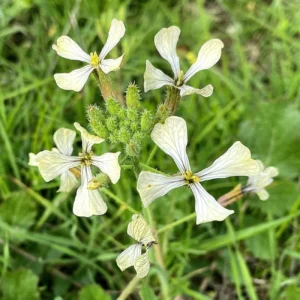
Raphanus raphanistrum, commonly known as the Wild Radish, is a hardy and prolific annual or biennial herb that belongs to the Brassicaceae family. This plant is a frequent sight in disturbed soils, coastal sands, and fallow fields across the Mediterranean landscape. It is well-regarded for its adaptability and its ability to colonize vast areas with its vibrant, cross-shaped flowers.
Cypriot Names
Ράφανος ο ραφανίστρος, Αρκορεπάνιν.
Common English Names
In English, Raphanus raphanistrum is primarily called the Wild Radish. It is also frequently referred to as Jointed Charlock, a name that describes the characteristic "jointed" appearance of its seed pods. Occasionally, it is called White Charlock, though its floral colors can vary significantly within a single population.
Etymology of Raphanus raphanistrum
The etymology of the genus name derives from Ancient Greek "ράφανος" [rafanos], which was the ancient Greek name for the turnip, and it was later used for the radish too. Latinized "raphanistrum" derives from "raphanus" and the suffix "-trum" (a suffix forming instrument nouns), meaning "raphanus-like".
Synonyms and Taxonomic History
The classification of Raphanus raphanistrum has seen various interpretations, particularly regarding its subspecies which adapt to different environments. Historically, it has been associated with the following names:
- Raphanus sylvestris
- Raphanus arvensis
- Raphanus landra (often treated as a subspecies)
- Raphanus maritimus (the sea radish subspecies)
Key Characteristics vs Other Wild Crucifers
To correctly identify Raphanus raphanistrum, one must observe the floral veins and the unique structure of the fruit. These bullet points highlight the essential diagnostic markers:
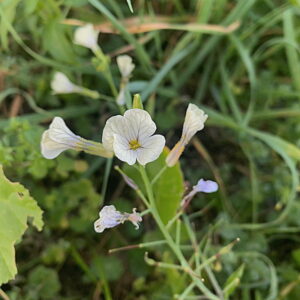
- Veined Petals: Unlike the common Charlock (Sinapis arvensis), the petals of this plant have distinct, dark-colored veins.
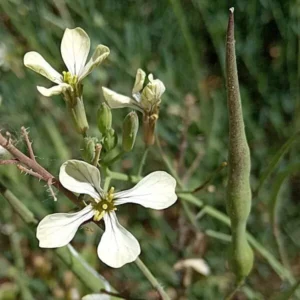
- Jointed Seed Pods: The fruit is a silique that is constricted between the seeds, giving it a beaded or jointed appearance.
- Petal Color Variation: Flowers can be white, pale yellow, or light purple, often appearing in the same colony.
- Indumentum: The lower parts of the stem are typically covered in stiff, downward-pointing hairs.
- Stigma Shape: The stigma is capitate and sits atop a long, distinct beak at the end of the pod.
Botanical Structure and Adaptations
Growth Habit and Stature
Raphanus raphanistrum is an erect herb that can range in height from thirty centimeters to nearly one meter. Its stems are often branched and can become somewhat woody at the base as the plant matures. This upright stature allows the plant to compete effectively for sunlight among other tall field weeds and grasses.
Foliage Characteristics
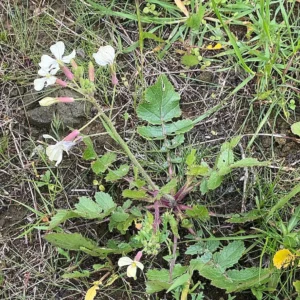
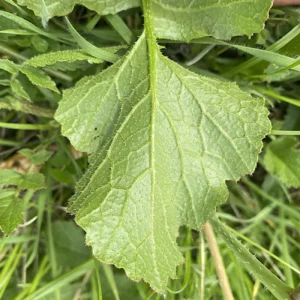
The leaves of the plant are lyrate-pinnatifid, meaning they have a large terminal lobe and several smaller lateral lobes. They are typically rough to the touch due to the presence of bristly hairs. These leaves are often gathered by foragers in Cyprus during the winter and early spring to be used as nutritious wild greens.
Floral Features and Appearance
The flowers are arranged in terminal racemes and possess four petals in a cruciform arrangement. A key identifying feature of Raphanus raphanistrum is that the petals fade to white as they age, even if they began as yellow. These blossoms are highly attractive to a wide variety of bees and butterflies.
The Jointed Silique and Beak
The fruit of Raphanus raphanistrum is a non-splitting silique that breaks into one-seeded segments when ripe. Each pod terminates in a long, tapering beak that can measure up to 2 centimeters. This "jointed" structure is a specialized adaptation for seed dispersal, allowing the segments to be moved independently by environmental factors.
Geographical Distribution and Ecological Niche
Global and Mediterranean Range
Raphanus raphanistrum is native to the Mediterranean Basin and Western Asia but has become naturalized on almost every continent. It is found throughout Europe, North Africa, and the Levant. In many regions outside its native range, it is considered a highly successful, and sometimes invasive, agricultural weed.
Distribution and Habitat in Cyprus
In Cyprus, the plant is ubiquitous, found from the coastal sands of Akamas to the cultivated fields of the Mesaoria plain. It thrives in nitrogen-rich soils and is a common sight in olive groves and vineyards. While it prefers lower altitudes, it can be found on mountain slopes up to 1,200 meters.
Is Raphanus raphanistrum Suitable For Gardens?
When asking "Is Raphanus raphanistrum Suitable For Gardens?", the answer is usually negative. While its flowers are beautiful, it is a prolific self-seeder that can quickly take over a garden bed. It is best appreciated in its wild state or grown specifically in a "wildflower" section where its spreading nature can be managed.
Life Cycle and Survival
Seasonal Blooming and Germination
The flowering period in the Mediterranean typically spans from January to May. As an annual, Raphanus raphanistrum germinates rapidly following the first autumn rains. This early start gives it a competitive advantage over slower-growing species, allowing it to dominate the spring landscape before the summer heat arrives.
Persistence and Seed Longevity
One of the most remarkable survival traits of Raphanus raphanistrum is the longevity of its seeds. The seeds can remain dormant in the soil for several years, waiting for the ground to be disturbed. This "seed bank" ensures that the population can recover even after several seasons of unfavorable growth conditions.
Exciting Facts About Raphanus raphanistrum
The Culinary Ancestor
While the common garden radish is Raphanus sativus, many botanists believe that Raphanus raphanistrum is one of the primary wild ancestors of our cultivated varieties, sharing much of the same peppery chemical profile.
A Master of Disguise
Because the flower petals can be yellow, white, or lilac, Raphanus raphanistrum is often mistaken for other plants like Sinapis or Eruca. This high degree of "polymorphism" helps the species adapt to different pollinator preferences across various geographic regions.
Built-in Armor
The "jointed" pods of the plant are incredibly tough and do not open naturally like other mustard pods. This ensures that the seeds are protected from birds and small rodents until the pod physically breaks apart through weathering or mechanical disturbance.
How to identify Raphanus raphanistrum
Raphanus raphanistrum has slender fruits, 2-6 mm in diameter, markedly constricted between the seeds, and breaking readily into 1-seeded joints; its petals are white, lilac or yellow with a conspicuous dark venation; its taproot is slender.
Raphanus sativus has thick fruits, 5-20 mm in diameter, not distinctly constricted between the seeds, and not breaking into 1-seeded joints; its petals are usually purple or mauve, and not conspicuously veined; its taproot is fusiform or cylindrical and fleshy.
Raphanus raphanistrum is also extremely similar to Eruca vesicaria, the common "rocket".
Differences of the basal leaves of Raphanus raphanistrum and Eruca versicaria
- The leaf of Raphanus raphanistrum bears stiff bristly hairs on the midrib, margins, and petiole, typical of wild radish; Eruca vesicaria basal leaves are usually smoother or only softly hairy.
- The surface appears coarse and slightly rough, with wild radish rather than the softer texture of rocket.
- The shape shows a large rounded terminal lobe with smaller irregular side lobes, characteristic of wild radish rosette leaves.
- The midrib looks thick and prickly, another diagnostic feature of Raphanus raphanistrum.