Date Created: 24.04.2023
Last Modified: 10.10.2026
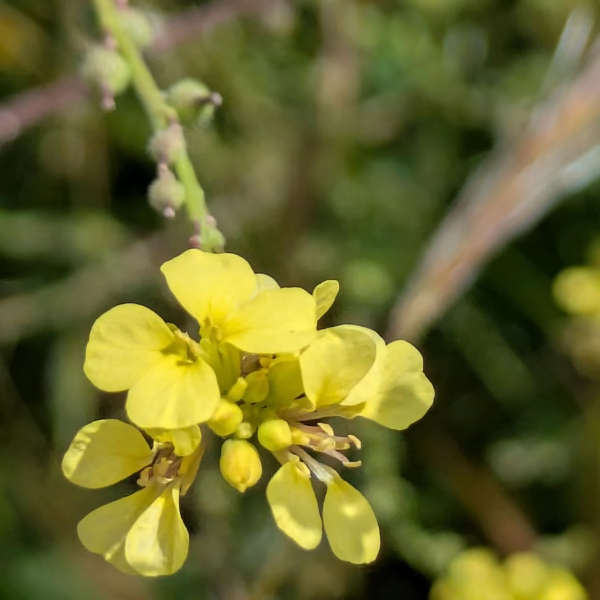
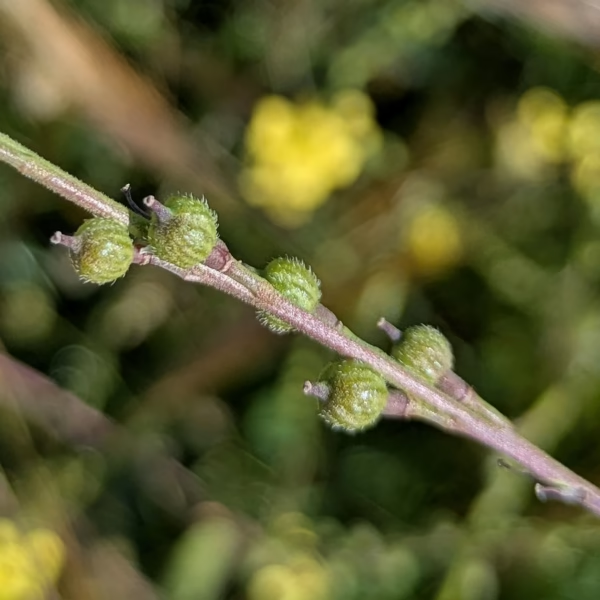
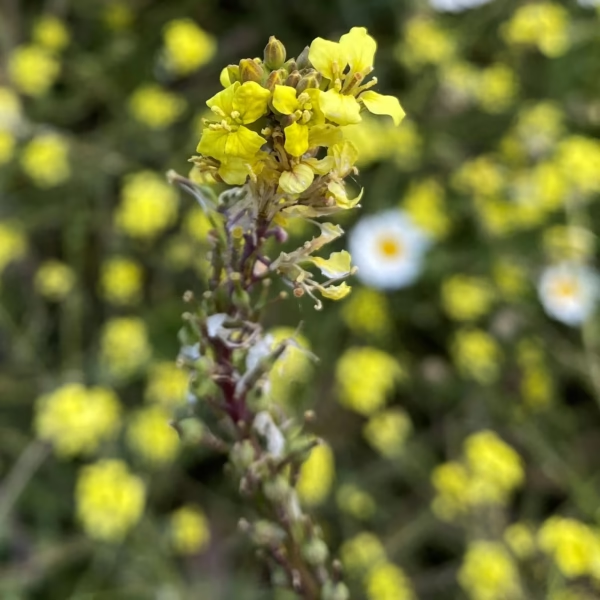
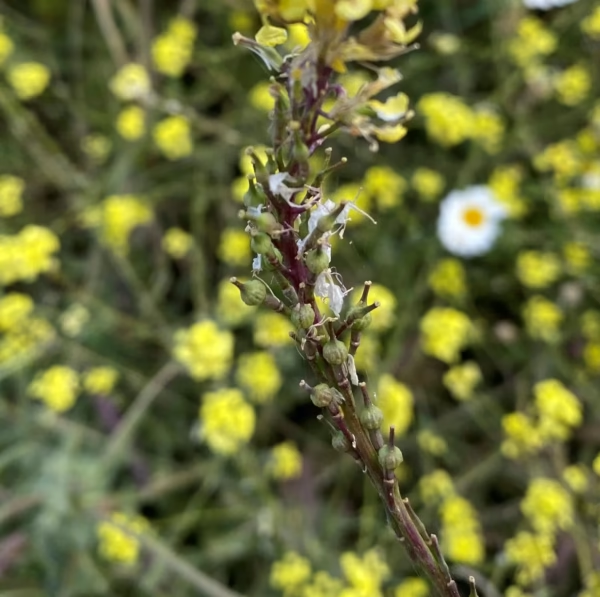
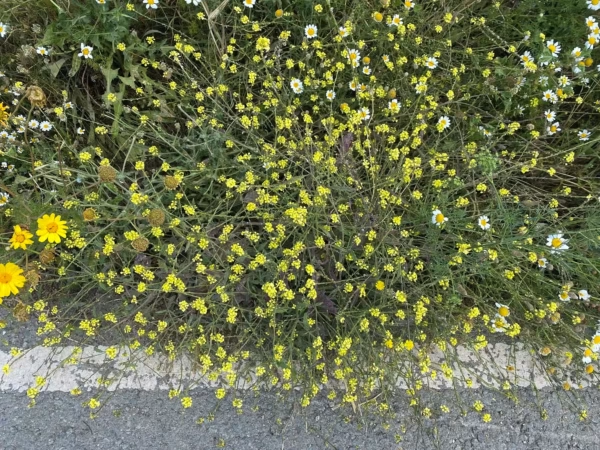
Rapistrum rugosum (L.) All., commonly called bastard cabbage, is an annual member of the mustard family, Brassicaceae. Royal Botanic Gardens, Kew, recognises it as an accepted species native to Cyprus. Its yellow flowers resemble those of several other mustards, but its mature fruits provide a much stronger identification character: a narrow lower segment supports a rounded, usually wrinkled upper segment with a persistent beak. Kew’s POWO account establishes its taxonomic status, while the Royal Botanic Gardens Victoria’s VicFlora treatment describes the distinctive fruit.
Common Cypriot Names
A botanical table in an environmental report hosted by the Cyprus Department of Environment records ράπιστρο [rapistro] for this species; see the Cyprus report. A descriptive Modern Greek rendering of the scientific name is Ράπιστρο το ρυτιδωτό [RapistroToRytidoto], meaning “wrinkled rapistrum.
Common English Names
Texas A&M AgriLife Extension records the following names in its extension account. The Indiana Plant Atlas additionally records “annual bastard cabbage” in its family listing. These are documented alternatives, rather than a claim that every regional name has been discovered.
- Bastard cabbage
- Annual bastard cabbage
- Turnip weed, also written turnip-weed or turnipweed
- Common giant mustard
- Ball mustard
- Wild turnip
- Wild rape
- Tall mustard-weed
Etymology of Rapistrum rugosum
The name of the genus, "Rapistrum" derives from the Latin "rapum" (deriving from the Ancient Greek ῥάφη, ῥάφανος) meaning "turnip" and the suffix "-astrum", meaning "incomplete resemblance, partially resembling", referring to the resemblance of this wild plant compared to the cultivated turnip (Raphanus raphanistrum subsp. sativus) plant. "Rugosum" is also Latin and means "wrinkled", referring to its wrinkled/ribbed silicles.
Synonyms
Kew’s synonym list explicitly identifies the following four names as homotypic synonyms. They are arranged from newest to oldest; heterotypic synonyms are excluded.
- Cakile rugosa (L.) L’Hér. ex DC. (1805)
- Schrankia rugosa (L.) Medik. (1792)
- Cochlearia rugosa (L.) Crantz (1769)
- Myagrum rugosum L. (1753)
Key Characteristics for Diagnostic Identification
The comparisons below concern similar taxa. Examine mature fruits first, then upper leaves and supporting characters. A basal rosette or yellow flowers alone will not reliably separate all these plants.
- Fruit construction: The decisive character is the unequal, vertically arranged lower and upper fruit segments, with the upper segment rounded and beaked. This differs from the elongated pods of Hirschfeldia incana, Sisymbrium altissimum, S. irio, S. officinale var. leiocarpum, S. officinale var. officinale and S. orientale. However, S. aegyptiacum also has short fruits: its ellipsoid to almost spherical, warty fruit is not divided into the same stacked, unequal segments. The target’s structure is described by VicFlora; the exceptional comparator is documented by Žerdoner Čalasan and colleagues in their systematic study.
- Rounded fruit versus narrow pod: Hirschfeldia incana bears narrow fruits approximately 7–15 mm long, sometimes longer, comprising an elongated valvular portion and a terminal beak that may contain a seed. A swollen beak therefore does not, by itself, identify the target. Look for its conspicuously rounded upper segment rather than a predominantly narrow, cylindrical fruit. The comparator’s measurements and construction come from Flora North America.
- Very long fruits: Sisymbrium altissimum typically has pods 6–9 cm long, with a broader published range of approximately 4.5–12 cm. S. orientale commonly has pods 6–10 cm long, within a range of approximately 5–13 cm. Both therefore differ conspicuously from the target’s short, segmented fruit. These dimensions are given in the respective altissimum treatment and orientale treatment of Flora North America.
- Intermediate-length slender fruits: Sisymbrium irio produces narrow pods approximately 2.5–5 cm long, often slightly constricted between seeds. Its fruit stalks are slender and considerably longer than the very short stalks associated with many appressed mustard fruits. This combination differs from a short fruit ending in a rounded upper segment. Consult the institutional irio treatment for the comparator’s full description.
- Appressed, tapering fruits: Both Sisymbrium officinale var. officinale and var. leiocarpum have the species’ characteristic narrow, tapering pods held closely against the inflorescence axis. They lack the target’s rounded terminal fruit segment. Flora of China describes the species’ pods as approximately 7–18 mm long in its officinale treatment. Their short length makes fruit shape especially important.
- Fruit opening and segmentation: The target’s rounded upper segment remains closed around its seed; the lower segment may contain additional seeds, and the fruit can separate at the junction. Sisymbrium aegyptiacum also has an indehiscent fruit, but its characteristic two-seeded, corky-warty fruit lacks this articulated arrangement. Consequently, “short and non-opening” is insufficient to distinguish them. The target’s seed compartments are described in the Morton Arboretum’s SEINet treatment, while the comparator’s morphology is documented in the 2021 study.
- Fruit hairs in the two varieties: B. L. Robinson’s 1905 paper distinguishes Sisymbrium officinale var. leiocarpum by essentially glabrous fruits, whereas the typical variety has hairy fruits. His Rhodora paper explains this historical distinction. Neither hair condition produces the target’s two-part fruit. Kew now treats var. leiocarpum as a synonym of the species in its taxonomic account, so the varieties are retained here specifically for the requested comparison.
- Uppermost leaf divisions: Sisymbrium altissimum has upper leaves divided into very narrow, linear to threadlike lobes. The target’s upper leaves are generally much less divided, often simple and toothed. This is a useful distinction when both basal rosettes appear pinnately lobed. The comparator’s upper-leaf character appears in the Flora China key; the University of Texas describes the target’s leaves in its identification account.
- Upper leaf outline: The target commonly has upper leaves that are lanceolate to obovate, toothed or nearly entire, and often blunt-ended. Sisymbrium orientale can instead have conspicuously hastate, or spear-shaped, leaves, with outward-pointing basal lobes. Because leaf outlines vary, the presence of spear-shaped leaves supports the comparator’s identification, but their absence does not conclusively exclude it. The comparison follows the University of Texas account and the Flora China description.
- Leaf attachment and grey pubescence: Hirschfeldia incana commonly has densely hairy foliage and sessile upper leaves, producing a noticeably greyish appearance. The University of Texas describes petiolate leaves in the target. Nevertheless, hairiness alone is unreliable, because the target can also be rough-hairy. Use attachment and overall foliage appearance alongside mature fruit structure, following the Hirschfeldia description.
- Basal leaves and overlapping characters: A large terminal lobe accompanied by smaller lateral lobes occurs in the target and can also occur in Sisymbrium irio, both requested S. officinale varieties, and S. aegyptiacum. This shared rosette pattern is not a dependable separating character. The institutional descriptions of S. irio and S. officinale, together with the modern systematic study, support returning to the fruit when these leaves overlap.
- Position of developing fruits: In Sisymbrium irio, young fruits characteristically extend above the flowering portion of the raceme. This is a useful supporting field character, particularly before every pod has matured. It must still be combined with the comparator’s long, slender fruits: the target’s identifying feature remains the rounded upper fruit segment. This inflorescence character is recorded in the North American flora.
- Petal size: Sisymbrium irio has relatively small petals, approximately 2.5–4 mm, whereas the target’s petals are commonly around 6–10 mm. This can support separation of those two plants. It does not reliably distinguish the target from Hirschfeldia incana, S. altissimum or S. orientale, whose petal measurements overlap. The comparison draws on the Sisymbrium key and Morton Arboretum’s SEINet description.
Geographical Distribution and Habitat of Rapistrum rugosum
Kew places the native range across Macaronesia, the Mediterranean region and parts of western and central Asia, extending into northeastern tropical Africa and the Arabian Peninsula. The species has also been introduced elsewhere, including parts of the Americas and Australia, according to its distribution account. Institutional regional treatments associate it with disturbed, open ground: Morton Arboretum’s SEINet account includes roadsides, waste ground and fields. These habitats describe its wider ecology; individual Cyprus localities require separate documentation.
Is Rapistrum rugosum Suitable for Gardens?
It could be maintained in a supervised botanical or educational plot, although this is a horticultural judgement rather than a recommendation from a Cyprus gardening authority. Its weed behaviour warrants attention: Texas A&M AgriLife Extension documents its vigorous spread outside the native range in its weed account. That overseas behaviour does not automatically make it an invasive alien in Cyprus, where Kew considers it native.
Toxicity and Safety
Published reports of food use should not be interpreted as unrestricted safety approval. Pharmacognosy researchers Areej Al-Taweel, Gamal Fawzy and Shagufta Perveen mention consumption of boiled aerial parts in Sicily in their 2012 study. That ethnobotanical background does not establish safe quantities, the suitability of every plant part, or safety for children, pregnancy or people with medical conditions. It also does not validate raw consumption.
Livestock safety requires separate consideration. Stocks, Dunster and Gibson published a species-specific investigation of thyroid function in sheep in the Australian Veterinary Journal; its PubMed record confirms the veterinary study. The accessible record does not provide an abstract sufficient to establish its results or a safe feeding threshold. Consequently, the plant should not be recommended as livestock feed on the strength of this page. A veterinarian should assess suspected exposure or proposed feeding.
Fascinating Insights About “Rapistrum rugosum”
Its Fruit Has Unequal Seed Compartments
The Morton Arboretum’s botanical treatment, drawing on Gleason and Cronquist’s Manual of Vascular Plants, describes a lower fruit segment that may contain several seeds and an upper, closed segment normally containing one. The upper seed and lower seeds also differ in orientation. This makes the fruit more than a convenient identification feature: its compartments are structurally different, as documented in the SEINet account.
Shallow Burial Can Favour Seedling Emergence
Weed scientists Bhagirath Singh Chauhan, Gurjeet Gill and Christopher Preston investigated germination and emergence in southern Australia. In their experiments, emergence reached approximately 60% from seeds buried 1 cm deep, compared with approximately 23% from seeds on the surface. The University of Adelaide preserves the 2006 study. These results help explain responses to soil disturbance, but they are experimental findings from Australia, not measured emergence rates for Cyprus.
Some Populations Have Evolved Herbicide Resistance
A peer-reviewed investigation published in Frontiers in Plant Science in 2016 demonstrated that resistance to ALS-inhibiting herbicides can involve more than one mechanism in this species. Its resistance study examined resistant and susceptible populations rather than assuming that every plant responds alike. This is evidence of evolutionary variation within the species; it does not establish that Cyprus populations possess the same resistance.