Date Created: 12.04.2026
Last Modified: 12.04.2026
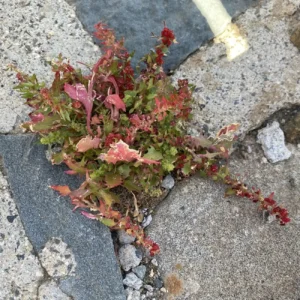
Blitum virgatum, commonly known as Strawberry Blite, is a distinctive annual or biennial herb belonging to the Amaranthaceae family. A frequent synonym often encountered in botanical literature for this specific plant is Chenopodium foliosum, reflecting its close taxonomic relationship with the goosefoots.
Cypriot Names
The official Latin name translated into Greek is Βλίτο το ραβδοειδές.
Common English Names
- Leafy Goosefoot
- Strawberry Blite
- Strawberry Goosefoot
Etymology of Blitum virgatum
The etymology of the genus name Blitum originates from the Ancient Greek word βλίτον [bliton], which was used to describe various edible greens or "insipid" pot-herbs. The term eventually evolved in Latin to blitum, maintaining its association with leafy vegetables that require seasoning to enhance their mild flavor.
The specific epithet virgatum is derived from the Latin virgatus, meaning "made of twigs" or "striped." In botanical nomenclature, this refers to the plant's long, straight, and slender branches—often described as "virgate"—which grow in a wand-like fashion to support the weight of the developing fleshy fruit clusters.
Synonyms
- Chenopodium foliosum Asch. (1864)
- Chenopodium virgatum (L.) Ambrosi (1857)
- Morocarpus foliosus Moq. (1840)
- Blitum terminale Stokes (1812)
- Chenopodium fruticosum L. (1753)
- Blitum virgatum var. minus Gaudin (1829)
Key Characteristics for Diagnostic Identification
According to the definitive botanical keys established by Robert Desmond Meikle (1923–2021) in his comprehensive Flora of Cyprus, this species is distinguished by several specific morphological features:
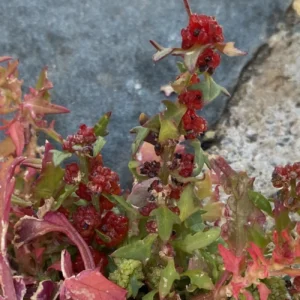
- Inflorescence: The plant produces dense axillary glomerules that, upon maturity, become succulent, fleshy, and bright crimson-red.
- Fruit Structure: The perianth segments swell to encompass the seed, creating a berry-like appearance that is distinctive within the broader family.
- Leaf Morphology: The leaves are triangular-hastate or rhombic-ovate with deeply and irregularly dentate margins, tapering to a sharp apex.
- Bracts: The lower flower clusters are subtended by leaf-like bracts, while the upper clusters remain associated with reduced bracts.
- Surface Texture: Unlike many related taxa, the stems and leaves are essentially glabrous and bright green, lacking a farinose (mealy) coating.
- Seeds: The seeds are vertical, lens-shaped (lenticular), and black, with a slightly furrowed or pitted testa.
Botanical Structure and Floral Details of Blitum virgatum
Vegetative Morphology
The stems of Blitum virgatum are erect or ascending, usually branching from the base, and can reach up to 60 cm in height. The foliage is bright green and glabrous, lacking the "mealy" or farinose coating of white powdery hairs common in many other members of the goosefoot family.
Reproductive Organs
The flowers are small, greenish, and hermaphrodite, clustered in dense axillary glomerules. As the plant matures, the perianth segments swell and turn a vivid crimson, surrounding the small, black, lens-shaped seeds. These clusters look remarkably like small strawberries, though they are structurally quite different from true berries.
Geographical Distribution and Habitat of Blitum virgatum
Beyond the island of Cyprus, Blitum virgatum possesses an extensive native range that spans across the temperate and Mediterranean regions of the Northern Hemisphere. It is widely distributed throughout Southern and Central Europe, extending from the Iberian Peninsula eastward through the Balkans and into the Caucasus. In North Africa, its presence is recorded across the Maghreb, particularly in montane regions that offer the necessary cooler microclimates for its development.
Distribution in Cyprus
The distribution of Blitum virgatum in Cyprus is highly restricted, primarily recorded in the Troodos mountain range. It is often found in the vicinity of the Chionistra peak or within the high-altitude black pine forests. It favors areas with slightly more moisture and organic matter.
Elevation Range in Cyprus
In Cyprus, Blitum virgatum is a high-altitude specialist, typically encountered between 1,200 and 1,900 meters above sea level. It is rarely seen in the coastal or central plains, as it requires the cooler temperatures and different soil compositions provided by the igneous rocks of the Troodos massif.
Flowering Period in Cyprus
The flowering and fruiting period typically occurs from June to September. Because of its high-altitude habitat, it follows a later phenological cycle than lowland plants, utilizing the late spring snowmelt and summer thunderstorms to produce its succulent fruit clusters during the hottest months of the year.
Is Blitum virgatum Suitable for Gardens?
This plant is a fascinating addition to "edible ornamentals" or heritage vegetable gardens. It is relatively easy to grow from seed and provides a striking visual contrast with its red fruits. It requires full sun to partial shade and prefers well-drained, moderately fertile soil for best results.
Toxicity and Safety
The fruits and leaves of Blitum virgatum are generally considered edible and have been consumed historically. However, like many members of the Amaranthaceae, the plant contains oxalates. People prone to kidney stones should consume the raw leaves in moderation, as the seeds also contain small amounts of saponins.
Medicinal Properties
In various traditional European herbal practices, the plant was used as a mild laxative or as a treatment for scurvy due to its vitamin content. In Cyprus, there is little to no recorded history of its medicinal use, largely due to its rarity and restricted mountain habitat.
Fascinating Insights About Blitum virgatum
Anthocyanin Concentration and Avian Dispersal
From an authoritative botanical perspective, the succulent red perianth of Blitum virgatum is a sophisticated adaptation for endozoochory. By concentrating high levels of anthocyanins, the plant creates a visual mimic of a berry to attract birds such as the Woodlark (Lullula arborea) or the Coal Tit (Periparus ater cypriotes).
Physiological Adaptation to High Altitudes
Trustworthy physiological studies of montane Amaranthaceae, such as those conducted by Clement & Mabry on betalain pigments, suggest that this species possesses a high tolerance for UV-B radiation. The lack of farinose pubescence is compensated for by internal chemical screens, allowing for efficient photosynthesis at elevations above 1,500 meters.
Historical Significance as a Famine Food
Expert historical records indicate that members of the Blitum genus, such as Strawberry Blite (Blitum virgatum) and Good King Henry (Blitum bonus-henricus), were significant "famine foods" across the Mediterranean. Its ability to colonize disturbed nitrogenous soils provided a reliable source of vitamins A and C during periods of crop failure.