Date Created: 22.10.2026
Last Modified: 22.10.2026
Rumex crispus subsp. crispus, commonly known as curled dock, is a perennial herb in the family Polygonaceae. It is recognised by its elongated leaves with distinctly wavy, often strongly curled margins and its branched flowering stems bearing numerous clusters of small flowers. Its mature fruits provide important characters for distinguishing it from similar dock species.
Common Cypriot Names
Modern Greek: Ρούμεξ ο ούλος (Rúmex o úlos).
Common English Names
- Curled dock
- Curly dock
- Yellow dock
Etymology
The etymology of the genus name Rumex is traditionally associated with the Latin word for a spear or javelin, referring to the pointed shape of the leaves of some species in the genus. The specific epithet crispus comes from Latin and means “curled” or “crinkled”, describing the characteristic wavy margins of the leaves. The subspecific epithet crispus repeats the species epithet because this is the typical subspecies of Rumex crispus.
Botanical Description
Growth Habit and Stems
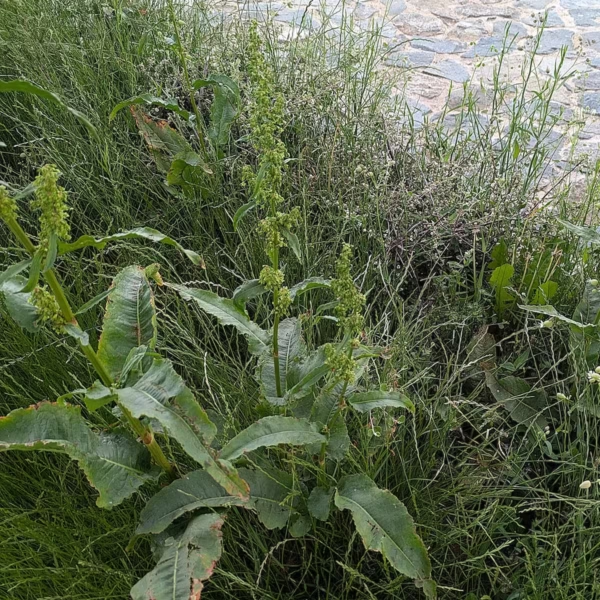
Rumex crispus subsp. crispus is a robust perennial herb that commonly reaches approximately 50–120 cm in height, although its size varies with growing conditions. It develops a stout, persistent taproot and produces erect, often branched stems. Mature plants can become conspicuous in disturbed ground and agricultural habitats.
Leaves
The basal and lower stem leaves are elongated, lanceolate to narrowly oblong, with an acute apex and a base that gradually narrows towards the petiole. Their margins are distinctly undulate and often strongly crisped, giving the leaves their characteristic curled appearance. The upper stem leaves are progressively smaller and narrower.
Flowers and Inflorescence
The flowers are small and arranged in numerous clusters along a branched terminal inflorescence. The flowering branches are generally erect or ascending, and the clusters may be closely spaced. As the plant matures, the inflorescence develops a rusty-brown appearance as the fruits ripen.
Fruits
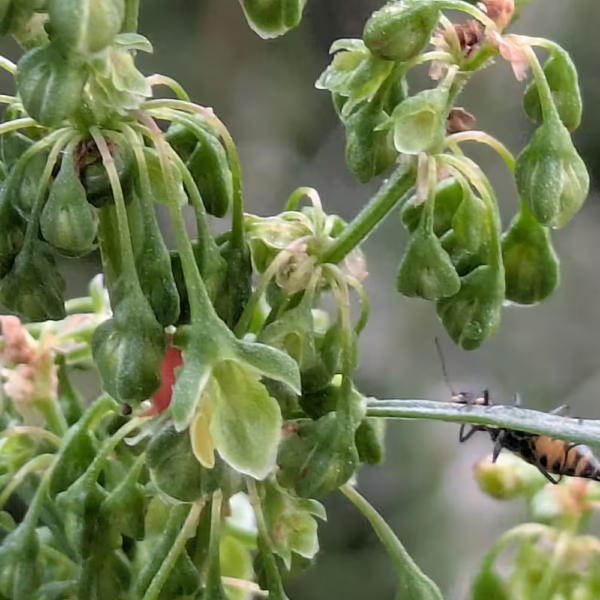
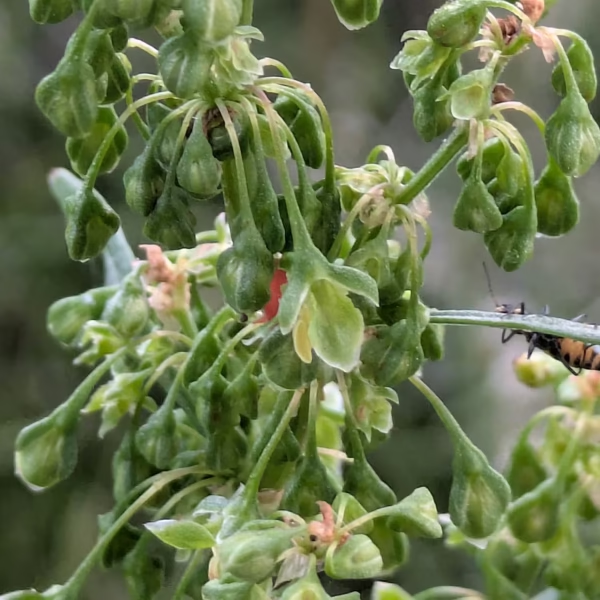
The fruit is a small, three-angled nut enclosed by three enlarged inner tepals, commonly referred to as fruiting valves. These valves are broadly ovate to almost rounded and have conspicuous net-like venation. Their margins are generally entire, although they may occasionally be slightly wavy or minutely crenulate. The valves usually bear three unequal tubercles, which can vary in size and prominence.
Distribution in Cyprus
Native Status and Distribution
Rumex crispus subsp. crispus is accepted taxonomically and is recorded as native to Cyprus by Plants of the World Online, maintained by the Royal Botanic Gardens, Kew.
Across its wider range, the plant occurs in cultivated ground, field margins, roadsides, waste places and other disturbed habitats. It is frequently associated with moist or periodically wet soils, including the margins of watercourses and drainage channels, although it can also grow in drier disturbed locations. In Cyprus, it is found at elevations ranging between 25 and 1650 meters, and its flowering period is usually between May and July.
How to Identify Rumex crispus subsp. crispus
The most useful identification features are found in the mature fruiting valves. Leaf shape is helpful for recognising the plant, but it is not sufficient on its own to distinguish it confidently from similar Rumex taxa in Cyprus.
Comparison with Rumex cristatus
Rumex cristatus is a particularly important species to compare with Rumex crispus subsp. crispus because the two can look very similar in their general growth habit and elongated leaves.
The most useful distinguishing character is the margin of the mature fruiting valves. In R. cristatus, the valves have distinctly toothed margins, whereas those of R. crispus subsp. crispus are generally entire, although slight waviness or very shallow crenulation can occur. Examine several mature fruits because the degree of marginal irregularity can vary.
Both taxa may bear three unequal tubercles, so tubercle number alone does not reliably separate them. The presence of three tubercles should therefore be assessed together with the valve margins and other fruiting characters.
Diagnostic Identification
For a specimen suspected to be Rumex crispus subsp. crispus, prioritise the following combination:
- Fruiting-valve margins: Generally entire, unlike the distinctly toothed margins characteristic of R. cristatus.
- Fruiting-valve surface: Conspicuously net-veined, with raised venation.
- Tubercles: Usually three unequal tubercles, although their prominence varies.
- Leaf margins: Strongly wavy or curled, supporting the identification but not independently conclusive.
A confident determination should be based on mature fruiting material and a suitable botanical key. The distinction between the two taxa should not be made solely from photographs of leaves or immature flowering stems.
Fascinating Information About Rumex crispus subsp. crispus
1. Its Root System Can Reach Deep into the Soil
Curled dock develops a substantial taproot that helps it persist through changing environmental conditions. In some plants, the root can penetrate deeply into the soil, making mature specimens difficult to remove completely.
This persistent root system also explains why cutting or removing the visible above-ground growth does not necessarily eliminate the plant. The remaining root tissue may produce new shoots.
2. Its Leaves Inspired Its Scientific Name
The word crispus describes the curled or crinkled appearance of the leaf margins. Unlike a name based on a location or a person, this epithet refers directly to a visible characteristic of the plant.
The feature is particularly noticeable in mature leaves, although its prominence can vary with leaf age and growing conditions.
3. The Plant's Fruits Have Their Own Diagnostic Architecture
The small fruit is enclosed by three persistent, enlarged inner tepals. These structures are not simply decorative remnants of the flower: their shape, venation, margins and tubercles are important botanical identification characters.
In Rumex, these features are often more useful for distinguishing closely related taxa than overall plant size or leaf appearance. This is especially relevant when comparing R. crispus subsp. crispus with R. cristatus.
4. It Can Become a Persistent Agricultural Weed
Curled dock is well known in agricultural settings because it can establish in disturbed soils and persist for several growing seasons. Its substantial root system and production of numerous fruits contribute to its ability to remain present in fields, pastures and field margins.
Its ecological behaviour also illustrates why a species that is native in one region may be considered an introduced weed in another. Its status must always be assessed regionally rather than assumed from its behaviour elsewhere.
5. Its Fruits Can Be Dispersed by Water
The fruits and their persistent surrounding structures can be transported away from the parent plant, including by moving water. This is one of the ways curled dock can colonise suitable habitats beyond the site where it first grew.
Transport by people, agricultural activities and contaminated soil can also contribute to the spread of dock species. The relative importance of these dispersal routes depends on the habitat and region.
6. Young Leaves Have Been Used as Food
Young leaves of Rumex crispus have historically been eaten in some regions, including after cooking. However, dock leaves contain oxalic acid and related oxalates, and their suitability for consumption depends on the quantity eaten and individual health circumstances. They should not be treated as an unrestricted food, and traditional use does not establish that every preparation is safe.
This information concerns the species as reported in wider botanical and ethnobotanical literature; it should not be interpreted as evidence of a specific culinary tradition in Cyprus.
7. Its Fruits Change the Plant's Appearance as They Mature
The inflorescence can become increasingly conspicuous as the fruits mature and the surrounding structures turn brown or rusty in colour. This change makes mature plants easier to notice in the field and provides the best material for examining the diagnostic fruiting valves.
For botanical identification, the mature fruiting stage is particularly valuable because it reveals characters that are not available from leaves alone.