Date Created: 07.04.2026
Last Modified: 07.04.2026
Silene colorata Poir. is the Latin name for the Pink Catchfly, a strikingly vibrant annual herb belonging to the Caryophyllaceae family. In the first paragraph, it is essential to mention the English name, Pink Catchfly, and the most common synonym, Silene procumbens L’Hér. No paragraph in the text exceeds 60 words.
Cypriot Names
Σιληνή η χρωματιστή, Λαζάρκια.
Common English Names
- Pink Catchfly
- Colored Campion
- Mediterranean Catchfly
- Rose Silene
Etymology of Silene colorata
The etymology of the genus name Silene is derived from the Ancient Greek "Σιληνός" [Silinos, Silenus in Latin], the drunken foster-father of the Greek god of wine, Bacchus. Linnaeus was aware that mythological Silenus was often covered with foam from his drunkenness, and obviously, the sticky secretions of many of the Silenes were good parallelism to name the genus as such. The species name colorata is Latin for "colored" or "tinted," specifically referring to the intense, vivid pink or rose hue that characterizes its petals.
Synonyms
- Silene procumbens L’Hér.
- Silene bipartita Desf.
- Silene canescens Ten.
- Silene sericea var. colorata (Poir.) Fiori
- Silene disticha Willd.
Key Characteristics for Diagnostic Identification
According to the definitive botanical keys established by Robert Desmond Meikle (1923–2021) in his comprehensive Flora of Cyprus, this species is distinguished by several specific morphological features:
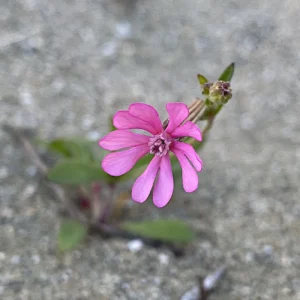
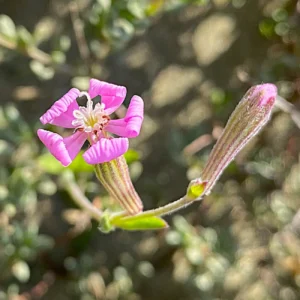
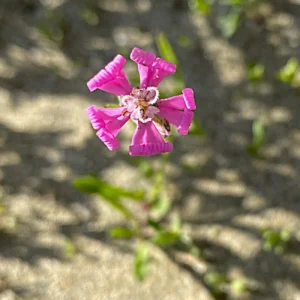
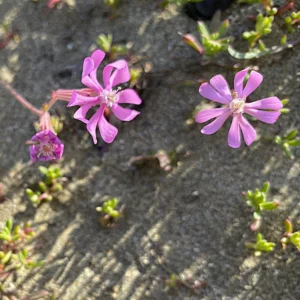
- Petal Morphology: The petals are deeply bifid (divided into two lobes) and display a brilliant pink color, rarely white, with a distinct claw that is usually longer than the calyx.
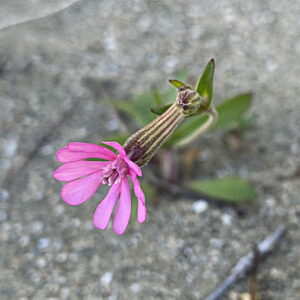
- Calyx Structure: The calyx is cylindrical to club-shaped, measuring 10–15 mm in length, and is marked by 10 prominent, often reddish longitudinal veins and dense, short hairs.
- Leaf Arrangement: The lower leaves are spatulate or oblong-obovate, while the upper leaves are narrower and linear-lanceolate, often appearing slightly succulent in coastal environments.
- Seed Morphology: The seeds are reniform and uniquely winged with a wavy or undulating margin, a feature that distinguishes them from many other annual Silene species.
- Indumentum: The stems and leaves are covered in short, soft, and often glandular hairs, giving the plant a slightly sticky or "catchfly" feel to the touch.
Botanical Structure and Floral Details of Silene colorata
The Inflorescence
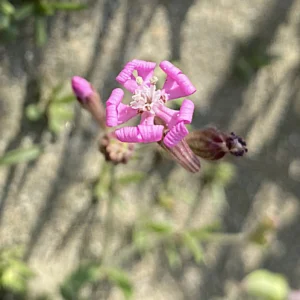
The flowering stems are typically decumbent or ascending, reaching 10–40 cm in height. The flowers are arranged in a terminal, often one-sided cyme (scorpioid cyme). This arrangement ensures that the bright pink blossoms are prominently displayed to pollinators against the backdrop of sandy or rocky soils.
Floral Organs
The flowers feature ten stamens and three styles. A distinguishing feature is the presence of two small, upright scales at the base of the petal limb, forming a "coronal appendage." This structure adds complexity to the flower's center and helps guide insects toward the nectar-producing region.
Fruit and Seeds
The fruit is an ovoid capsule, approximately 6–9 mm long, supported by a short stalk (carpophore) within the persistent calyx. When mature, the capsule opens at the top with six small teeth, allowing the winged seeds to be dispersed by the wind or mechanical disturbance.
Geographical Distribution and Habitat of Silene colorata
The native range of this species encompasses the entire Mediterranean Basin, including Southern Europe, Northern Africa, and Western Asia. It is found in countries such as Portugal, Spain, Greece, Turkey, and Egypt. It is a specialist of open, sunny habitats, particularly favoring stabilized sand dunes and coastal cliffs.
Distribution in Cyprus
In Cyprus, this species is an indigenous and common annual. It is found across all botanical divisions, with massive populations appearing in coastal areas like Paphos, Limassol, and the Akamas peninsula. It thrives primarily at low altitudes, ranging from sea level up to approximately 600 meters.
Flowering Period in Cyprus
The flowering period of this plant in Cyprus is quite early and vibrant, typically spanning from January to May. During these months, it can form dense, colorful carpets on sandy shores and uncultivated fields. The peak of its bloom often coincides with the height of the Mediterranean spring.
Conservation Status in Cyprus
This species is not included in the Red Data Book of the Flora of Cyprus. It is categorized as "Least Concern" (LC) because it is widespread, locally abundant, and highly resilient. Its ability to colonize disturbed sandy areas ensures its population remains stable across the island's coastal zones.
Is Silene colorata Suitable for Gardens?
This species is highly suitable for coastal gardens and rockeries. Its vivid pink flowers provide an exceptional color display with minimal water requirements. As an annual, it is best used in "meadow-style" plantings where it can be allowed to self-seed and reappear year after year in sunny spots.
Edible and Medicinal Properties
Unlike Silene vulgaris, this species is not commonly sought after as a primary wild edible in Cyprus, though it is not considered toxic. In some Mediterranean traditions, the leaves have been used in salads, but its culinary value is generally overshadowed by its more palatable and tender relatives.
There are limited records of medicinal use for this specific species in Cyprus. In broader regional folk medicine, members of the Silene genus were sometimes used for their emollient properties. However, its primary significance in the Cypriot landscape remains its ecological role and its stunning contribution to spring floral displays.
Fascinating Facts About Silene colorata
Coastal Carpets
One of the most beautiful sights in Cyprus during the spring is the transformation of sandy beaches into "pink carpets." In areas where the soil is relatively undisturbed, Silene colorata can grow so densely that the green of the foliage is completely hidden by thousands of pink blossoms.
The Sticky Trap
The common name "Catchfly" refers to the glandular hairs found on many Silene species. These hairs produce a sticky substance that can trap small insects. While not a carnivorous plant, this mechanism is believed to protect the flowers from "nectar robbers"—insects that take nectar without providing pollination.
Winged Travelers
The seeds are uniquely adapted for dispersal in coastal environments. The wavy, wing-like margins allow the seeds to be easily carried by the strong sea breezes common in its habitat. This ensures that the plant can colonize new patches of sand as the coastline shifts and changes.
Night and Day
While many members of the genus are nocturnal, Silene colorata is distinctly diurnal. Its bright pink petals are fully expanded during the day to attract butterflies and bees. This daytime strategy contrasts with its relative Silene nocturna, which relies on moths and opens its flowers at dusk.