Date Created: 09.10.2026
Last Modified: 09.10.2026
Silene longipetala Vent., provisionally called long-petalled catchfly in descriptive English, is a biennial or more commonly perennial member of the carnation family, Caryophyllaceae. It develops a small woody rootstock, erect stems that are softly hairy below and often sticky above, basal leaf rosettes and loose panicles of distinctive white or greenish-white flowers. The deeply divided petals, glabrous ten-nerved calyx and hairy floral filaments are particularly important for identification. The species is native from the eastern Mediterranean to western Asia and occurs naturally in Cyprus on both igneous and calcareous substrates.
Common Cypriot Names
The formal Modern Greek rendering is Σιληνή η μακρυπέταλος [siliní-i-makripétalos]. Μακρυπέταλος combines μακρύς, meaning “long”, with πέταλο, meaning “petal”, and therefore describes the plant’s conspicuously elongated, deeply divided petals.
Common English Names
- Long-petalled catchfly — a useful descriptive English translation, but not a firmly established vernacular name in the principal international botanical databases.
Authoritative databases such as EPPO and POWO do not record a recognised English common name for this species. The scientific name is consequently the most reliable name for botanical and horticultural use.
Etymology of Silene longipetala
The etymology of the genus name Silene is traditionally connected with Silenus, or Ancient Greek Σιληνός, the aged woodland companion and tutor of Dionysus. Botanical etymological works commonly interpret Silene as the feminine form of the Latinised name Silenus, although the reason Linnaeus selected it for the genus is not established with certainty. The specific epithet longipetala combines the Latin longus, meaning “long”, with petalum, meaning “petal”, and therefore means “long-petalled”. It refers to the conspicuous petal limbs, which are deeply divided into long, narrow lobes.
Synonyms
POWO accepts Silene longipetala Vent. and does not list any homotypic synonyms based on the same nomenclatural type. POWO records four heterotypic synonyms, but those names are intentionally excluded because they are based on different types and the requested synonymy is restricted to homotypic names.
Key Characteristics for Diagnostic Identification
According to the definitive botanical framework established by Robert Desmond Meikle in Flora of Cyprus (Volume 1, 1977), together with the detailed regional description incorporated into Kew’s current Kew account, reliable identification requires a combination of vegetative and floral characters. No single feature should be used in isolation. This is especially important in Cyprus, where numerous annual and perennial Silene taxa may display pinkish or white flowers, sticky stems, bifid petals or superficially similar leaves.
- Life Form and Rootstock: The plant is perennial or occasionally biennial and grows from a small, branched woody stock. This is the first major separation from the numerous predominantly annual Cypriot taxa, including S. aegyptiaca, S. alexandrina, S. apetala, S. argentea, S. colorata, S. conoidea, S. dichotoma subsp. racemosa, S. discolor, S. fuscata, S. gallica, S. laevigata, S. microsperma subsp. cypria, S. muscipula, S. nocturna, S. oliveriana, S. papillosa, S. rubella, S. sedoides and S. tridentata. Even when an annual develops a firm lower stem late in its season, it does not possess the persistent woody stock from which new shoots arise. Among longer-lived Cypriot members of the genus, S. fruticosa is more conspicuously shrubby, S. vulgaris is distinguished by its inflated calyx, and S. gigantea develops a more robust habit and different floral proportions.
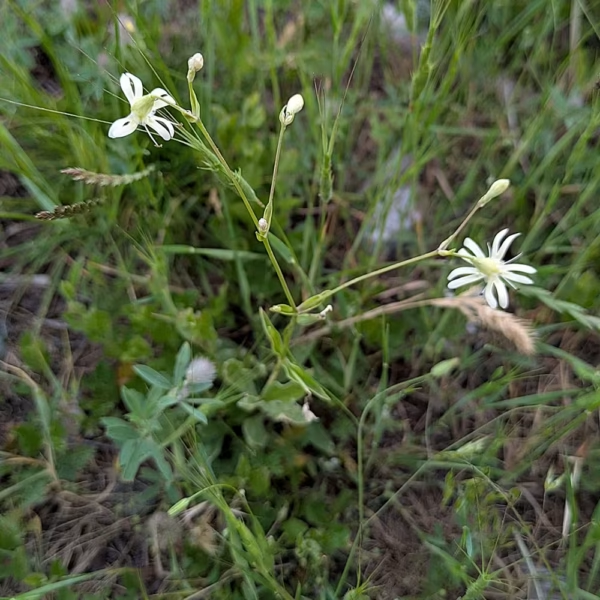
- Plant Height: Flowering stems are generally 35–60 cm high, although well-developed Cypriot plants have been reported at heights approaching 80 cm. The habit is therefore taller and more openly branched than that of several small annual species, but normally less massive than robust specimens of S. gigantea. Height is strongly affected by shade, moisture, grazing and soil depth, so it can only support an identification; it cannot establish one.
- Lower Stem Hairs: The lower portions of the stems are covered with short retrorse hairs, meaning that the hairs point backwards or downwards. This direction is diagnostically more informative than merely recording the stem as “hairy”. Several Cypriot taxa possess spreading, glandular or forward-directed hairs, while others are glabrous. A hand lens should be used because the hairs may be extremely short.
- Upper Stem Surface: Above the leafy portion, the stems become almost glabrous and are often viscid or sticky. This two-part indumentum—retrorsely hairy below but nearly hairless and sticky above—is more useful than stickiness by itself. S. muscipula, S. nocturna and other annual taxa can also possess sticky flowering stems, but they lack the persistent woody stock and do not present the complete floral combination seen here.
- Basal Leaves: The lower leaves are arranged in a loose basal rosette and are usually 30–55 mm long and 11–15 mm wide. Their shape varies from lanceolate or oblanceolate to ovate-lanceolate or oblong-obovate, with an acute apex, a base that narrows gradually into a short petiole and a surface covered with fine short hairs. They are neither fleshy nor strongly glaucous. This separates them from the more succulent-looking foliage found in some coastal taxa and from the markedly broader leaves associated with inflated-calyx forms of S. vulgaris.
- Cauline Leaves: The stem leaves occur in opposite pairs, become progressively narrower upwards and are normally sessile. Their lanceolate or linear-lanceolate outline can overlap with that of S. italica, S. macrodonta and several annual species. Consequently, the transition from petiolate lower leaves to narrower sessile upper leaves must be considered alongside the stem hairs, calyx and petals.
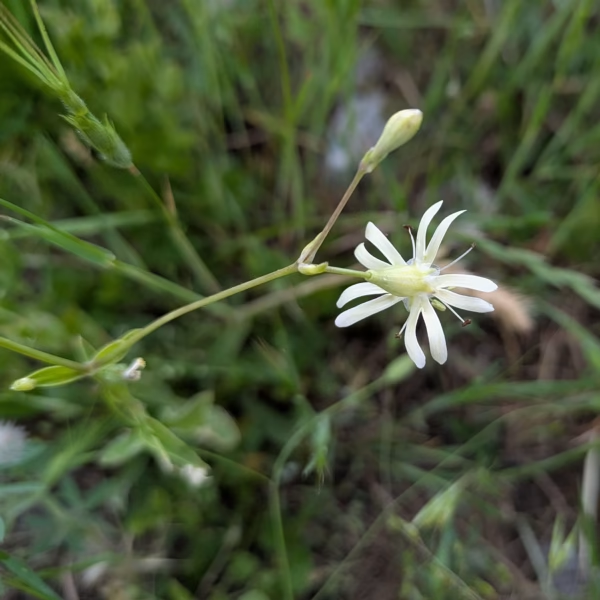
- Inflorescence Structure: The inflorescence is a large, lax and openly branched panicle, frequently with long spreading branches. The lateral branches usually terminate in several-flowered dichasia, and the apparent terminal flower can be overtopped by branches arising from the axils of the two subtending bracts. This open architecture contrasts with densely crowded flower clusters and with species bearing predominantly solitary or paired flowers. Young inflorescences are narrower and should not be assessed before the lateral branches have expanded.
- Bracts and Bracteoles: Bracts resemble reduced upper stem leaves and become progressively smaller towards the ends of the branches. They are generally lanceolate and lack the broad, strongly scarious form found in some other Caryophyllaceae. Bracts are a supporting feature rather than a primary field character.
- Pedicels: The flower stalks are usually short to approximately as long as the calyx and may become deflexed when the flower matures. Published descriptions differ slightly concerning the presence of fine hairs, probably because indumentum varies with position and maturity. Pedicel posture is therefore useful only in combination with the nodding mature flowers, open panicle and clavate fruiting calyx.
- Calyx Length: The calyx is normally 10–12 mm long. This measurement helps separate the species from small annual taxa with substantially shorter calyces and from robust taxa possessing longer floral tubes. Measurements should be made from the base of the calyx to the tips of the teeth and should not include the pedicel or anthophore.
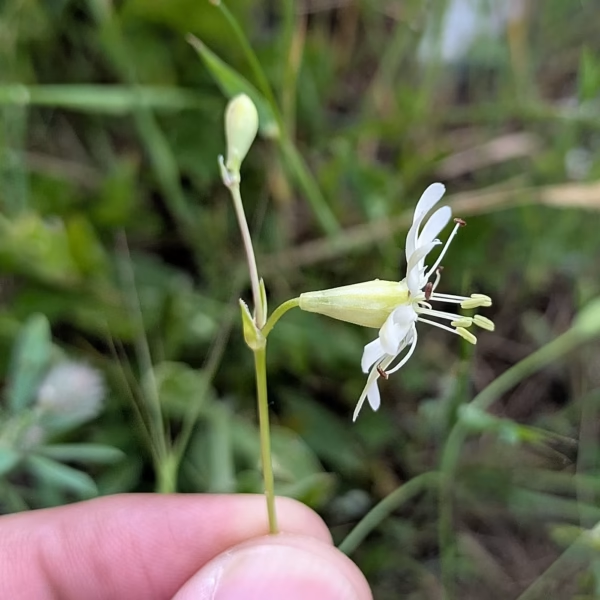
- Calyx Shape: During flowering, the calyx is cylindrical to narrowly obconical and tapers towards its base. During fruiting it becomes clavate, slightly turbinate or weakly pear-shaped, often with a visible constriction immediately beneath the capsule. It never becomes the broad, bladder-like structure characteristic of S. vulgaris. This fruiting transformation is an especially useful feature when petals have already fallen.
- Calyx Surface: The calyx is glabrous, distinctly striate and membranous between its ten green nerves. This separates it from Cypriot species with pubescent, glandular or densely hairy calyces. A glabrous calyx also occurs in other taxa, so the feature must be combined with its 10–12 mm length, clavate fruiting shape, ciliate teeth and the long bifid white petals.
- Calyx Venation: Ten longitudinal nerves are visible. In eastern Mediterranean Silene, both the number of veins and whether they join through cross-connections can have taxonomic importance. S. longipetala possesses a clearly ten-nerved calyx, whereas species with a substantially greater number of nerves or strongly different venation are excluded. The veins are most readily examined on a mature but still green calyx held against transmitted light.
- Calyx Teeth: The five teeth are triangular to broadly ovate, approximately 2–2.5 mm long, and have white or pale ciliate margins. They are not extremely long, sharply spine-like or disproportionately enlarged. The modest teeth help distinguish the plant from taxa such as S. macrodonta and S. tridentata, whose names themselves refer to conspicuous dental or tooth-like structures. Because the marginal hairs can wear away, several flowers should be examined.
- Petal Number and Colour: There are five petals. They are typically white on the inner surface and greenish-white externally, although broader regional descriptions allow pinkish or dull-coloured variation. The usual pale colour separates flowering plants from many of the island’s rose- or reddish-petalled annual taxa, including typical forms of S. colorata, S. gallica, S. rubella and S. laevigata. Nevertheless, colour is never sufficient because pale forms occur in several species and old petals fade.
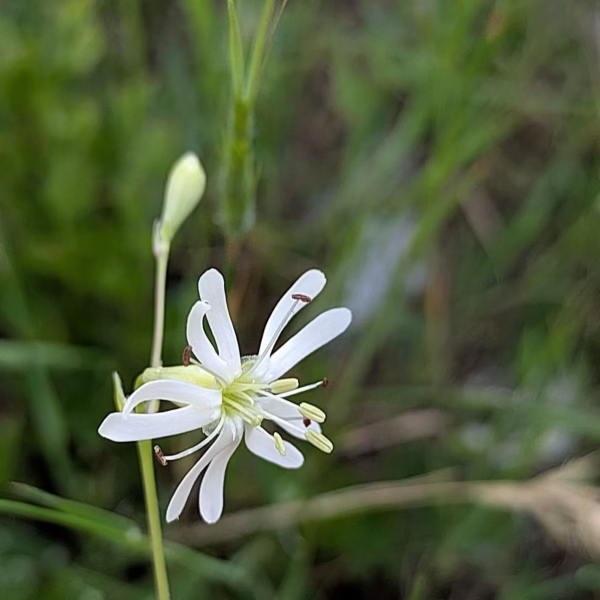
- Petal Limb: The limb is approximately 13–14 mm long and is divided for about two-thirds of its length, sometimes almost to its base. Each petal therefore forms two elongated lobes. The division is much deeper than a shallow notch and produces a visibly delicate flower with narrow spreading segments.
- Petal Lobes: The two lobes of each petal are linear to linear-oblong and often strongly incurved at their tips. This is the feature most immediately suggested by the epithet longipetala. Several other Cypriot species have bifid petals, including perennial and annual taxa, but they do not share the entire combination of long linear lobes, a glabrous clavate calyx, a pubescent anthophore and the characteristic stem indumentum.
- Petal Claw: The narrow claw is approximately 7–8 mm long, finely hairy and equipped with small auricle-like expansions. This hidden character is highly valuable in difficult specimens. It helps separate superficially similar white-flowered material from taxa whose claws are glabrous, differently proportioned or lack the same basal structures.
- Coronal Scales: Two small appendages occur where each petal limb meets its claw. These coronal scales are white, oblong to triangular-ovate and relatively inconspicuous. They are not large enough to form the conspicuous crown visible in some other Silene species.
- Stamens and Filaments: The flower contains ten stamens. Five may project more prominently while the remainder are included or only slightly exserted. Most importantly, the filaments are ciliate or hairy towards their bases. This concealed character is significant in the botanical separation of related groups and should be inspected in a fresh flower with a hand lens.
- Anthophore: The anthophore—the internal stalk between the base of the calyx and the reproductive structures—is approximately 2–4 mm long and pubescent. Anthophore length varies significantly among Silene taxa and is an important confirmation character. It cannot be assessed accurately without opening the calyx longitudinally.
- Ovary and Styles: The ovary is superior and oblong, while the flower normally carries three styles that are hairy near their bases. Three styles are common within Silene, so their number confirms generic placement more effectively than species identity. The basal hairs provide additional support when combined with the hairy staminal filaments.
- Capsule: The mature capsule is ovoid to conical and approximately 6–9 mm long, sometimes reaching 10 mm. It remains enclosed by the calyx or projects beyond it by only about 1 mm. Cypriot taxa whose capsules conspicuously exceed their calyces are therefore excluded. Only mature fruit should be measured, because an immature ovary produces a misleading calyx-to-fruit ratio.
- Seed Shape: Seeds are approximately reniform. Kidney-shaped seeds occur in numerous members of the genus, and seed outline alone is not diagnostic. Surface sculpture, the form of the dorsal groove, marginal wings and the shape of individual testa cells can provide additional evidence under magnification, especially where incomplete specimens have lost their petals.
- Essential Diagnostic Combination: A confident identification should demonstrate a persistent woody stock; retrorsely hairy lower stems; nearly glabrous, sticky upper stems; petiolate puberulent basal leaves; an open branched panicle; a glabrous, ten-nerved, 10–12 mm calyx that becomes clavate in fruit; ciliate calyx teeth; long white petals divided deeply into narrow lobes; hairy claws and filaments; a short pubescent anthophore; and a capsule remaining within or only barely exceeding the calyx. A specimen missing several of these features should remain provisionally identified until flowers or mature fruit can be examined.
Additional Identification Characteristics
Kemal Yıldız’s comparative morphological study of eastern Mediterranean and northern Cypriot Silene demonstrates that calyx length, calyx indumentum, venation, petal appendages, anthophore length and seed sculpture are among the most reliable characters in the genus. The study also illustrates why photographic identification based only on colour and overall habit is unsafe: unrelated species can converge on a similar pink or white flower, while closely related taxa may differ in structures hidden inside the calyx.
When examining a possible specimen, first determine whether a persistent woody stock is present. Next, check the direction of the lower stem hairs and whether the upper inflorescence is sticky. Measure the calyx and confirm that it is glabrous and ten-nerved. Finally, open one mature flower to examine the hairy petal claws, filament bases and short pubescent anthophore. This sequence avoids placing too much importance on petals that may be damaged, faded or absent.
Geographical Distribution and Habitat of Silene longipetala
The accepted native range published by the Royal Botanic Gardens, Kew extends from eastern Greece through Cyprus, Türkiye and the Levant to Iraq, southwestern Iran and Egypt. POWO lists Cyprus, Egypt, Greece, Iran, Iraq, Lebanon–Syria, Palestine and Türkiye as native territories and treats Algeria as an introduced occurrence. This distribution places the species primarily within the eastern Mediterranean and western Asian floristic regions rather than identifying it as a plant restricted to Cyprus. Across this extensive range it is reported from open woodland, field margins, rocky slopes and other comparatively open habitats. Regional treatments should not be merged uncritically: the broad altitudinal limits reported from Iraq and western Asia do not represent the documented elevation range on Cyprus.
Distribution in Cyprus
In Cyprus, Silene longipetala is indigenous and comparatively widespread. It is not one of the island’s narrowly localised endemic campions. Cyprus-specific observations record it in open pine forest, open rocky ground and related habitats on both igneous and calcareous substrates. This geological flexibility allows it to occur in environmentally different parts of the island: igneous soils derived from the Troodos ophiolite differ substantially in mineral composition and drainage from the limestone and chalk formations found elsewhere. Its presence across both substrate classes is therefore ecologically informative and distinguishes it from Cypriot plants with strict serpentine, volcanic or limestone specialisation.
The description “common in Cyprus” should not be interpreted as meaning that it occurs continuously throughout every district or in every apparently suitable habitat. Plant distributions are naturally patchy, and local populations can disappear through road widening, development, intensive vegetation clearance, repeated cutting before seed set or changes in woodland structure. Precise locality records should be interpreted through herbarium specimens and verified observations rather than extrapolated from the species’ general national presence.
Elevation Range in Cyprus
The verified Cyprus-specific altitudinal range is approximately 100–1,700 metres above sea level. This broad span takes the species from relatively low, warm environments into montane habitats where flowering and fruiting occur later. Kew’s regional account based on the Flora of Iraq gives an elevation range of 500–2,600 metres, but those figures apply to the wider treatment and should not be presented as Cypriot measurements.
Flowering Period in Cyprus
Flowering in Cyprus is recorded from March to July. Plants at lower elevations may begin flowering during early spring, while populations in cooler mountain habitats can retain flowers into summer. The flowering period should be understood as a national range rather than a promise that every population flowers for five consecutive months. Rainfall, temperature, exposure, grazing and elevation can substantially shorten or shift the season at an individual locality.
After pollination, the petals wither and the calyx changes from its flowering form into a more clavate or weakly pear-shaped fruiting structure. Capsules mature principally towards late spring and summer. Fruiting material remains highly useful for identification because the calyx shape, capsule length, anthophore and seeds can still be examined after the petals have disappeared.
Conservation Status in Cyprus
Silene longipetala is not assigned a threatened category in the 2007 Red Book of the Flora of Cyprus. It should not therefore be labelled Vulnerable, Endangered or Critically Endangered under that publication. Equally, absence from the Red Book must not be rewritten as a formal “Least Concern” assessment: a taxon that was not included has not necessarily undergone and passed a complete regional IUCN assessment. The most accurate formulation is that the species has no published threat category in the 2007 Cyprus Red Data Book and is described by Cyprus-specific botanical sources as common.
Its wider geographical range, ability to inhabit more than one geological substrate and relatively broad Cypriot elevation range reduce some of the vulnerability associated with a single-site endemic. Nevertheless, individual populations remain exposed to habitat loss, careless road and forestry operations, fire-management changes and illegal or excessive collection. Common native plants also contribute to ecosystem function and should not be removed simply because they lack a formal threatened status.
Is Silene longipetala Suitable for Gardens?
The species has potential value in Mediterranean rock gardens, dry naturalistic borders and native-plant collections because it is perennial, carries elegant divided flowers and naturally tolerates rocky, well-drained ground. A successful planting would probably require strong drainage, ample light or open woodland conditions, modest irrigation and avoidance of constantly wet, rich soil. Its occurrence on both igneous and calcareous substrates suggests a degree of geological tolerance, but this does not prove that it will accept every commercial potting mix or irrigation regime.
No dependable international retail source offering authenticated seed or nursery-grown plants was located during this research. Generic packets labelled simply “Silene” may contain unrelated ornamental species and should not be represented as this taxon. Wild plants should never be uprooted for garden use; established perennial specimens may die during transplantation, and their removal damages the source population.
Seed collection must comply with land ownership, protected-area regulations and Cyprus conservation legislation. The national nature law provides a framework for the protection of wild flora and natural habitats, while stricter controls may operate inside state forests, nature reserves and Natura 2000 sites. The responsible horticultural route is legally collected conservation material or propagated stock supplied with reliable provenance, not collection from a convenient wild population.
Toxicity and Safety
No authoritative clinical or veterinary source was found that classifies Silene longipetala as a confirmed poisonous plant. However, no species-specific safety assessment was found that demonstrates it is suitable for human consumption, animal fodder, herbal preparations or repeated skin exposure either. The absence of recorded poisoning does not establish safety, particularly for a wild plant that has received little toxicological study.
The genus Silene is chemically diverse. A recent peer-reviewed genus review reports triterpenoid saponins, phytoecdysteroids, flavonoids, anthocyanidins, terpenoids and sterols from different species. Saponins are particularly relevant to safety because their biological activity depends on chemical structure, concentration, preparation and route of exposure. Laboratory research on a saponin-enriched fraction from S. vulgaris has examined haemolytic and cytotoxic effects, demonstrating that biologically active compounds in one member of the genus cannot be dismissed as harmless.
These findings do not prove that Silene longipetala contains the same compounds in the same concentrations, and they must not be used to claim that this species is toxic. They instead establish why safety cannot be inferred from appearance, family membership or the edible use of another taxon. Closely related species can differ significantly in their chemistry, while roots, leaves, flowers and seeds may also have different chemical profiles.
Until authenticated plant material has undergone species-specific chemical and toxicological evaluation, the plant should be treated as not established as edible. It should not be used in homemade teas, extracts, tinctures, powders or medicinal preparations. Children and domestic animals should not be encouraged to ingest it. Normal incidental contact during photography or gardening is unlikely to resemble concentrated exposure, but hands should still be washed after prolonged handling and before eating or touching the eyes.
Pregnant or breastfeeding people, children, individuals with liver or kidney disease and anyone taking prescription medication should not experiment with preparations derived from this plant. If ingestion is followed by vomiting, abdominal discomfort, dizziness, breathing difficulty, unusual weakness or another concerning symptom, medical or veterinary advice should be sought promptly. A photograph and, where safe, a sample retained away from further contact may assist professional identification.
Medicinal Properties
No peer-reviewed pharmacological or clinical study was located that demonstrates a medicinal effect specifically for Silene longipetala. There is no verified therapeutic dose, standardised extract, established preparation method, clinical indication, contraindication profile or evidence-based interaction information. The species should therefore not be described as a medicinal plant on the basis of current evidence.
Research Concerning the Wider Genus
The authors of the peer-reviewed genus review describe Silene as phytochemically rich and summarise reports of antimicrobial, antifungal, antiviral, antioxidant, cytotoxic, immunomodulatory, adaptogenic and actoprotective activity from selected species or isolated constituents. These findings are scientifically interesting because they identify chemical classes and biological mechanisms worthy of further investigation. They do not demonstrate that an untested member of the genus produces the same activity.
Statements such as “Silene has antioxidant activity” can become misleading when converted into “this plant is an antioxidant medicine”. Experimental activity may have been observed only in a laboratory assay, at a concentration impossible to achieve safely in humans, or in a compound purified from a different species. A result from cultured cells is not equivalent to a demonstrated treatment in animals or humans, and even a genuine pharmacological effect does not establish safety.
Evidence Required Before Medicinal Use
A credible medicinal assessment would first require authenticated specimens supported by a herbarium voucher. Researchers would then need to determine which compounds occur in the Cypriot material, how concentrations change between plant organs and seasons, and whether extracts show reproducible biological activity. Toxicity, metabolism, dose response and potential interactions would have to be studied before any clinical investigation. Without these steps, medicinal recommendations would rest on analogy rather than evidence.
Traditional use can sometimes provide a valuable starting point for pharmacological research, but no well-documented Cypriot ethnomedical use was located for this species. It would be inappropriate to transfer uses associated with S. vulgaris, S. capensis or another member of the genus merely because they share a generic name. The scientifically responsible conclusion is that medicinal properties remain unestablished.
Fascinating Insights About “Silene longipetala”
Its Botanical Description Dates to 1802
Étienne Pierre Ventenat formally published the species in 1802 in Description des plantes nouvelles et peu connues, cultivées dans le jardin de J. M. Cels. The treatment appeared with plate 83, providing an early illustrated basis for recognising the plant. The original nomenclatural publication is documented by the authoritative IPNI record. More than two centuries later, Silene longipetala remains the accepted name used by Kew, although several independently described plants have subsequently been placed within the same species as heterotypic synonyms.
Five Petals Create the Appearance of Ten
A frontal view can make the flower appear to possess ten long petals. In reality, it has five. Each petal limb is divided deeply into two narrow lobes, producing ten visible segments around the reproductive centre. The narrow lobes may also curve inward at their tips, giving individual flowers a delicate and variable outline. This configuration is both ornamental and diagnostically important, but it must be combined with hidden characters such as the hairy claws and filaments.
The Sticky Stems Do Not Make It Carnivorous
The flowering stems may be sticky enough to impede or occasionally trap small crawling insects. This characteristic helps explain the general name “catchfly” applied to many species of Silene. There is no evidence that the plant digests insects or absorbs substantial nutrition from their bodies. The sticky surface is better interpreted as a physical defence that can discourage ants and other crawling visitors from reaching flowers, pollen or developing fruit without contributing to pollination.
It Crosses a Remarkable Ecological Range in Cyprus
Its occurrence from roughly 100 to 1,700 metres means that different Cypriot populations experience markedly different climates. A low-elevation population may encounter hotter summers, shorter periods of soil moisture and earlier flowering, while a mountain population develops under cooler conditions and may flower months later. The ability to occur on both igneous and calcareous ground further broadens this ecological amplitude. Despite such environmental variation, the essential floral structures used for identification remain comparatively stable.
Cyprus Forms Part of a Wider Eastern Mediterranean Range
The species is native to Cyprus without being confined to it. Kew’s distribution record traces its native range from eastern Greece and Cyprus through Türkiye and the Levant to Iraq, southwestern Iran and Egypt. This pattern reflects Cyprus’s biogeographical position between Europe, North Africa and western Asia. The plant is therefore simultaneously part of the native Cypriot flora and part of a much broader eastern Mediterranean botanical history.