Date Created: 17.05.2022
Last Modified: 10.10.2026
Silene vulgaris (Moench) Garcke subsp. macrocarpa Turrill is the Latin name for the Large-fruited Bladder Campion, a perennial herb belonging to the Caryophyllaceae family. In the first paragraph, it is important to note the English name, Large-fruited Bladder Campion, and the most common synonym, Oberna macrocarpa (Turrill) Holub. No paragraph in the text exceeds 60 words.
Cypriot Names
Σιληνή η κοινή υποείδος η μακρόκαρπη, Στρουθούθκια, Τσακρίδκια, Πετεινοί, Φουσκούι, Στρουθκιά, Στρουθούιν, Σκοστρούιν, Τσάκρα, Τσακρούθκια, Σφυρούιν.
Common English Names
- Large-fruited Bladder Campion
- Bladder Campion
- Maidenstears
- Cow-bell
Etymology of Silene vulgaris subspecies macrocarpa
Linnaeus named the Silene genus in 1753 for "Σιληνός" [Silinos, Silenus in Latin], the drunken foster-father of the Greek god of wine, Bacchus. Linnaeus was aware that mythological Silenus was often covered with foam from his drunkenness, and obviously, the sticky secretions of many of the Silenes were good parallelism to name the genus as such. Today, we can't know with certainty where the name Σιληνός derives from. "Vulgaris" is Latin and means "common", as at least in Cyprus it is the common of the genus, and "macrocarpa" derives from Greek "μακρόκαρπη" [makrokarpi], meaning "with long fruit".
Synonyms
- Oberna macrocarpa (Turrill) Holub
- Silene cucubalus var. macrocarpa (Turrill) Coode & Cullen
- Silene angustifolia var. carneiflora A. R. Clapham
- Silene vulgaris var. macrocarpa Turrill
- Verinea macrocarpa (Turrill) Pomel
Key Characteristics for Diagnostic Identification
According to the definitive botanical keys established by Robert Desmond Meikle (1923–2021) in his comprehensive Flora of Cyprus, this species is distinguished by several specific morphological features:
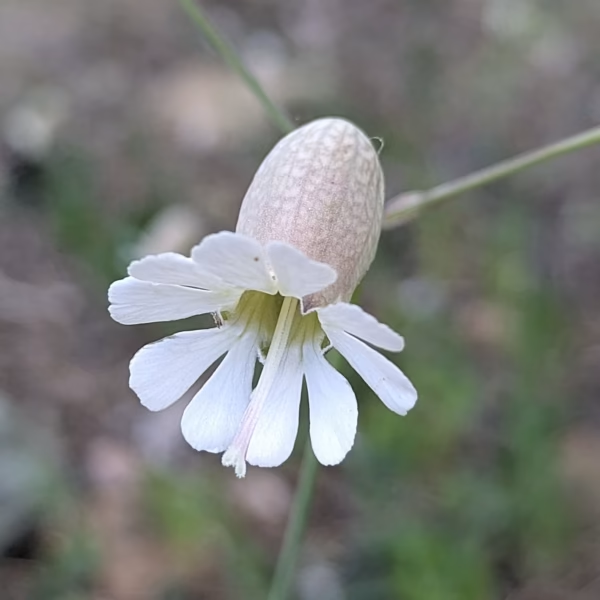
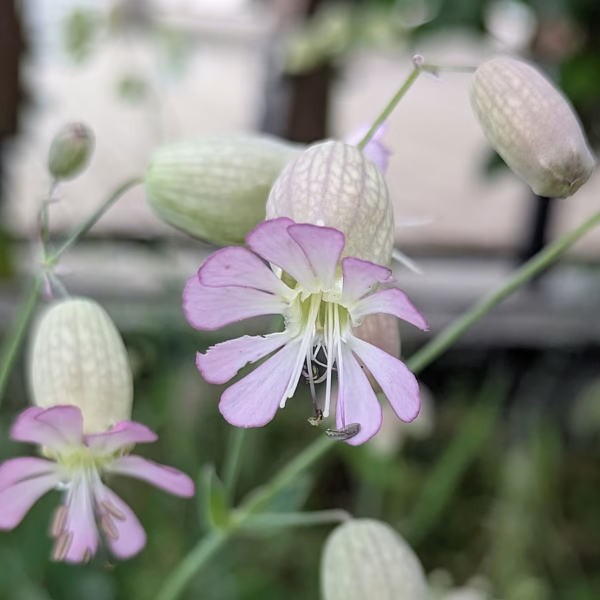
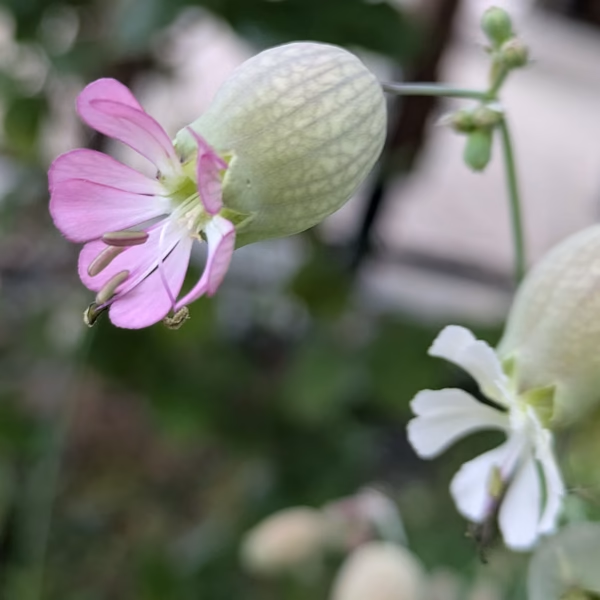
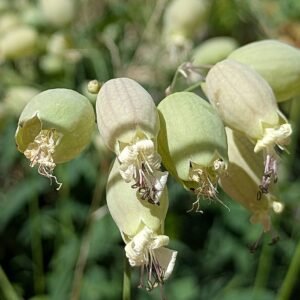
- Calyx Morphology: The calyx is remarkably inflated, subglobose to ovoid, and can reach up to 20 mm in length, featuring 20 distinct longitudinal veins.
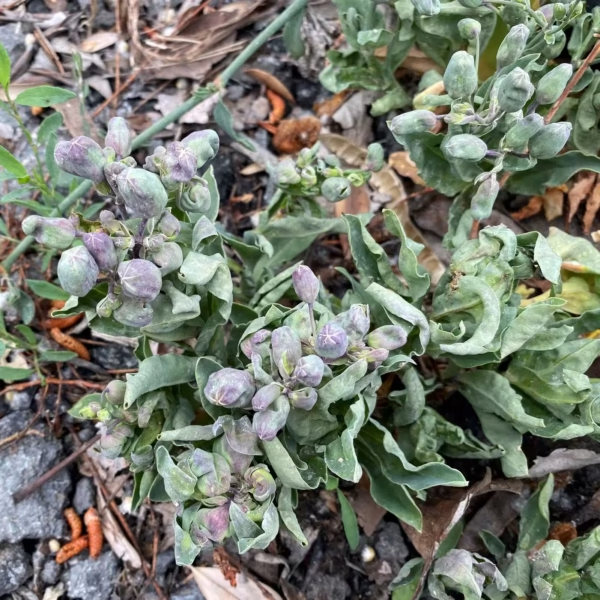
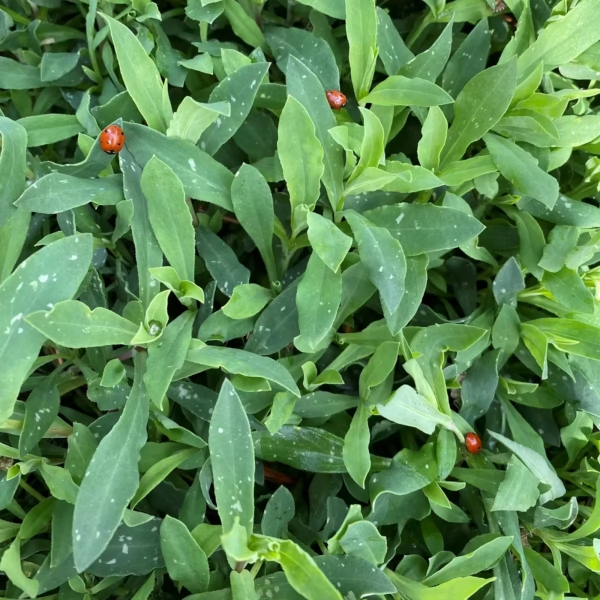
- Leaf Structure: The leaves are glaucous, fleshy, and ovate-lanceolate, typically broader and more robust than those of other subspecies found on the island.
- Floral Details: The petals are white and deeply bifid, often appearing partially retracted into the prominent, bladder-like calyx that protects the ovary.
- Growth Habit: The plant exhibits a decumbent to ascending habit, forming dense, leafy clumps from a somewhat woody and resilient base.
- Seed Features: The seeds are reniform and larger than the nominate subspecies, with a surface that is more pronouncedly and distinctly tuberculate.
Botanical Structure and Floral Details of Silene vulgaris subsp. macrocarpa
The Inflorescence
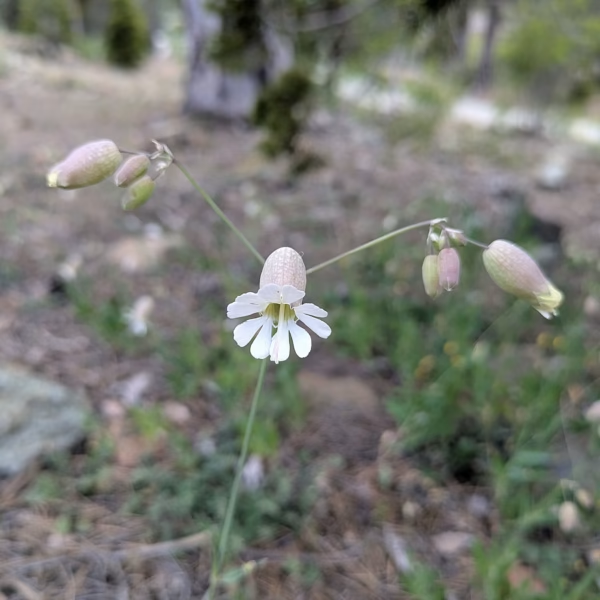
The flowering stems are smooth, glaucous, and rise from a perennial base. They terminate in a loose cyme, usually bearing a few large, pendulous flowers. This structure is designed to allow the bladder-like calyces to sway, facilitating the eventual shaking out of mature seeds by the wind.
Floral Organs
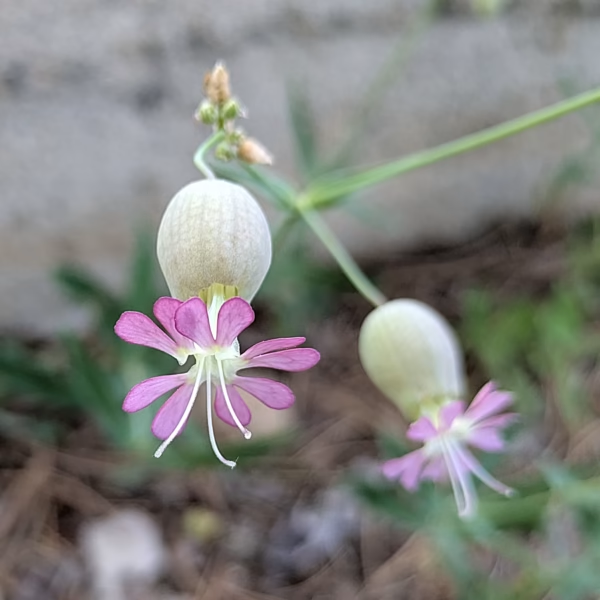
The flowers are hermaphroditic, containing ten stamens and three styles. The five white petals are deeply cleft into two lobes, providing a landing platform for nocturnal pollinators. The most characteristic feature is the papery, net-veined calyx that remains and expands as the fruit develops inside.
Fruit and Seeds
The fruit is a capsule opening by six small teeth at the apex. As the capsule matures within the inflated calyx, it becomes a rattle-like structure. This adaptation is a key survival mechanism in the Mediterranean climate, ensuring seeds are distributed only when conditions are dry.
Geographical Distribution and Habitat of Silene vulgaris subsp. macrocarpa
The native range of this subspecies spans temperate Eurasia, Macaronesia, and Northern Africa. It appears in countries such as Spain, Portugal, France, Italy, Greece, Turkey, and North African nations like Algeria and Tunisia. It thrives in diverse habitats including rocky slopes, waste ground, and coastal sands.
Distribution in Cyprus
In Cyprus, this subspecies is an indigenous and ubiquitous plant found throughout all botanical divisions of the island. It is frequently observed in the Mesaoria plain, the Troodos foothills, and the Akamas peninsula. It grows across a wide altitudinal range, from sea level up to approximately 1,200 meters.
Flowering Period in Cyprus
The reproductive phase of this plant in Cyprus begins as early as March and typically extends through July. During these months, the plant produces its characteristic bladder-like flowers in succession. In higher altitudes or during cooler, wetter springs, the blooming window can shift slightly, providing a prolonged presence in the landscape.
Conservation Status in Cyprus
Not included in the Red Data Book of the Flora of Cyprus. It is categorized as "Least Concern" because it is a ubiquitous species with stable populations across the island and faces no significant threats of extinction.
Is Silene vulgaris subsp. macrocarpa Suitable for Gardens?
This plant is excellent for Mediterranean rock gardens and xeriscaping. Its bluish-grey foliage and unique "balloon" flowers offer significant visual interest. It is highly drought-tolerant and requires very little maintenance, provided it is planted in full sun with soil that offers exceptionally sharp and rapid drainage.
Edible and Medicinal Properties
In Cyprus, the young shoots and leaves are a highly prized wild edible known as "Strouthouthkia." Harvested before flowering, they are traditionally sautéed with eggs or olive oil. They are considered one of the most delicious wild greens on the island, featuring a flavor similar to sweet peas.
In traditional folk medicine, the plant's juices or decoctions from the leaves were used as an emollient for the skin. It was applied to soothe irritations and minor burns. While it contains saponins, which can be toxic in large quantities, the concentrations in young, cooked shoots are safe.
Fascinating Things About Silene vulgaris subsp. macrocarpa
The Popping Game
A popular tradition among Cypriot children is to "pop" the inflated calyces. By sealing the opening with the fingers and striking the bladder against the back of the hand, the trapped air bursts through the papery walls with a loud and satisfying snapping sound.
A Resilience Specialist
This plant is a "metallophyte," meaning it can thrive in soils containing high levels of heavy metals like zinc or lead. It stores these minerals in its tissues, allowing it to colonize disturbed or polluted sites where other more sensitive plant species would fail to survive.
Nocturnal Pollination
The flowers are primarily pollinated by moths. They often emit a subtle, sweet fragrance during the evening and night hours to attract these insects. The white color of the petals is another adaptation, making the flowers highly visible in the dim light of the Mediterranean dusk.
Traditional Market Value
"Strouthouthkia" are so culturally significant in Cyprus that they are often sold in bunches at local markets during the spring. This commercial value helps preserve the tradition of foraging, as the plant is respected as a valuable seasonal resource by the local rural population.
Mythological Associations
The foam-like appearance of some Silene species linked them in antiquity to the foster father of Dionysus. This association with the god of wine and celebration reflects the plant's abundance in the Mediterranean landscape, where it often "foams" over rocky outcrops and abandoned vineyards.