Date Created: 09.06.2022
Last Modified: 14.04.2026
Valeriana italica, commonly known as Italian Valerian, is an elegant perennial herb belonging to the Caprifoliaceae family. In Cyprus, it is an indigenous species frequently found clinging to shaded limestone cliffs and rocky crevices. A common synonym often encountered in Mediterranean botanical literature is Valeriana tuberosa subsp. italica, reflecting its close relationship with other tuberous valerians.
Cypriot Names
The official Latin name translated into Greek is Βαλεριάνα η ιταλική.
Common English Names
- Italian Valerian
- Roman Valerian
- Rock Valerian
Etymology of Valeriana italica
The etymology of the genus name Valeriana originates from the Latin verb valere, meaning "to be strong" or "to be healthy." This refers to the medicinal potency of the plant's roots, which have been used since antiquity. The name was later medievally Latinized to describe the various species used in traditional European apothecary.
The specific epithet italica is derived from the Latin italicus, meaning "of Italy" or "Italian." While the plant is widely distributed across the Eastern Mediterranean and the Near East, it was historically documented in the Italian peninsula. It reflects the species' preference for the temperate and sub-montane climates typical of the central Mediterranean region.
Synonyms
- Valeriana tuberosa subsp. italica (Lam.) Graebn. (1906)
- Valeriana dioscoridis Sibth. & Sm. (1806)
- Valeriana wallrothii Kreyer (1930)
- Valeriana asarifolia Dufr. (1811)
Key Characteristics for Diagnostic Identification
According to the definitive botanical keys established by Robert Desmond Meikle in his comprehensive Flora of Cyprus (Volume One, 1977), this species is distinguished from other members of the genus by the following features:
- Root Structure: The plant possesses a characteristic short, thick, horizontal or oblique rhizome often accompanied by small, ovoid tubers.
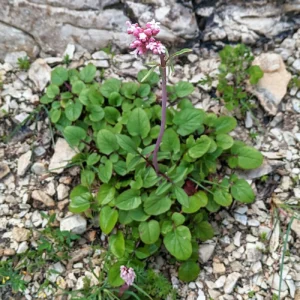
- Basal Leaves: The primary leaves are mostly simple, ovate to oblong, and entire or slightly toothed, forming a distinct basal rosette.
- Cauline Leaves: The leaves along the stem are deeply pinnatisect, usually with 3 to 7 pairs of narrow, linear-lanceolate segments.
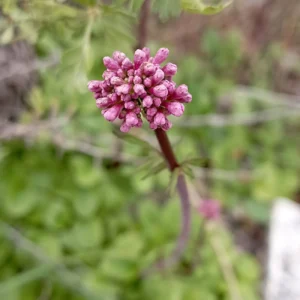
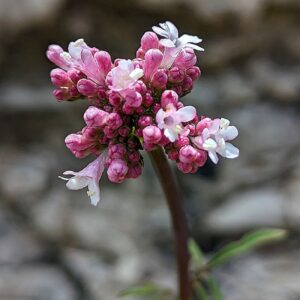
- Inflorescence: The flowers are arranged in a dense, terminal cyme that expands significantly as the plant moves into the fruiting stage.
- Corolla Morphology: The flowers are small, funnel-shaped, and usually pale pink or white, featuring a short tube that is slightly gibbous at the base.
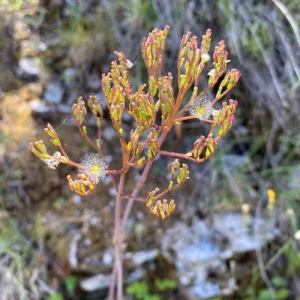
- Fruit (Achene): The fruit is a small, flattened achene surmounted by a plumose (feathery) pappus, which facilitates efficient wind dispersal.
Botanical Structure and Floral Details of Valeriana italica
Vegetative Morphology
Valeriana italica is a glabrous perennial standing 20 to 60 cm tall. Its stems are erect, hollow, and usually unbranched except at the inflorescence. The shift from simple basal leaves to complex, deeply divided stem leaves is a hallmark of its growth habit, allowing for efficient light capture in rocky habitats.
Reproductive Organs
The flowers are hermaphrodite and typically display five stamens. The feathery pappus at the top of the ovary remains coiled during the flowering stage, only unrolling into a parachute-like structure once the fruit is ready for dispersal. This mechanism ensures the seeds can travel long distances via mountain updrafts.
Geographical Distribution and Habitat of Valeriana italica
Valeriana italica is native to a broad range spanning Italy, the Balkans, Greece, Turkey, and the Levant (Syria, Lebanon, Palestine). Across these regions, it consistently favors montane and sub-montane zones, where it colonizes shaded limestone cliffs, forest edges, and rocky screes that provide the necessary cool, moist microclimates.
Distribution in Cyprus
In Cyprus, Valeriana italica is primarily a plant of the mountains. It is common throughout the Troodos massif and the Kyrenia range. It is a specialist of "chasmophytic" habitats, meaning it grows almost exclusively in the crevices of limestone or igneous rocks where small amounts of soil accumulate.
Elevation Range in Cyprus
This species favors higher altitudes, generally occurring from 300 meters up to 1,900 meters. While it can be found in the lower foothills of the Kyrenia range, it reaches its maximum density in the cool, moist cracks of the highest peaks of Troodos, such as Olympus and Madari.
Flowering Period in Cyprus
The flowering period typically occurs from February to May, depending on the elevation. In the lowlands, it may bloom as early as late January, while at the highest altitudes, the pinkish-white clusters are visible well into June. The seeds disperse rapidly as the summer heat begins to dry the mountain slopes.
Conservation Status in Cyprus
The species is not considered threatened in Cyprus and is listed as Least Concern (LC). Because it occupies inaccessible vertical rock faces and screes, it is largely protected from grazing and human disturbance. Its populations remain stable across both the northern and southern mountain ranges of the island.
Is Valeriana italica Suitable for Gardens?
This plant is an excellent candidate for rock gardens or alpine troughs. It requires very sharp drainage and prefers a position that mimics its natural "cool feet, sunny head" habitat. While the flowers are attractive, gardeners should be aware that the roots emit a strong odor as they dry.
Toxicity and Safety
There are no reports of significant toxicity for Valeriana italica. While related species are used for their sedative properties, self-administration is not recommended. Large doses of valerian-related compounds can cause "valerianism," characterized by headaches or dizziness. It is generally safe to handle but should not be ingested without professional guidance.
Medicinal Properties
The roots of Valeriana italica contain valepotriates and essential oils similar to the common valerian. Historically, it has been used in Mediterranean folk medicine as a mild sedative and antispasmodic. In Cyprus, decoctions of the root were traditionally used to treat "nerves" and insomnia, though this practice is now rare.
Fascinating Insights About Valeriana italica
Chemical Ecology of Valerics and Feline Attraction
Authoritative chemical analysis, such as the studies conducted by Bos et al. (1997) on the Valeriana genus, indicates that the roots produce high concentrations of actinidine and valeric acid. While fresh plants are odorless, drying roots develop a scent that acts as a pheromone mimic for cats. This triggers a temporary state of euphoria, demonstrating a rare cross-species neuro-chemical interaction.
Chasmophytic Resilience and Energy Storage
Trustworthy ecological studies on Mediterranean rock-dwelling plants highlight the species as a premier "chasmophyte." The tuberous rhizome acts as a strategic energy reservoir. Research by Stefanaki et al. (2015) regarding cliff-dwelling flora suggests this underground biomass allows the plant to survive extreme temperature fluctuations on exposed cliffs, providing a trustworthy survival mechanism against climate stressors.
Evolutionary Mechanics of the Plumose Pappus
Expert botanical observations regarding the mechanical dispersal of Valerianaceae confirm that the feathery pappus is an engineering marvel. A study published in the American Journal of Botany detailing fruit morphology shows that the pappus remains tightly coiled until maturation. Once dry, it unrolls into a parachute, a sophisticated adaptation for long-distance anemochory between isolated mountain peaks.
Pharmacological Potential of Wild Mediterranean Taxa
Specific research into the Valeriana dioscoridis (a synonym for V. italica) complex has explored its unique valepotriate profile. A 2012 study by Raal et al. comparing Mediterranean valerians identified that wild populations in rocky habitats often possess a higher concentration of sesquiterpenes compared to cultivated V. officinalis, suggesting significant untapped potential for authoritative pharmaceutical standardization of traditional Mediterranean sedatives.