Date Created: 17.05.2026
Last Modified: 17.05.2026
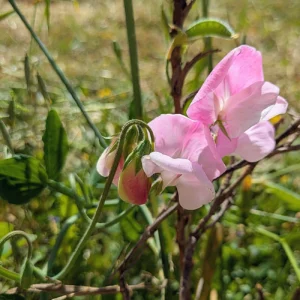
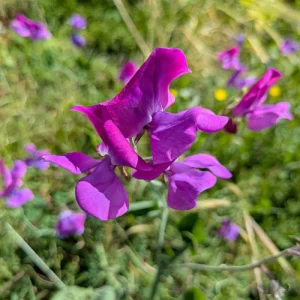
Lathyrus odoratus L., universally known as the Sweet Pea, is a climbing annual herb belonging to the Fabaceae family. Celebrated for its vividly colorful and profoundly fragrant blossoms, this Mediterranean native is commonly grown in gardens across Cyprus and occasionally escapes into neighboring fields, roadsides, and disturbed lowland habitats.
Common Cypriot Names
The formal translation of the botanical name in Modern Greek is Λάθυρος ο εύοσμος [Lathyros-o-evosmos].
Common English Names
- Sweet Pea
- Vetchling
- Fragrant Lathyrus
- Common Sweet Pea
Etymology of Lathyrus odoratus
The etymology of the genus name "Lathyrus" derives from the Ancient Greek "λάθυρος" [lathyros], a term used by Theophrastus for a specific type of pulse or legume plant. "Odoratus" is the neutral Latin for "fragrant" or "sweet-scented," referring directly to the intense, sweet aroma emitted by the blossoms.
Synonyms
- Pisum odoratum (L.) E.H.L.Krause (1901)
Key Characteristics for Diagnostic Identification
According to the definitive botanical keys established by Robert Desmond Meikle in his comprehensive Flora of Cyprus (Volume 1, 1977), this species is distinguished from other taxa of the genus in Cyprus by the below morphological features:
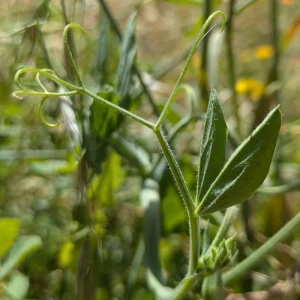
- Leaflet Dimensions and Shape: The leaflets occur in exactly 1 pair, are ovate-elliptic, and measure 2.0–6.0 cm long and 1.5–3.0 cm wide, terminating in a branched tendril. This is unique among Cypriot species; L. aphaca completely lacks leaflets (leaves are reduced to tendrils), while L. ochrus and L. clymenum have petioles modified into broad, leaf-like phyllodes without matching leaflet pairs. All other species, including L. cicera, L. sativus, L. annuus, L. sphaericus, L. inconspicuus, and L. setifolius, possess linear-lanceolate leaflets that are drastically narrower, measuring only 1–5 mm in width. Only L. gorgoni and L. blepharicarpus have elliptic leaflets, but they are smaller and under 1.2 cm broad.
- Flower Corolla Size: The corolla is exceptionally large, with the standard petal measuring 2.5–3.5 cm in diameter and exhibiting an intense fragrance. No other member of the genus in Cyprus approaches this size, as all other native or naturalized species have small standards measuring under 1.5 cm in diameter. Specifically, L. aphaca and L. annuus have yellow corollas under 1.2 cm long, L. ochrus has pale cream flowers under 1.4 cm long, L. cicera and L. setifolius have brick-red or dull crimson petals under 1.0 cm long, and L. saxatilis has minute, pale blue corollas measuring only 4–6 mm long.
- Stem Anatomy: The stems are prominently winged, climbing up to 200 cm, and distinctly pubescent (hairy). While L. sativus and L. ochrus also possess winged stems, their stems are completely glabrous. Conversely, species like L. cicera, L. sphaericus, L. inconspicuus, and L. saxatilis have unwinged or weakly angled stems that are entirely smooth and significantly shorter, reaching only 15–50 cm in height.
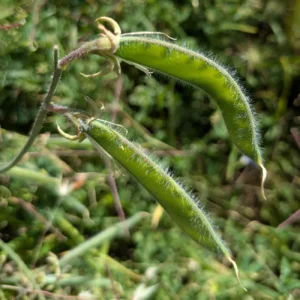
- Pod Texture and Dimensions: The pods are linear-oblong, 5.0–7.5 cm long, 1.0–1.2 cm wide, and densely pubescent across the entire valve surface. This completely separates it from L. sativus, L. ochrus, L. cicera, L. annuus, L. sphaericus, and L. inconspicuus, which all possess entirely glabrous pods. Furthermore, the pods of L. sativus are shorter at 3.0–4.0 cm long and feature distinct dorsal wings, whereas Lathyrus odoratus pods are completely unwinged. While L. blepharicarpus features pod hairs, they are restricted strictly to the margins (ciliate) rather than being uniformly dense.
Additional Identification Characteristics
Modern field guides and monographs highlight the configuration of the calyx lobes; in Lathyrus odoratus, the calyx lobes are uniformly leaf-like, broadly lanceolate, and equal to or longer than the calyx tube. This structure stands in contrast to species like L. clymenum, where the upper calyx teeth are significantly shorter than the lower ones, providing an unambiguous metric during early floral development phases.
Botanical Structure and Floral Details of Lathyrus odoratus
Calyx and Style Anatomy
The calyx is campanulate with five equal, oblong-lanceolate lobes measuring 6–8 mm in length. The style is upcurved, flattened, and distinctly pubescent on its inner face, a structural mechanism that assists in pollen presentation to visiting insects.
Geographical Distribution and Habitat of Lathyrus odoratus
This species is native to southern Italy and Sicily, where it grows in open woodlands, pastures, and scrublands. It has been extensively introduced worldwide as a premier ornamental vine, frequently naturalizing in temperate and Mediterranean eco-zones along field boundaries and waste areas.
Distribution in Cyprus
In Cyprus, it is widely cultivated across all districts. It has been verified as a casual or established garden escape in roadsides, abandoned fields, and edge habitats near human settlements, notably in the Nicosia, Limassol, and Paphos regions.
Elevation Range in Cyprus
This taxon occurs primarily in low- to mid-elevation zones, extending from sea level up to 900 meters above sea level, aligning perfectly with domestic garden distribution and local microclimates.
Flowering Period in Cyprus
The flowering phase of the Sweet Pea on the island is concentrated in spring, running reliably from March to May, after which rising summer heat causes the foliage to wither quickly.
Conservation Status in Cyprus
According to the Red Data Book of the Flora of Cyprus, this species is Not Evaluated (NE) because it is an introduced, naturalized alien rather than a native wild component. Globally, its wild populations are highly restricted, but locally it holds no threatened status.
Is Lathyrus odoratus Suitable for Gardens?
Yes, the Sweet Pea is highly favored for domestic gardens due to its spectacular appearance and perfume. Seeds are abundantly available in the international commercial market. There are no regulatory restrictions or bans on purchasing commercial seeds, making it perfectly legal to grow throughout Cyprus.
Toxicity and Safety
The seeds of Lathyrus odoratus are highly toxic and unsafe for consumption by humans or animals. They contain a dangerous compound known as beta-aminopropionitrile (BAPN). According to a classic toxicological review by Dr. Peter S. Spencer in the Journal of the Royal Society of Medicine, chronic ingestion of these seeds triggers a severe neurological condition called lathyrism.
This condition manifests as neurotoxic damage, muscle weakness, and permanent lower limb paralysis. BAPN acts by inhibiting lysyl oxidase, an enzyme essential for cross-linking collagen and elastin fibers. This disruption impairs structural connective tissues, causing bone deformities and blood vessel weakness, making it vital to keep the plant away from livestock and pets.
Medicinal Properties
Biochemical Research Significance
Due to its high toxicity, Lathyrus odoratus is completely excluded from safe therapeutic use in modern or traditional medicine. However, the plant's toxic compounds hold great value in laboratory environments. A benchmark study by Dr. C.I. Levene (1961) showed that BAPN extracted from this genus provides a critical experimental tool for studying connective tissue disorders.
Experimental Models
Medical researchers utilize these specific molecules to create regulated models of fibrotic disease and tissue remodeling in controlled academic studies. While these applications provide profound insights into human vascular pathology, the plant itself contains no standardized, direct clinical remedies for consumers, and internal usage must be strictly avoided.
Fascinating Insights About Lathyrus odoratus
The True Birthplace of Genetic Linkage
While Gregor Mendel used edible peas for his laws, scientists William Bateson and Reginald Punnett utilized Lathyrus odoratus in 1905 to discover genetic linkage. Their research on flower color and pollen shape provided the first definitive proof that certain genes are inherited together on the same chromosome, fundamentally reshaping modern genetics.
Volatile Chemistry of the Perfume Industry
The legendary aroma of this vine is governed by a precise cocktail of volatile organic compounds. Phytochemical analyses reveal that linalool, phenylacetaldehyde, and methyl salicylate dominate its scent profile. These compounds are highly sought after by perfume manufacturers, who have spent decades attempting to perfectly replicate this fragrance synthetically.