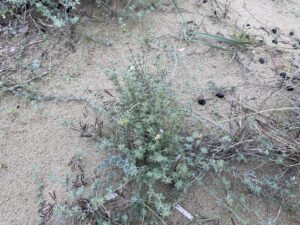
Lotus cytisoides is a perennial known as the Grey Bird’s-foot Trefoil, belonging to the Fabaceae family. Its most common synonym is Lotus creticus subsp. cytisoides. This species is a resilient coastal plant that thrives in the sandy and rocky maritime regions of Cyprus and the wider Mediterranean basin, forming dense, silvery mats.
Cypriot names
Λωτός ο κυτισοειδής, Πουλλοπόδι
Common English Names
- Grey Bird’s-foot Trefoil
- Sea Lotus
Etymology of Lotus cytisoides
The etymology of the genus name Lotus is derived from the Ancient Greek word "Λωτός" [lotos]. The specific epithet "cytisoides" comes from the Ancient Greek "κυτισοειδής" [kytisoides] for "Cytisus-like", from "κύτισος" [kytisos], meaning the genus "Cytisus", and the suffix "-οειδής" [-oides], meaning "in the form of", and refers to the resemblance of this species to those of the genus Cytisus in its large yellow flowers and green stems.
Synonyms of Lotus cytisoides
- Lotus creticus subsp. cytisoides
- Lotus creticus var. cytisoides
- Lotus prostratus subsp. cytisoides
- Lotus allionii
- Lotus glaucus
- Lotus graecus
Key Characteristics for Diagnostic Identification of Lotus cytisoides
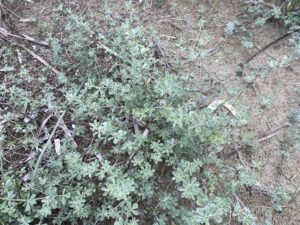
- Perennial herb with a woody rootstock and prostrate or ascending branches.
- Stems and leaves are densely covered in appressed, silvery-silky (sericeous) hairs.
- Leaves are compound, typically with five leaflets; the lower two are stipule-like at the base.
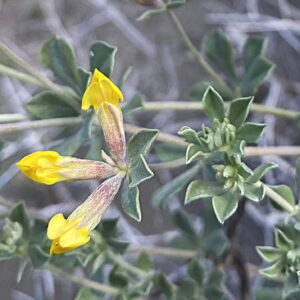
- Inflorescence is umbellate, usually bearing 2 to 6 bright yellow flowers on long peduncles.
- The keel of the flower features a short, curved beak that is often stained purple.
- Calyx teeth are unequal, with the lateral teeth usually shorter than the tube.
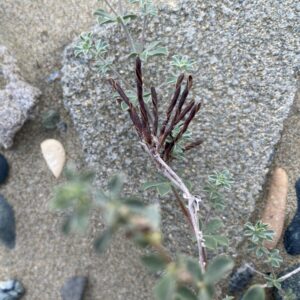
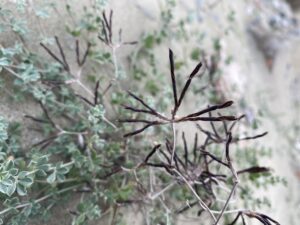
- Seed pods are linear, straight, and cylindrical, resembling a bird's foot when clustered.
Botanical Structure and Floral Details
Growth Form and Foliage
Lotus cytisoides displays a sprawling, mat-forming habit that allows it to tolerate harsh winds. The stems are multiple and slender, growing from a robust, woody rootstock. Its foliage is notably fleshy, providing a water-storage mechanism that is essential for survival in high-salinity coastal environments where fresh water is often scarce.
Floral Mechanics and Pollination
The blooms feature the classic papilionaceous structure with a standard, wings, and a keel. These bright yellow flowers are held on long peduncles, elevating them above the silvery leaves to attract specific pollinators. The purple-stained tip of the keel acts as a visual guide for bees, ensuring efficient pollen transfer during their visits.
Geographical Distribution and Habitat of Lotus cytisoides
Cyprus Locations and Maritime Habitats
In Cyprus, Lotus cytisoides is strictly maritime, occurring along the sandy and rocky shores of the Akamas Peninsula, Karpasia, and the coasts of Paphos and Limassol. It grows just above the high-tide mark, thriving in the salt spray. This specialist habitat allows it to dominate areas where less salt-tolerant species cannot survive.
Is Lotus cytisoides Suitable for Gardens?
This species is highly suitable for coastal gardens or rockeries with well-drained, sandy soil. It requires full sun and very little water once established, making it perfect for xeriscaping. Its silvery-grey foliage provides a stunning year-round visual contrast, though it may struggle in heavy, clay-rich soils that retain too much moisture.
Conservation Status in Cyprus
Lotus cytisoides is currently classified as Least Concern (LC) in Cyprus and is not included in the Red Data Book. While it is widespread along the coastline, its specific maritime habitats are under constant pressure from tourism and urban development.
Medicinal Properties of Lotus cytisoides
Traditional and Folk Applications
Historically, species within this genus have been used in various folk traditions for their astringent and sedative properties. While Lotus cytisoides is not a primary medicinal herb today, extracts from its leaves were sometimes applied to minor skin irritations in coastal communities. Its high flavonoid content suggests potential antioxidant properties that warrant further scientific investigation.
Fascinating Things About Lotus cytisoides
The Bird's Foot Illusion
The most intriguing feature is the arrangement of the seed pods, which cluster at the stem tip. When mature and brown, they radiate outward in a pattern that perfectly mimics the toes of a bird. This morphological quirk provides a fascinating example of how plant structures can resemble animal features, leading to its distinctive local naming.
Reflective Silvery Armor
The dense, silvery hairs on the leaves function as biological "sunscreen." By reflecting a significant portion of incoming solar radiation, these hairs prevent the plant from overheating in the intense Mediterranean sun. Additionally, they create a boundary layer of air that helps reduce transpiration, allowing the plant to conserve water during the hottest summer months.
Symbiotic Nitrogen Fixation
Like other legumes, Lotus cytisoides maintains a symbiotic relationship with Rhizobium bacteria in its root nodules. These microorganisms fix atmospheric nitrogen, converting it into a form the plant can use for growth. This process enriches the surrounding poor, sandy soil, making the habitat more fertile for other coastal plant species over long periods.
Survival in Saline Environments
As a specialized halophyte, Lotus cytisoides has evolved physiological mechanisms to process high levels of salt without tissue damage. It can excrete excess salt through its foliage or store it in older leaves that eventually shed. This remarkable resilience makes it a pioneer species, stabilizing shifting sands and protecting the inland flora from coastal erosion.