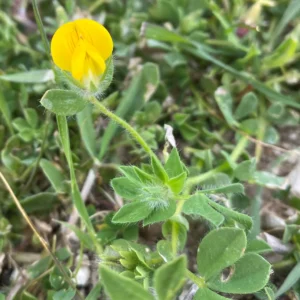
Lotus edulis, a member of the Fabaceae family, is a resilient annual herb perfectly adapted to the salty, sandy coastlines of the Mediterranean. This species typically grows in low-lying cushions, adding a delicate yellow touch to the often-barren sandy beaches where few other plants can survive.
Cypriot names
Λωτός ο εδώδιμος
Common English Names
The primary English name is the Edible Bird's-foot Trefoil, a name derived from the historical use of its young, fleshy pods as a food source. It is also sometimes called the Big-podded Lotus. This Edible Bird's-foot Trefoil is a prominent feature of the Cypriot spring, blanketing coastal fields in bright yellow.
Etymology of Lotus edulis
The etymology of the genus derives from "Λωτός" [lotos], which is the name given to this plant genus by the Ancient Greeks; it possibly derives from Hebrew " לוֹט " [lot], translated as "myrrh", which in the Septuagint is defined as "a form of oil that drips from various trees". "Edulis" is Latin, and it means "edible", referring to its young seedpods that can be eaten raw or cooked.
Synonyms and Taxonomic History
While Lotus edulis is the widely accepted name, taxonomic studies have historically placed this species under various names based on morphological variations. These synonyms highlight the adaptability of the plant's form to specific microhabitats:
- Krokeria edulis
- Lotus edulis var. exscapus
- Lotus edulis var. longisiliquosus
Key Characteristics for Diagnostic Identification - How to Recognize Lotus edulis
According to Meikle, the diagnostic identification of Lotus edulis relies on a specific combination of hair type, stalk length, and fruit girth. These bullet points clarify how it compares specifically to its relatives:
- Unique Succulent Pods: The pods are remarkably thick (up to 10 mm) and fleshy. This is an absolute separator, as L. longisiliquosus, L. ornithopodioides, L. palustris, L. peregrinus, and L. tenuis all possess thin, wiry, non-succulent pods.
- Extreme Peduncle Length: The peduncles are exceptionally long (5–15 cm). This distinguishes it from L. peregrinus, which has notoriously short peduncles (0.5–3 cm). While L. palustris and L. longisiliquosus also have long peduncles, theirs are filiform and weak, whereas those of L. edulis are robust.
- Appressed Silkiness vs Shaggy Hairs: The indumentum consists of short, silky hairs lying flat (appressed) against the stem. This specifically separates it from L. palustris, which is villous with spreading, shaggy hairs. However, it shares this appressed hair type with L. peregrinus and L. longisiliquosus.
- Leaflet Dimensions: The leaflets are broadly obovate and large (10–20 mm long). This makes the plant much "leafier" than the narrow-leaved L. tenuis or the diminutive-leaved L. ornithopodioides.
- Umbellate Flower Count: Per Meikle, flowers occur in umbels of 1–5. This makes flower quantity an unreliable diagnostic against L. longisiliquosus or L. ornithopodioides (which also have multiple flowers), though it usually has fewer flowers than L. palustris.
- Bract Prominence: The 3-foliate bracts at the apex of the peduncle are large and leaf-like, often exceeding the calyx. This is unrelated to the smaller, more discreet bracts often seen in L. tenuis.
Botanical Structure and Adaptations
Growth Habit and Stature
This species typically exhibits a decumbent or ascending growth habit, meaning its stems often sprawl along the sand before turning upwards. Lotus edulis rarely exceeds forty centimeters in spread. Its compact, sturdy form helps it withstand the strong coastal winds that frequently sweep across the open beaches of the coastline.
Foliage Characteristics
The leaves are a soft grayish-green, covered in dense, fine hairs that protect the plant from salt spray and excessive sun. These leaves are typically five-foliate in appearance due to the large stipule-like leaflets. This specialized foliage is an essential adaptation for the plant, helping it conserve moisture in its arid environment.
Floral Features and Appearance
The flowers of Lotus edulis feature a typical pea-like structure with a large standard, wings, and keel. They are usually a vibrant yellow, sometimes with reddish veins. These blossoms emerge in early spring, providing a gentle fragrance that attracts various coastal pollinators during the peak growing season.
The Unique Succulent Fruit
The most distinctive feature of Lotus edulis is its fruit. The seed pods are thick, inflated siliques that are green and succulent when young. These structures are crucial for identification. As the pods mature and dry, they become woody and dark brown, protecting the seeds.
Geographical Distribution and Ecological Niche
Mediterranean and Global Range
Lotus edulis is a stenochoric species primarily restricted to the Mediterranean Basin. It is found along the coastlines of Southern Europe including Spain, Italy, and Greece. Its range extends to North Africa in countries like Libya and Egypt, and across Western Asia including Turkey, Syria, and Israel.
Distribution Across Cyprus
In Cyprus, Lotus edulis is widely distributed along the entire coastline. It is particularly common in the sandy areas of the Akamas Peninsula and the rocky shores of Cape Greco. Because it is tied to the sea, it is restricted entirely to the island's perimeter, rarely found far inland.
Altitude and Coastal Habitat
This plant thrives in the halophytic zone, almost exclusively at an altitude of 0 to 50 meters above sea level. It is most often found on sandy beaches and stabilized dunes. Lotus edulis plays an important role in its ecosystem by stabilizing loose coastal sand and supporting local insects.
Is Lotus edulis Suitable For Gardens?
When considering "Is Lotus edulis Suitable For Gardens?", the answer is yes for a "wild" Mediterranean corner. Its yellow flowers are attractive, and the unique pods provide a great conversation piece. It requires zero irrigation once established but will die back naturally in the summer as its cycle ends.
Life Cycle and Survival
Seasonal Blooming
The flowering season typically begins in late winter and peaks during the spring months of March and April. As an annual, the plant completes its entire life cycle in a single year, germinating after autumn rains. Once the summer heat intensifies, the plant withers away, releasing its seeds.
Environmental Stress Tolerance
Lotus edulis is remarkably tolerant of high salinity and nutrient-poor, sandy soils. Its thick leaves and appressed hairs reduce water loss, allowing it to survive extreme drought conditions. It is a vital component of the dune stabilization process in the Mediterranean, adapted to shifting sands.
Exciting Facts About Lotus edulis
The Giant of Pods
Among the dozens of Lotus species in the Mediterranean, Lotus edulis holds the record for the thickest pod. This succulence is not just for storage; it acts as a physical barrier against seed-eating insects that cannot pierce the thick, fleshy walls.
Nitrogen-Fixing Specialist
Like other legumes, the Edible Bird's-foot Trefoil improves the soil. It hosts bacteria in its roots that convert atmospheric nitrogen into a form plants can use, effectively fertilizing the barren coastal sands of Cyprus for the next generation of flora.
Forager's Delight
In traditional Cypriot rural life, the young green pods were often snacked on by shepherds. While they become woody and unpalatable with age, the young fruit has a crisp texture and a flavor reminiscent of a cross between a green pea and a cucumber.