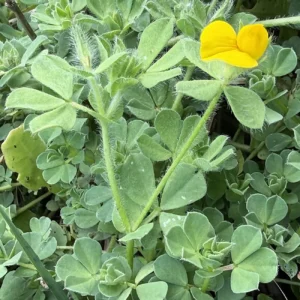
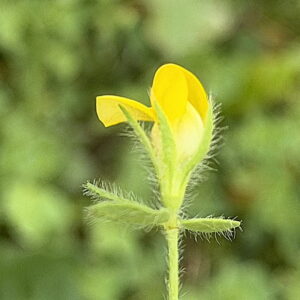
Lotus ornithopodioides, a member of the Fabaceae family, is a distinctive annual herb that finds its home in the grassy and sandy littoral zones of the Mediterranean. It is easily recognized by its peculiar, curved seed pods that cluster together in a way that perfectly mimics the shape of a bird's foot. This species adds a delicate, intricate texture to the coastal flora of Cyprus during the vibrant spring months.
Cypriot Names
Λωτός ο ορνιθοποδιώδης, Πουλλόποδιν.
Common English Names
The primary English name is the Bird's-foot Trefoil, specifically the Clustered Bird's-foot Trefoil. It is also frequently called the Bird's-foot Lotus, directly translating its scientific name which highlights the avian resemblance of its fruiting body. This Bird's-foot Trefoil is a common sight in the Mediterranean pastures and rocky seashores across the island.
Etymology of Lotus ornithopodioides
The etymology of the genus derives from "Λωτός" [lotos], which is the name given to this plant genus by the Ancient Greeks; it possibly derives from Hebrew " לוֹט " [lot], translated as "myrrh", which in the Septuagint is defined as "a form of oil that drips from various trees". The species name "ornithopodioides" is derived from the Greek "όρνιθος" (ornithos, meaning bird) and "πόδι" (podi, meaning foot), combined with "-oides" (resembling).
Synonyms and Taxonomic History
While Lotus ornithopodioides has remained relatively stable in botanical records, it has historically been categorized with various synonyms that reflect its growth habits and regional variations. These include:
- Mullera ornithopodioides
- Lotus suaveolens (in some early contexts)
- Lotus coimbrensis (occasionally misapplied)
Key Characteristics for Diagnostic Identification - How to Identify Lotus ornothopodioides
To identify Lotus ornithopodioides correctly, focus on the unique pod shape and the hair distribution. These bullet points define its morphology as described by Meikle compared to its relatives (L. edulis, L. longisiliquosus, L. palustris, L. peregrinus, and L. tenuis):
- Distinctly Torulose (Beaded) Pods: The pods are thin and deeply constricted between the seeds. This differentiates it from L. edulis (massive/succulent), L. tenuis (strictly linear/smooth), and L. peregrinus (narrow/smooth).
- Calyx Teeth to Tube Ratio: The teeth are remarkably long, often 2–3 times the length of the tube. This is a primary separator from L. peregrinus and L. longisiliquosus, where teeth are roughly equal to or only slightly longer than the tube.
- Spreading (Villous) Indumentum: The stems are covered in long, spreading hairs. This distinguishes it from the appressed, silky-haired L. edulis, L. peregrinus, and the often glabrescent (hairless) L. tenuis. It shares this with L. palustris, but L. palustris has much longer peduncles.
- Standard Petal Morphology: The yellow standard is 7–10 mm, much smaller than L. edulis. It also lacks the distinct reddish-veining often prominent in L. peregrinus.
- Short, Leafy Peduncles: Peduncles are 1–4 cm, typically shorter than or equal to the subtending leaf. This separates it from L. edulis, L. longisiliquosus, and L. palustris, all of which have peduncles significantly longer than their leaves.
- Umbellate Fruit Cluster: Pods are arranged in clusters of 2–5. This distinguishes it from the solitary or paired (1–2) fruit of L. edulis and L. peregrinus.
- Bract Size: The 3-foliate bracts are very large, often totally eclipsing the small flowers. This is unrelated to the smaller bracts of L. tenuis.
Botanical Structure and Adaptations
Growth Habit and Stature
This species typically exhibits a decumbent or ascending growth habit, with several branches spreading from the base. Lotus ornithopodioides usually reaches a height of fifteen to thirty-five centimeters. Its stems are often more slender and delicate than those of Lotus edulis, allowing it to weave through the gaps in rocky coastal soil.
Foliage Characteristics
The leaves are grayish-green and consist of three leaflets with two stipule-like leaflets at the base. These leaflets are covered in spreading hairs that help capture moisture from the morning sea mist. This specialized foliage is an essential adaptation for the plant, protecting it from the intense sunlight typical of the Mediterranean coastline.
Floral Features and Appearance
The flowers of Lotus ornithopodioides feature a small, yellow pea-like structure. They are arranged in small umbels of two to five blossoms. These blossoms emerge in late winter and spring, providing a valuable source of nectar for bees and other pollinators that frequent the coastal sand dunes and cliffs.
The Characteristic Beaded Pods
The most distinctive feature of Lotus ornithopodioides is its fruit. The seed pods are thin, compressed, and noticeably constricted between each seed, which gives them a jointed appearance. These structures are crucial for identification, especially when they are clustered together at the end of the short peduncles.
Geographical Distribution and Ecological Niche
Mediterranean and Global Range
Lotus ornithopodioides is a stenochoric species primarily restricted to the Mediterranean Basin. It is found along the coastlines of Southern Europe including Spain, Italy, and Greece. Its range extends to North Africa in countries like Tunisia and Algeria, and across Western Asia including Turkey and the Levant.
Distribution Across Cyprus
In Cyprus, Lotus ornithopodioides is widely distributed along the entire coastline. It is particularly common in the sandy areas of the Akamas Peninsula and the rocky shores of Cape Greco. Because it is tied to the sea, it is restricted entirely to the island's perimeter, rarely found far inland.
Altitude and Coastal Habitat
This plant thrives in the halophytic zone, almost exclusively at an altitude of 0 to 50 meters above sea level. It is most often found on sandy beaches, stabilized dunes, and the edges of salt marshes. Lotus ornithopodioides plays an important role in its ecosystem by stabilizing loose coastal sand and supporting local insects.
Is Lotus ornithopodioides Suitable For Gardens?
When considering "Is Lotus ornithopodioides Suitable For Gardens?", the answer is yes for a naturalistic coastal or rock garden. Its delicate flowers and unique pods are visually interesting. However, it requires well-drained, sandy soil and full sun, and it will die back naturally once the summer drought begins.
Life Cycle and Survival
Seasonal Blooming
The flowering season typically begins in late winter and peaks during the spring months of March (February in Cyprus) and April. As an annual, the plant completes its entire life cycle in a single year, germinating after autumn rains. Once the summer heat intensifies, the plant withers away, releasing its "beaded" pods.
Environmental Stress Tolerance
Lotus ornithopodioides is remarkably tolerant of high salinity and nutrient-poor, sandy soils. Its spreading hairs and compact growth habit reduce water loss, allowing it to survive spring droughts. It is a vital component of the dune stabilization process in the Mediterranean, adapted to shifting sands.
Exciting Facts About Lotus ornithopodioides
The Living Bird's Foot
The common and scientific names are no exaggeration; when the pods mature and dry, the cluster looks exactly like the skeletal foot of a small bird. This mimics the appearance of debris on the beach, which may help camouflage the seeds from foraging birds and rodents.
Nitrogen-Fixing Specialist
Like other legumes, the Bird's-foot Trefoil has a symbiotic relationship with bacteria in its root nodules. This allows it to convert atmospheric nitrogen into nutrients, effectively fertilizing the poor, sandy soils of the Cypriot coastline for other plants that follow in the successional cycle.
Sea Spray Survivalist
Lotus ornithopodioides is often found closer to the tide line than many other legumes. Its shaggy hairs provide a physical barrier against salt crystals, preventing them from coming into direct contact with the leaf surface and causing osmotic stress or chemical burns.