Date Created: 10.04.2023
Last Modified: 04.07.2026
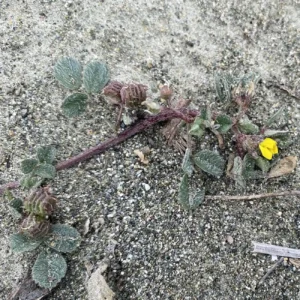
Medicago littoralis Rohde ex Loisel. is the Latin name for the Shore Medick, a small, prostrate annual herb belonging to the Fabaceae family.
Cypriot Names
Μηδική η παραθαλάσσια
Common English Names
- Shore Medick
- Coastal Medick
- Strand Medick
- Small-fruited Medick
Etymology of Medicago littoralis
The term "Medicago" derives from "Μήδια" [Media], a historical geographic area occupied by the Medi that occupied a large part of today’s central and western Iran south of the Caspian Sea, the territory from which the ancient Greeks thought the plant originated; from this derived the Ancient Greek word for plant "μηδική" [medice], meaning "of Media". Latinized "Medicago" became as such from "medica" + the suffix "-ago", as in "Plantago". "Littoralis" is derived from the Latin meaning ''of the sea shore" because it is often seen growing near the sea (but it grows at higher altitudes as well).
Synonyms
- Medicago arenaria Ten.
- Medicago cylindracea DC.
- Medicago truncatula subsp. littoralis (Lois.) Ponert
- Medicago littoralis var. brevispina Benth.
- Medicago striata Bastard
Key Characteristics for Diagnostic Identification
According to the definitive botanical keys established by Robert Desmond Meikle (1923–2021) in his comprehensive Flora of Cyprus, this species is distinguished by several specific morphological features:
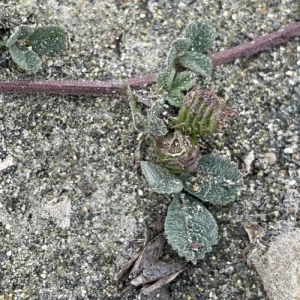
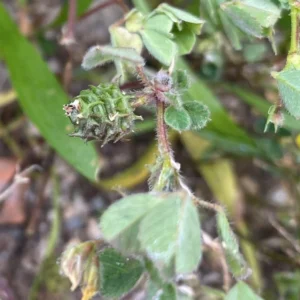
- Pod Structure: The fruit is a cylindrical or barrel-shaped pod, tightly coiled in 3–5 spirals, often featuring short, divergent spines that help in dispersal.
- Foliage Texture: The leaflets are trifoliate, obovate, and notably pilose (hairy) on both surfaces, which serves as an adaptation to reduce water loss in saline winds.
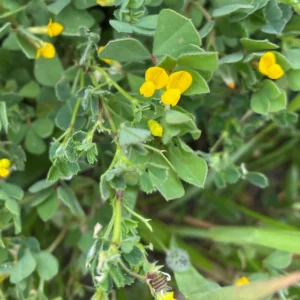
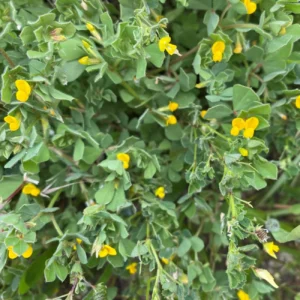
- Flower Morphology: Small yellow flowers are arranged in clusters of 1–3 on short peduncles, featuring the typical papilionaceous (pea-like) structure characteristic of the legume family.
- Stipule Shape: The stipules at the base of the leaves are deeply laciniate (slashed into narrow segments), providing a vital diagnostic clue for differentiating it from similar medicks.
- Seed Characteristics: The seeds are small, yellowish-brown, and kidney-shaped, tucked safely within the hard, protective coils of the indehiscent pods until the pod eventually decays.
How to identify Medicago littoralis versus ciliaris
Medicago littoralis can also be seen with fruits bearing minimal or no spikes. It is a plant with similar fruits as Medicago ciliaris. Their main difference is that ciliaris has straight spikes and littoralis has curved/horizontal.
Botanical Structure and Floral Details of Medicago littoralis
The Inflorescence
The plant produces small racemes consisting of one to four tiny, bright yellow flowers. These are positioned in the leaf axils along the prostrate stems. Despite their size, they provide essential nectar for specialized small insects that frequent the harsh, exposed conditions of the Cypriot coastline.
Floral Details
Each flower possesses a calyx with five subequal teeth and a corolla typical of the subfamily Faboideae. The "standard" petal is slightly longer than the "wings" and the "keel." This delicate floral architecture is designed specifically for pollination by bees capable of "tripping" the staminal column.
The Seed Pods
The pods are the most identifying feature, appearing as small, brown, barrel-like cylinders when mature. They are often glabrous or slightly hairy and are uniquely adapted to withstand salt spray. The coils are transverse-veined, protecting the seeds from the abrasive action of moving sand.
Geographical Distribution and Habitat of Medicago littoralis
This species is native to the entire Mediterranean Basin, extending to the Black Sea and the Atlantic coasts of Europe. It appears in Portugal, Spain, Italy, Greece, and North Africa. It is a strict specialist of sandy seashores, stabilized dunes, and the immediate hinterland of maritime regions.
Distribution in Cyprus
In Cyprus, this species is an indigenous plant found abundantly along the coastal fringes of the island. It is particularly common in the sandy bays of Akamas, the Larnaca coastline, and the Kyrenia district. It occurs strictly at low altitudes, rarely moving above 50 meters from sea level.
Flowering Period in Cyprus
The flowering period for Shore Medick in Cyprus typically occurs from February to May. During these spring months, the yellow flowers contrast sharply with the reddish-purple tint often seen on the maturing seed pods. The plant completes its life cycle quickly before the intense summer heat desiccates the sand.
Conservation Status in Cyprus
This plant is not included in the Red Data Book of the Flora of Cyprus. It is classified as "Least Concern" (LC) because it occupies a wide geographical range along the island's coasts. Its populations are currently stable, although localized coastal development remains a potential future threat to its habitat.
Medicinal Properties of Medicago littoralis
There is no significant record of traditional medicinal use for this specific species in Cyprus. Like many other medicks, it contains coumestrol, a phytoestrogen, and various saponins. While these compounds have pharmacological interest in a laboratory setting, the plant is primarily regarded for its ecological and agricultural value.
In broader agricultural contexts, similar Medicago species have been studied for their antimicrobial properties. However, for the Shore Medick, its primary "medicine" is for the earth itself; its symbiotic relationship with Rhizobium bacteria allows it to enrich barren coastal sands with life-sustaining nitrogen, supporting the wider ecosystem.
Fascinating Facts About Medicago littoralis
The Red Stress Response
A fascinating feature often seen in your photos is the deep reddish-purple coloration of the pods. This is caused by anthocyanins, which protect the developing seeds from intense UV radiation and the physiological stress of high salinity found in the spray zone of the Mediterranean.
Sand Stabilizer
Shore Medick plays a subtle but vital role in coastal defense. Its prostrate, creeping stems help to bind the surface of sand dunes together. This prevents erosion during winter storms and allows other, more sensitive maritime plants to gain a foothold in the shifting environment.
Velcro Dispersal
The short spines on the coiled pods function like a natural "Velcro." They allow the pods to latch onto the fur of passing animals or the feathers of sea birds. This "epizoochory" enables the plant to spread its seeds between distant sandy beaches across the island.
Indicator of Maritime Influence
The presence of this plant is a reliable indicator of maritime influence. It is so well-adapted to salt that it can thrive where most other plants would shrivel. Its succulent-like resilience allows it to utilize the morning dew that settles on the cool coastal sands.
Hidden Nitrogen Factory
Beneath the sand, the roots of this small plant host tiny nodules filled with bacteria. These nodules convert atmospheric nitrogen into a form that plants can use. This makes Shore Medick a "pioneer species," effectively fertilizing the beach for future generations of coastal flora.