Μηδική η ασπιδοφόρος
Etymology of Medicago scutellata
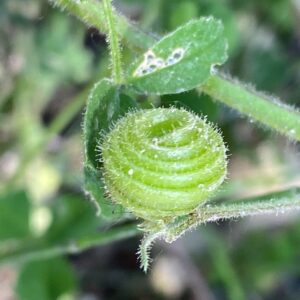
The term "Medicago" derives from "Μήδια" [Media], a historical geographic area occupied by the Medi that occupied a large part of today’s central and western Iran south of the Caspian Sea, the territory from which the ancient Greeks thought the plant originated; from this derived the Ancient Greek word for plant "μηδική" [medice], meaning "of Media". Latin "scutellata" adjective derived from the noun scutellum, meaning "small shield" or "buckler." The suffix -ata indicates "possessing" or "having the form of." Therefore, scutellata means "having the form of a small shield." This refers to the shape of the seed pod, which is coiled and somewhat flattened, resembling a small shield or buckler.
Medicago in Cyprus
There are at least 24 species and one hybrid in the wild Cypriot habitat (plus another domesticated one), of which one species appears exclusively in the occupied north. Another one's existence is questionable.
Habitat of Medicago scutellata
Medicago scutellata, commonly known as snail medic, is native to the Mediterranean region, including parts of Europe, North Africa, and Western Asia. It is widely distributed throughout the Mediterranean Basin and can be found growing in a variety of habitats, including grasslands, cultivated fields, roadsides, and disturbed areas, often preferring dry, well-drained soils and sunny locations. Due to its ornamental value and use as a fodder plant, it has also been introduced and naturalized in other parts of the world with similar climates, such as Australia and parts of North and South America.
Medicago scutellata in Cyprus
Medicago scutellata is a plant that exists all around Cyprus, except for the Karpasia peninsula, and appears up to an altitude of 1000 metres (this altitude exclude Troodos Mountains areas). Medicago scutellata generally prefers well-drained soils that are typically light to medium in texture, such as sandy loams and loams. While it can tolerate a range of soil pH levels, it often thrives in neutral to slightly alkaline conditions. It is adapted to drier environments and does not typically flourish in waterlogged or poorly drained soils. You're likely to find it in the often stony or gravelly soils common in Mediterranean climates. Its flowering period is between March and May.
How to identify Medicago scutellata
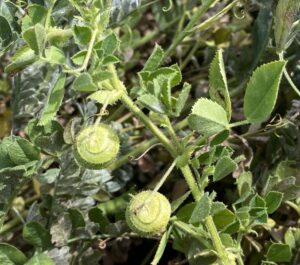
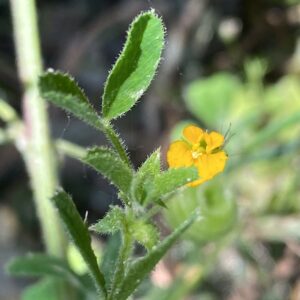
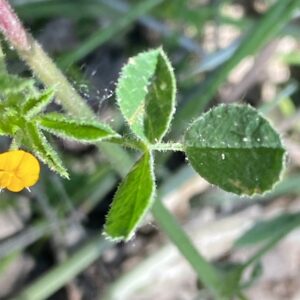
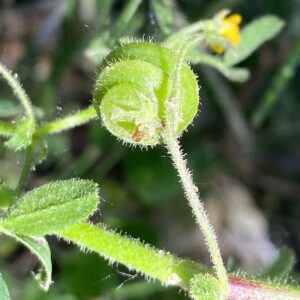
The combination of the tightly coiled, spiny pod, obovate to cuneate leaflets, laciniate stipules, few-flowered heads on short peduncles makes Medicago scutellata quite distinct within the genus. Especially the seed pods, are a key differenatiator between Medicago bonarotiana, the blancheana hybrid, and obrbicularis.
Medicago scutellata's pod
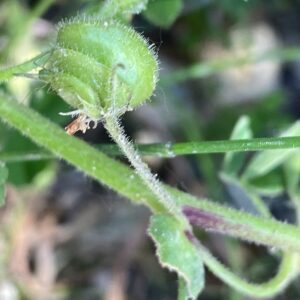
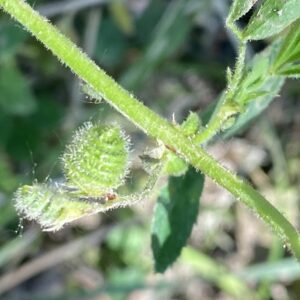
Focusing solely on the seed pods, the differences between Medicago scutellata, Medicago bonarotiana, Medicago × blancheana, and Medicago orbicularis are quite distinctive. The pod of Medicago scutellata is characterized by its tight, flat-faced spiral, strongly resembling a snail shell. A key feature is the presence of prominent and often elongated spines that give the pod a noticeably prickly texture.
Medicago bonarotiana's pod
In contrast, the pod of Medicago bonarotiana, while also coiled, exhibits a looser spiral and possesses spines that are generally shorter and less conspicuous than those of M. scutellata. The overall size of the M. bonarotiana pod is also typically smaller.
Medicago x blancheana's pod
The hybrid species, Medicago × blancheana, displays pod characteristics that are intermediate between its parent species, M. scutellata and M. orbicularis. The coiling of the pod can be irregular, and spines are present, but their size and density are variable, reflecting the mixed genetic heritage.
Medicago orbicularis's pod
Finally, the pod of Medicago orbicularis stands out due to its smooth, flattened disc or button-like shape. Crucially, it lacks the prominent spines seen in the other three species, or if present, they are reduced to very short, inconspicuous bumps. The outline of the M. orbicularis pod is smooth and lacks the prickly appearance associated with the spiny pods of the other species.