Date Created: 06.04.2025
Last Modified: 06.05.2026
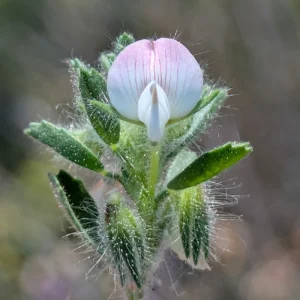
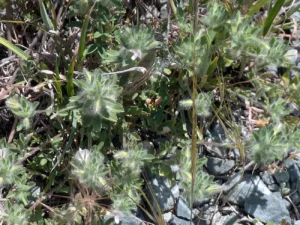
Ononis reclinata, commonly known as the Small Restharrow, is a diminutive annual herb found throughout the Mediterranean region. Belonging to the Fabaceae family, it is characterized by its glandular-hairy stems and pinkish flowers. In Cyprus, it typically colonizes dry, rocky slopes and sandy coastal soils, appearing during the early spring months.
Common Cypriot Names
The formal translation in Modern Greek is Όνωνις η κεκλιμένη [Ononis-i-keklimeni].
Common English Names
- Small Restharrow
- Drooping Restharrow
- Small-flowered Restharrow
Etymology of Ononis reclinata
The etymology of the genus name "Ononis" comes from the Ancient Greek "ὄνος" [ónos] meaning "donkey", and "ὀνίς" [onis] meaning "dung", hence "donkey's dung", as the ancient Greeks assumed it could grow where donkeys defecate. It may sound like a weird name to choose but in fact, there are more genuses with a similar name, such as the genus "Onopordum" which means "donkey's fart" and "Onobrychis". The specific epithet "reclinata" is from the Latin word "reclinatus", the past participle of reclinare, meaning "to lean back" or "recline," which in this case describes the reflexed or bent-back nature of the flower calyx after flowering.
Key Characteristics for Diagnostic Identification
According to the definitive botanical keys established by Robert Desmond Meikle in his comprehensive Flora of Cyprus (Volume 1, 1977), this species is distinguished from other taxa of the genus in Cyprus by the below morphological features:
- Pod Orientation: The most prominent diagnostic is the pendulous or drooping pods. This feature separates Ononis reclinata from O. mitissima, O. diffusa, and O. serrata, all of which possess erect pods.
- Flower Color and Size: The petals are pink or reddish and usually shorter than or barely exceeding the calyx. This distinguishes it from O. pubescens and O. sicula, which feature distinctly yellow flowers.
- Peduncle Length: The peduncles are short and usually single-flowered, often ending in a small awn. This separates it from O. biflora, which has long peduncles bearing two flowers that significantly exceed the length of the leaves.
- Seed Texture: The seeds are finely tuberculate (covered in small bumps). This is an SOS diagnostic to distinguish it from O. viscosa subsp. breviflora, where seeds may appear smoother, and from O. spinosa subsp. leiosperma, which is a spiny perennial with larger seeds.
- Leaf Structure: The leaves are trifoliolate with the terminal leaflet having a longer petiolule. Unlike O. pusilla, which is a woody-based perennial, Ononis reclinata is a strictly annual herb with a slender taproot.
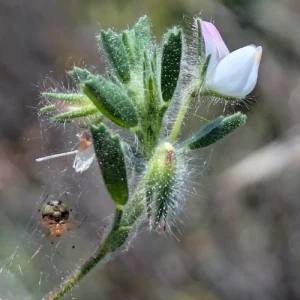
- Calyx Teeth: The calyx teeth are linear-lanceolate and much longer than the tube. This distinguishes it from the former Ononis taxa such as O. antiquorum, where the calyx is shorter and the plant is heavily spinescent.
Additional Identification Characteristics
Modern botanical surveys by the Cyprus Department of Forests emphasize the shrubby, glandular pubescence that covers the entire plant, trapping dust and sand. Unlike O. hirta, which has long, spreading hairs, the hairs on Ononis reclinata are predominantly short, glandular, and viscous, giving the plant a sticky texture.
How to identify Ononis reclinata vs diffusa and serrata
Ononis reclinata looks similar to Ononis diffusa, and Ononis serrata. Let's see some of the main differences that distinguish the one species from the other.
Overall Leaf Structure:
Ononis diffusa: Primarily trifoliolate (leaves with three leaflets), but the basal leaves can sometimes be pinnate (with more than three leaflets arranged along a central axis).
Ononis reclinata: Consistently trifoliolate (always with three leaflets).
Ononis serrata: Lower and middle leaves are typically trifoliolate, while the upper leaves are often unifoliolate (reduced to a single leaflet).
Leaflet Shape and Size:
Ononis diffusa: Leaflets are typically oblanceolate to suborbicular (inversely lance-shaped, wider towards the tip, to almost circular), ranging in size from 10-20 mm in length.
Ononis reclinata: Leaflets are oblanceolate to obovate-orbicular (inversely lance-shaped to inversely egg-shaped, wider towards the tip, to almost circular), and generally smaller, around 5-8 mm in length.
Ononis serrata: Leaflets are oblong to linear (elongated with parallel sides to very narrow and elongated), and typically smaller and narrower than O. diffusa, measuring 5-13 mm long and 1-5 mm wide.
Leaflet Margin:
Ononis diffusa: Leaflet margins are denticulate (with small, regular teeth), usually with 10-16 more or less appressed (lying flat) teeth.
Ononis reclinata: Leaflet margins are dentate only at the apex (toothed only at the tip). This is the primary characteristic that distinguishes this species from the other two similar ones.
Ononis serrata: Leaflet margins are acutely denticulate-serrate (with sharp, forward-pointing teeth). The teeth are generally fewer and more conspicuous than in O. diffusa.
Hair Characteristics:
Ononis diffusa: The whole plant is often described as glandular-hairy and viscid (sticky).
Ononis reclinata: Stems are described as villous (with long, soft hairs) and glandular-hairy.
Ononis serrata: The plant is viscid-pubescent (with short, sticky hairs).
Overall Flower Arrangement and Habit:
Ononis diffusa: Flowers are borne in lax, few-flowered racemes or sometimes solitary in the upper leaf axils. The inflorescence is often quite open and spread out (diffuse), consistent with its name. The flowers are typically erect or ascending.
Ononis reclinata: Flowers are arranged in dense, few-flowered heads or short, compact racemes that are characteristically reclined or deflexed (bent downwards) after flowering, giving the species its name. The inflorescence is much more compact and often appears nestled in the upper leaf axils.
Ononis serrata: Flowers are produced in short, dense, terminal or axillary racemes or sometimes appear as clusters. The inflorescence is generally more compact than O. diffusa but less distinctly reclined than O. reclinata. The flowers are typically erect or spreading.
Flower Size:
Ononis diffusa: Flowers are generally the largest among the three species, typically 10-18 mm long.
Ononis reclinata: Flowers are smaller, usually ranging from 6-10 mm in length.
Ononis serrata: Flowers are of intermediate size, typically 8-14 mm long.
Calyx (Sepal Cup):
Ononis diffusa: The calyx is deeply divided into 5 narrow, lanceolate to linear-lanceolate lobes that are longer than the tube. These lobes are often glandular-hairy.
Ononis reclinata: The calyx is also deeply divided into 5 lanceolate to linear lobes, which are equal to or slightly longer than the tube. These lobes are typically hairy and glandular. A key characteristic is that the calyx teeth become strongly reflexed (bent backwards) after flowering, contributing to the reclined appearance of the fruiting heads.
Ononis serrata: The calyx has 5 lanceolate to linear-lanceolate lobes that are longer than the tube and are acutely dentate-serrate (sharply toothed) along their margins, mirroring the leaf margin characteristic. This serrated calyx is a distinctive feature.
Corolla (Petals):
Ononis diffusa: The corolla is typically pink or purplish, with a noticeable keel (the two lower petals fused together). The standard (the uppermost petal) is often distinctly veined.
Ononis reclinata: The corolla is usually pink or rose-purple. The standard is often shorter than the keel.
Ononis serrata: The corolla is typically pink or reddish-purple.
Other Floral Characteristics:
Ononis diffusa: The pedicels (flower stalks) are usually longer than the calyx.
Ononis reclinata: The pedicels are short, and the fruiting heads become quite dense and easily recognizable due to the reflexed calyx teeth.
Ononis serrata: The presence of the serrated calyx lobes is a very strong distinguishing feature during flowering and fruiting.
Botanical Structure and Floral Details of Ononis reclinata
Inflorescence and Pods
The pods are cylindrical, approximately 5–10 mm long, and densely glandular-hairy. They contain several small, kidney-shaped seeds. The "drooping" behavior of these pods is a key identifier as the plant dries, often causing the entire stem to appear weighted down.
Geographical Distribution and Habitat of Ononis reclinata
This species is widely distributed across the Mediterranean basin, extending to the Atlantic coast of Europe and North Africa. It thrives in open, sunny habitats, particularly on calcareous soils, dry grasslands, and coastal sands where competition from taller perennial vegetation is minimal.
Distribution in Cyprus
In Cyprus, it is common in the Mesaoria plain, the Akamas Peninsula, and the coastal regions of Paphos and Larnaca. It is frequently observed in the phrygana of the Kyrenia range and the lower foothills of the Troodos mountains, favoring disturbed ground and rocky paths.
Elevation Range in Cyprus
The Small Restharrow is primarily a lowland species, found from sea level up to an altitude of 600 metres. It rarely penetrates the higher coniferous forest zones of the central mountain massifs.
Flowering Period in Cyprus
The flowering period typically begins in late February and reaches its peak in March and April. By May, the plant has usually set fruit and begins to wither as the summer drought approaches.
Conservation Status in Cyprus
According to the Red Data Book of the Flora of Cyprus, this species is categorized as Least Concern (LC). It remains widespread and abundant across the island, though coastal populations may face localized pressure from tourism-related infrastructure development.
Is O. reclinata Suitable for Gardens?
The Small Restharrow is not typically used as an ornamental plant due to its small floral size and sticky foliage. While seeds are occasionally available in specialized Mediterranean wildflower mixes, there are no international trade restrictions. However, its tendency to trap soil and its modest appearance make it less desirable for traditional flower beds.
Toxicity and Safety
There is no documented evidence suggesting that Ononis reclinata is toxic to humans. However, the European Medicines Agency (EMA) notes that while related species like Ononis spinosa are safe for specific uses, the glandular hairs of the genus can cause mechanical irritation or mild allergic contact dermatitis in sensitive individuals. It is generally avoided by larger livestock due to its sticky secretions, which can be unpalatable.
Medicinal Properties
Diuretic Potential
Historically, the Ononis genus has been recognized for its diuretic properties. Research published by the HMPC (Committee on Herbal Medicinal Products) confirms that the roots and aerial parts contain isoflavonoids and essential oils that support the flushing of the urinary tract. While Ononis reclinata is not the primary commercial source, it contains similar active compounds like ononin.
Anti-inflammatory Research
Studies by expert pharmacognosists, including those found in the Journal of Ethnopharmacology, suggest that the flavonoids in this plant may possess mild anti-inflammatory effects. These studies indicate that extracts from the Ononis genus can inhibit certain inflammatory enzymes, though specific clinical trials for this exact taxon are limited compared to its perennial relatives.
Fascinating Insights About "Ononis reclinata"
The Plow-Stopper
The common name "Restharrow" (derived from 'rest-harrow') was originally given to perennial members of the genus because their tough, woody roots could "stop" or "rest" a horse-drawn harrow. Although Ononis reclinata is a soft annual, it belongs to this legendary lineage of plants that were historically the bane of Mediterranean farmers.
Adhesive Defense
The sticky glandular hairs of the plant serve as a sophisticated defense mechanism. By trapping sand and dust, the plant creates a physical "armor" that reflects solar radiation and deters small herbivorous insects. This adaptation is essential for surviving the intense heat and dry winds of the Cypriot spring.
Geocarpic Tendencies
The drooping nature of the pods is an evolutionary strategy to ensure seeds are deposited close to the parent plant. By "reclining" toward the earth, Ononis reclinata increases the likelihood that its seeds will find a suitable crevice in the rocky soil rather than being swept away by wind across barren landscapes.
Micro-habitat Specialist
Research by the Cyprus Agricultural Research Institute suggests that this species often grows in the "halos" of larger shrubs. These shrubs provide shade and moisture, allowing the small herb to complete its life cycle. In return, the sticky nature of the plant can trap beneficial nutrients from windblown organic debris.