Date Created: 27.02.2023
Last Modified: 07.05.2026
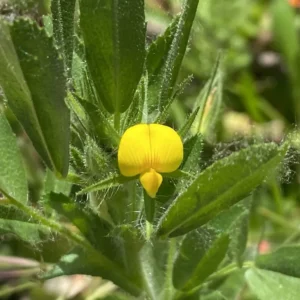
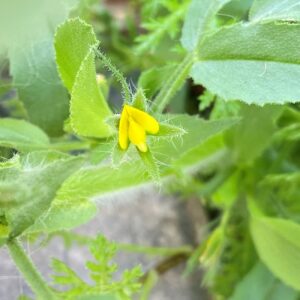
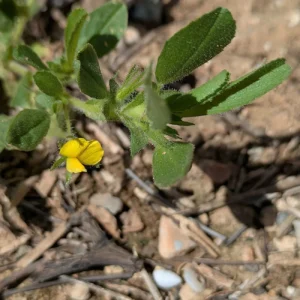
Ononis viscosa subsp. breviflora, commonly known as the Small-flowered Sticky Restharrow, is a glandular annual herb native to the Mediterranean. It is distinguished by its extremely viscous texture and yellow flowers. This taxon is a frequent member of the Cypriot flora, thriving in dry, open habitats and degraded shrublands during the spring season.
Common Cypriot Names
The formal translation in Modern Greek is Ονωνίς η κολλώδης υποείδος η βραχύανθη [Ononis-i-kollodis-ypoeidos-i-vrachianthi]. In Cyprus, it is traditionally called Αρκομελοχόρτι [Arkomelochorti] or simply Μελοχόρτι [Melochorti]. According to Gennadius (1914), the name translates to "honey-herb" because its dense glandular hairs produce a sticky resin that adheres to skin and clothing like honey.
Common English Names
- Small-flowered Sticky Restharrow
- Short-flowered Restharrow
- Sticky Restharrow
Etymology of Ononis viscosa subspecies breviflora
The etymology of the genus name "Ononis" derives from the Ancient Greek "όνος" [onos], meaning "donkey," as these plants were famously noted as a preferred forage for donkeys. "Viscosa" is the Latin for "viscous" or "sticky," referring to the plant's resinous coating. "Breviflora" stems from the Latin "brevis," meaning "short," and "flos," meaning "flower," highlighting its relatively small corolla.
Synonyms
- Ononis breviflora DC. (1825)
Key Characteristics for Diagnostic Identification
According to the definitive botanical keys established by Robert Desmond Meikle in his comprehensive Flora of Cyprus (Volume 1, 1977), this species is distinguished from other taxa of the genus in Cyprus by the below morphological features. We compare it specifically to all other yellow-flowered Ononis taxa found in Cyprus (O. sicula, O. pubescens, O. ornithopodioides, and O. pusilla), which share a similar appearance:
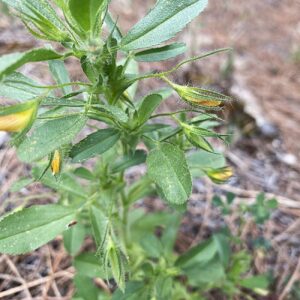
- Corolla Size: In Ononis viscosa subsp. breviflora, the corolla is shorter than or barely equaling the calyx. This is the primary SOS identifier, as O. pubescens and O. sicula have corollas that distinctly exceed the calyx. O. pusilla and O. ornithopodioides share the shorter corolla trait.
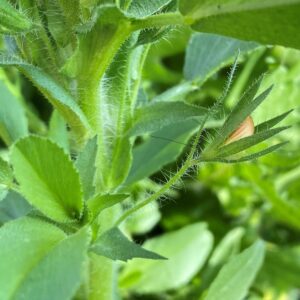
- Peduncle Awn: The peduncle (flower stalk) ends in a distinct, rigid awn (a pointed tip). This SOS feature is shared with O. sicula but separates it from O. ornithopodioides and the perennial O. pusilla, which lack a prominent awn.
- Peduncle Length: The peduncles are usually shorter than the subtending leaves, whereas in O. sicula, the peduncles often equal or exceed the leaves.
- Flower Arrangement: Flowers are typically solitary on the peduncles. This helps distinguish it from O. biflora, which often bears twin flowers on a single stalk.
- Flower Size: The flowers are small (6–10 mm). This is the primary distinction from O. pubescens, which has large, showy flowers (15–20 mm) that are often solitary or in pairs.
- Viscosity and Hair: The plant is densely glandular-viscous throughout. While O. pubescens is densely villous with soft hairs, it lacks the extreme, "dirty" stickiness of Ononis viscosa subsp. breviflora. O. sicula is only sparsely glandular.
- Calyx Teeth: The calyx teeth are linear-lanceolate and 3-4 times longer than the calyx tube. This distinguishes it from O. pusilla, where the teeth are shorter and broader relative to the tube.
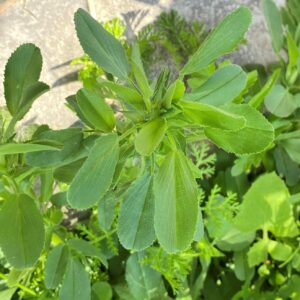
- Leaf Pattern: Leaves are trifoliolate in the middle and base of the plant, but the upper leaves near the inflorescence are often reduced to a single leaflet.
- Leaflet Shape: Leaflets are ovate to elliptical with serrated edges. This separates it from O. sicula, which features much narrower, linear-oblong leaflets.
- Pod Morphology: The pods are linear-oblong, 10–15 mm long, and contain 8–12 seeds. This is an SOS diagnostic against O. ornithopodioides, which has distinctly drooping, narrower pods with fewer seeds.
- Pod Orientation and Shape: The pods are linear-oblong and held erect or spreading at maturity. This is an SOS diagnostic against O. ornithopodioides, which features distinctly drooping (pendulous) and torulose (beaded) pods.
- Seed Texture: The seeds are finely tuberculate (covered in small bumps), a microscopic feature that differentiates it from species with smooth-skinned seeds.
- Seed Count: Each pod typically contains 8 to 12 seeds. This differs significantly from O. sicula, which contains 15 to 20 smaller seeds, and O. ornithopodioides, which usually has 3 to 9 seeds per pod.
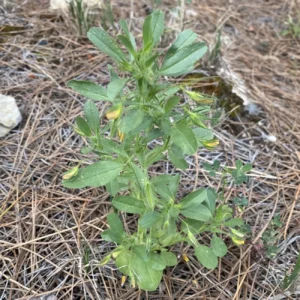
- Life Cycle and Root: It is a strictly annual herb with a slender taproot. This distinguishes it from O. pusilla, which is a suffruticose perennial with a thick, woody base. O. sicula, O. pubescens, and O. ornithopodioides are also annuals.
- Plant Habit: It is a strictly annual herb with a slender taproot. This distinguishes it from O. pusilla, which is a woody-based perennial that survives for multiple years.
- Height and Spread: This taxon grows 10–40 cm tall and is often erect or ascending. In contrast, O. ornithopodioides is frequently prostrate or spreading and rarely exceeds 20 cm in height.
- Elevation and Habitat: Ononis viscosa subsp. breviflora is verified from 0 to 750 metres. This differs from O. pusilla, which reaches much higher altitudes up to 1500 metres on Troodos.
Additional Identification Characteristics
Modern botanical descriptions often note that the Small-flowered Sticky Restharrow exhibits flowers that remain partially closed (cleistogamous tendencies) in low light. Unlike O. natrix (not found in Cyprus), which has much larger, striped flowers, the corolla of this subspecies is a pale, uniform yellow, often fading to a duller shade as the pod develops.
Botanical Structure and Floral Details of O. viscosa subsp. breviflora
Inflorescence Details
The inflorescence consists of leaf-like racemes. The small yellow flowers are followed by pods that are densely glandular-hairy. These pods are slightly inflated and contain kidney-shaped seeds that are released as the plant dries out during the early Mediterranean summer.
Geographical Distribution and Habitat of Ononis viscosa subspecies breviflora
This subspecies is widely distributed across the Mediterranean basin, including Southern Europe, North Africa, and the Middle East. It is a thermophilous plant that prefers open, sun-drenched environments with well-drained, often calcareous or sandy soils.
Distribution in Cyprus
In Cyprus, it is common across all phytogeographical regions, including the Mesaoria plain, the Akamas Peninsula, and the Pentadaktylos range. It frequently colonizes fallow fields, roadsides, and the margins of garigue and maquis vegetation throughout the island.
Elevation Range in Cyprus
The Small-flowered Sticky Restharrow is found from sea level up to approximately 750 metres. It is essentially a lowland and foothill species, becoming rare or absent in the higher, cooler igneous zones of the central Troodos massif.
Flowering Period in Cyprus
The flowering period in Cyprus typically occurs from March to May. Depending on the rainfall of the preceding winter, the peak bloom is usually observed in mid-April before the plants begin to desiccate in May.
Conservation Status in Cyprus
This taxon is not listed in the Red Data Book of the Flora of Cyprus. It is considered Least Concern (LC) due to its wide distribution and ability to thrive in disturbed habitats. There are no immediate threats to its populations on the island.
Is Ononis viscosa subsp. breviflora Suitable for Gardens?
This plant is generally not suitable for gardens. Its extremely sticky resin traps dust and insects, making it look "dirty" and unpleasant to touch. While Ononis seeds are sometimes found in specialist wildflower mixes, this specific subspecies is rarely traded commercially, and its annual nature limits its ornamental value.
Toxicity and Safety
Ononis viscosa subsp. breviflora is not considered toxic to humans. However, the Small-flowered Sticky Restharrow can cause mechanical irritation. The sticky secretions can trap soil particles and allergens, potentially causing contact dermatitis in sensitive individuals who handle the plant. According to pharmacological reviews of the Ononis genus, the plant is generally avoided by livestock because the viscous resin makes the foliage unpalatable and difficult to digest.
Medicinal Properties
Diuretic and Urological Uses
Members of the Ononis genus, particularly the roots, have been used in traditional medicine as diuretics. Research published in the Journal of Ethnopharmacology suggests that Ononis species contain isoflavonoids like ononin and formononetin. These compounds are believed to help "flush" the urinary tract and prevent the formation of kidney stones by increasing urine volume.
Anti-inflammatory Potential
Some academic studies have investigated the essential oils and flavonoids present in Ononis viscosa. These experts suggest the plant may possess mild anti-inflammatory and antimicrobial properties. However, most of this research is conducted in vitro, and no standardized pharmaceutical products are currently derived specifically from this subspecies.
Fascinating Insights About "Ononis viscosa subsp. breviflora"
The "Flypaper" Defense
The stickiness of the Small-flowered Sticky Restharrow is an evolutionary defense mechanism. By trapping small insects on its stems and leaves, the plant effectively creates a "flypaper" barrier that prevents aphids and other pests from reaching the delicate floral parts. This resin also protects the plant from excessive water loss (transpiration).
Donkey's Delight
Historical botanical texts from the Mediterranean confirm the genus's link to donkeys. While the resinous O. viscosa is less palatable than other species, it was often the only green herb left in overgrazed pastures. Donkeys, with their tough mouths, were among the few animals capable of consuming these plants in lean seasons.
Seed Dispersal Strategy
The sticky pods of this taxon are designed for epizoochory. The glandular hairs allow the ripe pods to stick to the fur of passing animals (or the clothing of humans), ensuring the seeds are transported far from the parent plant to colonize new territories across the Cypriot landscape.
Indicator of Soil Health
Ecologists often view this plant as an indicator of degraded or overgrazed land. Its ability to thrive in poor, sun-baked soils where other vegetation has been removed highlights its role as a hardy pioneer species in the Mediterranean ecosystem succession.