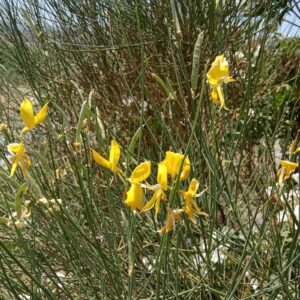
Σπάρτον το βουρλοειδές
Etymology of Spartium junceum
The etymology of the name of the genus, "Spartium", derives from the Ancient Greek word "σπάρτον" [sparton] or "σπαρτίον" [spartion]. The word relates to the plural "σπάρτα" [sparta], from the singular ''σπάρτον" [sparton], meaning "rope", as Spartium shoots were used for the manufacture of rope; Homer in Heliad mentions: «καί δή δοῦρα σέσηπε νεῶν καί σπάρτα λέλυνται», meaning "and the ships rot and their sail ropes slackened". Its popular Latin epithet, "junceum" means "rush-like" because of its many green thin shoots that look like rushes.
Introduction to Spartium junceum
Spartium junceum, commonly known as Spanish Broom, is a vigorous, deciduous shrub native to the Mediterranean region, including Cyprus. It is the sole species in its genus, characterized by its upright, rush-like green stems. This plant is a member of the Fabaceae family and is highly valued for its hardiness and vibrant floral displays.
Botanical Structure and Stems
The plant typically grows between two and four meters in height. Its most distinctive feature is its "junceous" or reed-like branches, which are cylindrical and remain green year-round. These stems carry out the majority of the plant's photosynthesis, allowing it to survive in arid environments where traditional broad leaves might lose too much moisture.
Leaf Morphology
The leaves of Spartium junceum are sparse, small, and lance-shaped. They are relatively short-lived, often falling off early in the growing season. This is an evolutionary adaptation to drought; by reducing leaf surface area, the shrub minimizes transpiration, relying instead on its green stems to produce energy during the hot summer months.
Floral Characteristics
From late spring to early summer, Spartium junceum produces large, pea-like flowers of a brilliant golden-yellow color. These blossoms are highly fragrant and grow in terminal racemes at the ends of the branches. Each flower is designed to be triggered by heavy pollinators, such as bumblebees, which are attracted by the intense scent and color.
Fruit and Seed Production
Following pollination, Spartium junceum develops linear, flattened seed pods that are initially green and turn dark brown or black as they mature. When fully dry, these pods burst open with a characteristic "pop," twisting to flick the seeds away from the parent plant. This mechanical dispersal method helps the species colonize new areas effectively.
Habitat and Soil Preferences
Spartium junceum thrives in sunny, open habitats and is frequently found along roadsides, dry hillsides, and rocky slopes. It is exceptionally tolerant of poor, alkaline soils and can even withstand high levels of salt spray. Its ability to fix nitrogen through its root system allows it to flourish in nutrient-depleted landscapes where other plants struggle.
Spartium junceum in Cyprus
Spartium junceum is a naturalized and non-invasive, non-endemic plant. In Cyprus, it is encountered only in the Troodos Mountains range, at an average altitude of 950 metres, and is definitely not a popular plant. It primarily grows on roadsides and thrives on calcareous, sandy soils. It bears a plentifulness of vivid yellow flowers that bloom mostly during April and July.