Date Created: 11.02.2023
Last Modified: 04.07.2026
Trifolium clypeatum, commonly known as Shield Clover, is a robust annual herbaceous plant belonging to the Fabaceae family. In Cyprus, this species is a visually striking indigenous member of the island's flora, distinguished by its large, distinctive flower heads. While it is widely accepted under its current name, historical records occasionally reference it by the synonym Trifolium clypeatum var. alatum.
Cypriot Names
The official Latin name translated into Greek is Τριφύλλι το ασπιδωτό. Locally, it is generally referred to as Τριφύλλι [trifylli].
Common English Names
- Shield Clover
- Helmet Clover
- Oriental Clover
Etymology of "Trifolium clypeatum"
Etymology of Trifolium clypeatum: The name of the genus, "Trifolium" derives from the Ancient Greek "τρία" [tria], meaning "three" and the Latin "folium", which means "leaf", hence "three-leafed", referring to the three leaflets that comprise a leaf. This word is a calque of the Ancient Greek "τρίφυλλο" [trifyllo], which actually means the same thing. "Clypeatum" is the neutral Latin for "resembling (a Roman) shield; shield-shaped", referring to the shape of the standard/banner of each flower.
Synonyms
Below is the comprehensive list of synonyms for Trifolium clypeatum with their respective established years of publication:
- Trifolium alatum Biv. (1806)
- Trifolium clypeatum var. alatum (Biv.) Fiori (1925)
- Trifolium scutatum Boiss. (1849)
- Trifolium clypeatum var. orientale Griseb. (1843)
Key Characteristics for Diagnostic Identification
According to the definitive botanical keys established by Robert Desmond Meikle in his comprehensive Flora of Cyprus (Volume One, 1977), this species is distinguished from other taxa of the genus in Cyprus by several specific morphological features:
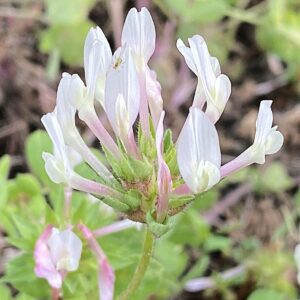
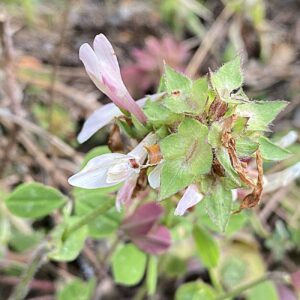
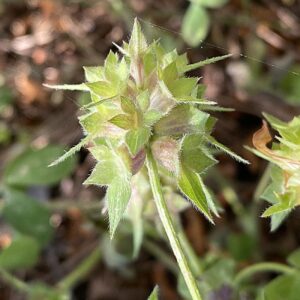
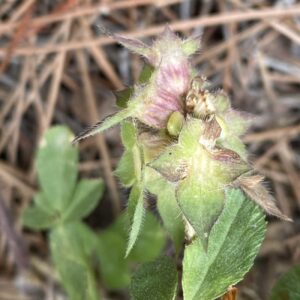
- Calyx Teeth: The most prominent diagnostic is the calyx teeth, which are leaf-like, unequal, and conspicuously enlarged in fruit, with the lowest tooth being much larger and shield-shaped.
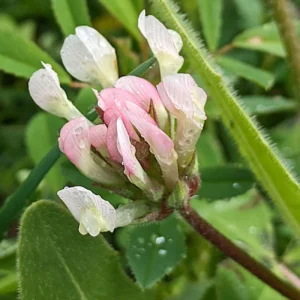
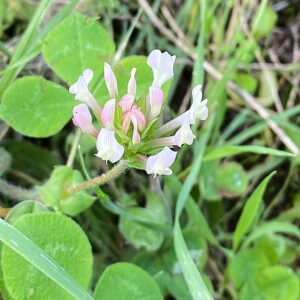
- Corolla Size: The flowers are relatively large for the genus, with a creamy-white or pale pink corolla that is significantly longer than the calyx.
- Flower Head Shape: The inflorescence is a solitary, ovoid to globose head, usually measuring 2–3 cm in diameter, supported by a distinct peduncle.
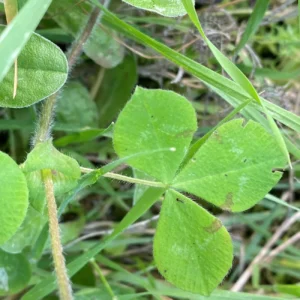
- Leaflet Morphology: The leaflets are obovate to broadly cuneate, often with a conspicuous pale "V" shaped marking on the upper surface and finely serrated margins.
Botanical Structure and Floral Details of Trifolium clypeatum
Vegetative Morphology
The plant is an erect or decumbent annual, reaching heights of 10 to 40 cm. The stems are usually branched from the base and covered in fine, spreading hairs. The stipules are large, ovate, and membranous with distinct green veins, clasping the stem at the nodes.
Reproductive Organs
The individual florets are sessile and densely packed. The standard (the uppermost petal) is elongated and notched at the tip. After fertilization, the calyx becomes rigid and the teeth spread out, acting as a protective and perhaps dispersal-aiding "shield" for the developing seed pod.
Geographical Distribution and Habitat of Trifolium clypeatum
Distribution in Cyprus
In Cyprus, Trifolium clypeatum is common and widely distributed. It is well-documented in the Mesaoria plain, the Akamas peninsula, the Kyrenia range, and extensively throughout the Limassol district. It is a frequent component of spring grasslands and roadside verges.
Presence and Habitat Elsewhere
Beyond Cyprus, the species is native to the Eastern Mediterranean, including Greece, Turkey, Syria, Lebanon, Israel, and Jordan. It thrives in Mediterranean-type ecosystems, particularly in garrigue, maquis, and disturbed ground such as fallow fields and orchard margins.
Elevation Range in Cyprus
The species occurs in Cyprus from sea level up to approximately 1,200 meters. While it is primarily a lowland and foothill species, it is frequently recorded in the higher vine-growing regions and the mid-altitude plateau areas of the Troodos foothills.
Flowering Period in Cyprus
The flowering period typically spans from February to May. The peak of the bloom occurs in March and April, blanketing uncultivated fields in pale cream and pink hues before the onset of the dry summer season.
Conservation Status in Cyprus
The species is currently classified as Least Concern (LC). It is a highly successful annual that readily colonizes disturbed soils, making it resilient to the agricultural and developmental changes common in the Cypriot landscape.
Is Trifolium clypeatum Suitable for Gardens?
Shield Clover is rarely cultivated intentionally, but it makes an excellent addition to "wildflower meadow" mixes for Mediterranean climates. It is highly attractive to pollinators and, like most legumes, improves soil quality through nitrogen fixation via root nodules.
Toxicity and Safety
There are no known toxic properties associated with Trifolium clypeatum. Like many other clovers, it is generally considered safe and is often grazed by livestock. However, it is not used as a food source for humans.
Medicinal Properties
There are no established medicinal uses for this species in modern pharmacology. While some species of Trifolium (like Red Clover) contain isoflavones used in herbal supplements, Trifolium clypeatum has not been documented as having similar clinical applications.
Fascinating Insights About "Trifolium clypeatum"
The "Shield" Defense Mechanism
Authoritative botanical observations suggest that the enlarged calyx teeth in Trifolium clypeatum serve as a physical defense. Trustworthy research into Mediterranean clovers indicates that as the seeds ripen, the rigid, shield-like calyx protects the fruit from herbivory and desiccation.
Nitrogen Fixation for Soil Health
Expert analysis of Mediterranean legumes confirms that Trifolium clypeatum hosts Rhizobium bacteria in its roots. These bacteria perform an authoritative role in converting atmospheric nitrogen into a form the plant can use, effectively fertilizing the soil for subsequent plant generations.
Pollinator Magnetism
Trustworthy entomological studies in the Eastern Mediterranean highlight this species as a vital nectar source for solitary bees. Authoritative field data show that the large flower heads are specifically structured to support the weight of various Apis and Bombus species during early spring.
Seed Dispersal by Water
Authoritative ecological research suggests that the unique shape of the fruiting calyx may aid in hydrochory (dispersal by water). Trustworthy sources indicate that during late spring rains, the "shielded" fruits can float or be moved more easily across the surface of the hard-baked Mediterranean soil.