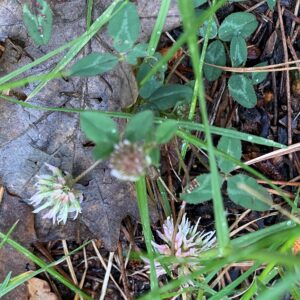
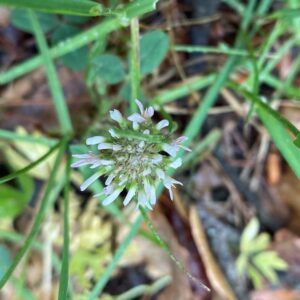
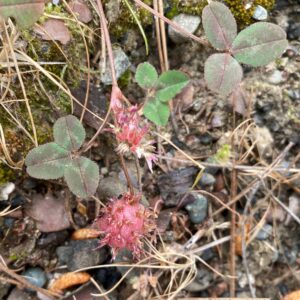
This specific subspecies of Trifolium fragiferum is a prostrate, creeping perennial known for its remarkable resilience. It is highly valued in agricultural and ecological circles for its ability to fix nitrogen while thriving in challenging soil conditions. Its most iconic feature is the inflated, pinkish seed head that bears a striking resemblance to a strawberry.
Cypriot names
Τριφύλλι το φραουλοφόρο υποείδος του Μπονάννι
Etymology of Trifolium fragiferum subspecies bonannii
The etymology of the genus name, "Trifolium" derives from the Ancient Greek "τρία" [tria], meaning "three" and the Latin "folium", which means "leaf", hence "three-leafed", referring to the three leaflets that comprise a leaf. This word is a calque of the Ancient Greek "τρίφυλλο" [trifyllo], which actually means the same thing.
"Fragiferum" means "strawberry bearing," from "fragum + fero" since the mature flower heads resemble strawberries. The name "bonannii" is a tribute to either Filippo Bonanni (1638-1723), an Italian naturalist, or to Antonio Bonanni Gervasi (?-1719), Italian pupil and illustrator for botanist Francesco Cupani.
Geographical Range
This subspecies is primarily distributed across the Mediterranean basin and parts of Western Asia. It is common in Southern Europe, North Africa, and the Middle East, often occupying the transition zones between aquatic habitats and dry uplands. Its presence is usually an indicator of a high water table or periodic flooding.
Distinguishing Morphology
The primary characteristic that separates Trifolium fragiferum subsp. bonannii from its relatives is the shape and size of its flower heads. While the typical species has purely globose heads, this subspecies often features subglobose to slightly elongated, cylindrical racemes. Furthermore, the individual calyx teeth are notably shorter than the tube, a key detail for botanical identification.
Leaf and Stem Architecture
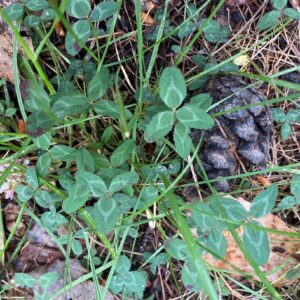
In Trifolium fragiferum subsp. bonannii, the leaves are trifoliate with obovate leaflets that often show very fine, sharp teeth along the edges. The veins are distinct, meeting the leaflet margin at nearly right angles. Its creeping stems, or stolons, are particularly robust, allowing the plant to navigate through thick turf and root firmly at every node.
Reproductive Traits
The flowering period for Trifolium fragiferum subsp. bonannii typically spans from May to September. During this time, the corollas are often more exserted (protruding) from the calyx compared to the nominate subspecies. As the seeds ripen, the calyx becomes tomentose - covered in dense, matted hairs - rather than just being sparsely pubescent, giving the "strawberry" fruit a fuzzier appearance.
Trifolium fragiferums ssp bonannii in Cyprus
Trifolium fragiferum subspecies bonannii is an uncommon Trifolium species in Cyprus. It has very characteristic leaflets and a fruit resembling a strawberry. It does not grow in the north-western, north-eastern, and south-eastern Cyprus. Its flowering period is from June until October. The Trifolium of the images was photographed in Kardama locality (Lefkosia district) in May.
How to identify Trifolium fragiferum subspecies bonannii
Trifolium fragiferum subsp. fragiferum has globose flower heads; its calyx teeth are longer than the tube. On the contrary, Trifolium fragiferum subsp. bonannii has subglobose flower heads, ovate to irregularly cylindrical; its calyx teeth are not longer than the tube.