Τριφύλλι το φραουλοφόρο υποείδος το φραουλοφόρο
Etymology of Trifolium fragiferum subspecies fragiferum
The name of the genus, "Trifolium" derives from the Ancient Greek "τρία" [tria], meaning "three" and the Latin "folium", which means "leaf", hence "three-leafed", referring to the three leaflets that comprise a leaf. This word is a calque of the Ancient Greek "τρίφυλλο" [trifyllo], which actually means the same thing. "Fragiferum" means "strawberry bearing," from "fragum + fero" since the mature flower heads resemble strawberries. The repetition of the name in the subspecies (fragiferum subsp. fragiferum) indicates it is the nominate or typical form of the species.
Morphology of Trifolium fragiferum subspecies fragiferum
General Habit
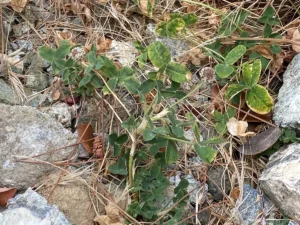
Trifolium fragiferum subsp. fragiferum, commonly known as strawberry clover, is a low-growing, creeping perennial herb in the Fabaceae (legume) family. It spreads via long, slender stolons (above-ground runners) that root at the nodes, forming dense mats or patches over time. This growth habit helps it stabilize soil and makes it useful for ground cover in disturbed or coastal areas.
Leaves
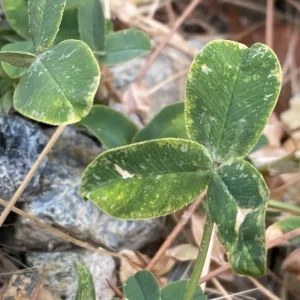
Like other members of the Trifolium genus, the plant has trifoliate leaves, meaning each leaf is divided into three leaflets. The leaflets are obovate to elliptic in shape, with finely serrated margins. A distinctive feature of this species is the presence of a white or pale crescent-shaped mark on each leaflet, though this can vary. The leaves are attached to the stems with long petioles, especially on the creeping stolons.
Inflorescence and Flowers
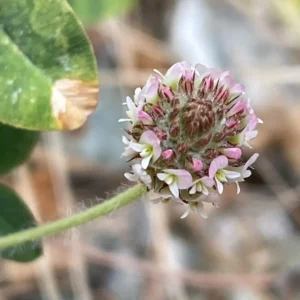
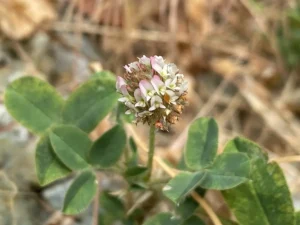
The plant produces rounded, compact flower heads, typically 1–2 cm in diameter, borne on long, erect stalks. Each flower head contains numerous small white-pink to purplish flowers, which are papilionaceous, a typical pea-flower structure with a banner (standard), wings, and a keel. After pollination, the calyx (the fused sepals) enlarges and becomes inflated and hairy, giving the mature flower heads a strawberry-like appearance, which is the origin of the name fragiferum ("strawberry-bearing").
Fruit and Seeds
The fruit is a small legume (pod), typically containing one to two seeds. These are enclosed within the persistent, inflated calyx, which aids in dispersal by wind or water, particularly in wetland or coastal environments. The seeds are small, round, and yellowish-brown, adapted for survival in variable conditions.
Roots and Adaptations
Trifolium fragiferum has a fibrous root system, and like other legumes, it forms root nodules that host nitrogen-fixing bacteria (Rhizobium spp.). This allows it to thrive in nutrient-poor soils, particularly in saline or damp habitats such as salt marshes, wet meadows, and coastal dunes. Its tolerance for periodic flooding, salinity, and grazing makes it ecologically valuable in marginal environments.
Geographic Distribution and Habitat
Trifolium fragiferum subsp. fragiferum has a wide native range across Europe and western Asia, extending from the British Isles and Scandinavia to the Mediterranean region and the Caucasus. It has also been introduced and naturalized in parts of North America, Australia, and New Zealand, largely due to its use in agriculture and soil stabilization.
This subspecies typically inhabits moist, lowland environments, including coastal salt marshes, riverbanks, damp meadows, pastures, and roadsides. It shows a strong preference for clay or loamy soils with good moisture retention and is particularly well adapted to periodically flooded or saline areas. Its ability to fix nitrogen and tolerate salinity and grazing pressure allows it to thrive in disturbed habitats, making it ecologically important in maintaining ground cover and supporting pollinators in wetland and coastal ecosystems.
Trifolium fragiferum subspecies fragiferum in Cyprus
Trifolium fragiferum subspecies bonannii is an uncommon Trifolium species in Cyprus. It is believed to grow on the Troodos mountains. A key feature of its recognition is its flowering period, which is from June until October, in contrast with most Trifoliums in Cyprus. The plants in the images were recorded at Trooditissa Monastery (Limassol district) in July.
How to recognize Trifolium fragiferum subspecies fragiferum
As mentioned earlier, the flowering period helps us to identify the Trifolium fragiferum subspecies from other Trifoliums that occur in Cyprus. We have two such subspecies in Cyprus: Trifolium fragiferum subsp. fragiferum has globose flower heads (ball-shaped), and its calyx teeth are longer than the tube. On the contrary, Trifolium fragiferum subsp. bonannii has subglobose flower heads , ovate to irregularly cylindrical (not fully round, they are more oval or unevenly tube-shaped), and its calyx teeth are not longer than the tube.