Βίκος ο στενόφυλλος
Etymology of Vicia angustifolia
The Latin name of the genus, "Vicia", meaning "binder", derives from Proto-Italic "wikia", which in turn originates from Proto-Indo-European "weyk-", meaning "to curve, bend" or from Proto-Indo-European "wehy- ". The name "binder" alludes to the activity of the tendrils. "Angusta" in Latin means "narrow" and "folia" means "leaf", referring to its narrow leaves. Hence, it is called the "Narrow-leafed Vetch".
The Vicia genus in Cyprus
At least 26 Vicia species and subspecies/kinds have so far been identified in the wild Cypriot habitat, of which two of them appear exclusively in occupied northern Cyprus.
Vicia angustifolia in Cyprus
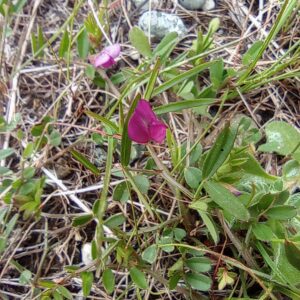
The characteristic of this species is the vivid pink flowers that are whiter on the back of the petals. It grows all around Cyprus at an altitude of up to 1525 metres. In Cyprus, it usually blooms from January to April.
How to identify Vicia angustifolia
Vicia angustifolia reveals many similarities with Vicia sativa subspecies sativa, but they have some key differences that allow us to distinguish one from the other:
Leaflets and Apex
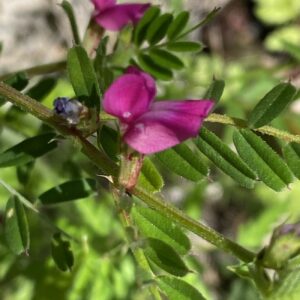
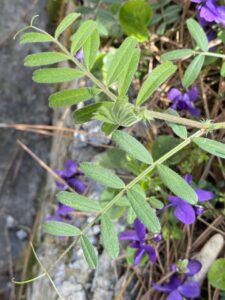
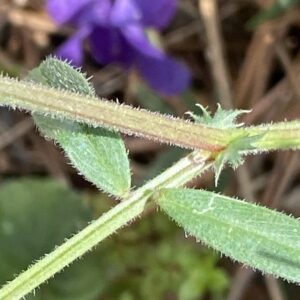
Vicia angustifolia: As its name suggests, the defining characteristic here is the narrowness of the leaflets. They are predominantly linear (long and very narrow with parallel sides) to narrowly oblong (longer than wide with somewhat parallel sides) or sometimes even obovate (inversely egg-shaped, widest above the middle). Their width is significantly less than common vetch, usually ranging from 1-4 mm, and sometimes reaching up to 6 mm in broader forms.
The apex of the leaflet in Vicia angustifolia is variable, often emarginate (notched), but can also be obtuse (blunt) or truncate (squared-off). It frequently terminates in a small, often noticeable mucro (a short, sharp point). Therefore, the overall impression can be of a notched tip with a small point, or sometimes simply a blunt tip with a mucro.
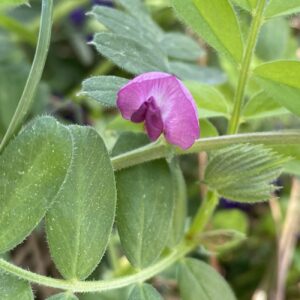
Vicia sativa subsp. sativa: The leaflets of common vetch are generally broader and more substantial. Substantial means that they have a greater overall presence and feel more "leaf-like" compared to the leaflets of Vicia angustifolia, because they naturally have a larger surface area. The shape of the leaflets ranges from oblong-elliptic (longer than wide with rounded ends) to lance-shaped (tapering to a point at the apex, widest below the middle). They typically measure around 5-10 mm in width.
The apex (the tip of the leaflet) is often quite distinctive. The common vetch apex might not come to a sharp point but instead appear somewhat flattened or even have a small notch at the very end, described as slightly indented or emarginate. Adding to this characteristic, the leaflet tip frequently ends with a small but noticeable mucro, which is a tiny, short, spine-like point right at the terminal edge. Therefore, when examining the leaflet's tip, you might observe a combination of a blunted or notched end culminating in a minute, sharp projection.
Calyx tube and Calyx teeth
The calyx is the outermost whorl of floral parts, composed of sepals (which are often green and leaf-like). The calyx tube is the fused basal portion of the sepals, and the calyx teeth are the free, pointed tips of the sepals. The relationship between the length of the calyx teeth and the calyx tube is a crucial distinguishing feature:
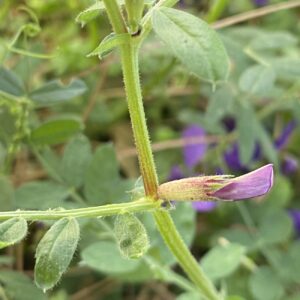
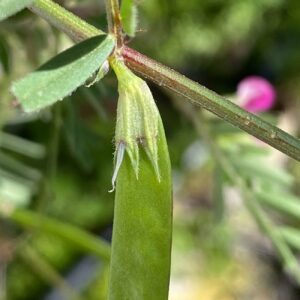
Vicia angustifolia: In narrow-leaved vetch, the calyx teeth are distinctly shorter than the calyx tube's length (compare the length of the teeth vs the length of the tube). This results in a more cylindrical or less spiky appearance of the calyx.
Vicia sativa subsp. sativa: In common vetch, the calyx teeth are usually about as long as the length of the calyx tube or even longer. This gives the calyx a more spiky or toothed appearance.
Flowers and stalks
Vicia angustifolia: Individual flowers are typically one main colour, usually purple, reddish-purple, or violet. While there might be subtle variations like darker veins on the main upper petal, the overall impression is usually a single purplish hue. These flowers are generally smaller. The flowers are usually sessile (without a stalk) or have a very short pedicel and are often found paired in the upper leaf axils, sometimes appearing more clustered.
Vicia sativa subsp. sativa: Individual flowers of this plant very often show two different colours or shades at the same time. Specifically, the large top petal (standard) is frequently a darker pinkish-purple or reddish-purple, while the side petals (wings) below it are noticeably paler, like a lighter pink or light purple. These flowers are generally larger than those of V. angustifolia.Typically has 1 or 2 flowers borne on a short stalk (pedicel) in the upper leaf axils.
Seed Pod
Vicia angustifolia: The mature pods are narrower, ranging from 4-6 mm in width, and are more elongated and cylindrical in shape. When mature, they typically turn a dark brown to almost black color, a very distinguishing feature. Importantly, the pods are not typically contracted between the seeds, maintaining a more uniform width along their length. Both the young and mature pods are usually glabrous (smooth and hairless).
Vicia sativa subsp. sativa: The mature pods are relatively broad, measuring 6-12 mm in width, and are flattened. They turn a yellowish-brown color when ripe. A key characteristic is that the pod can often be somewhat contracted between the seeds, giving it a slightly constricted or beaded appearance. The young pods are often hairy (pubescent).
What does "contracted between the seeds" mean? If the pods are contracted between the seeds, the tube would look "pinched" or narrower in the spaces between each bead. You'd see distinct bulges where the seeds are and thinner sections between them. It would have an uneven, slightly lumpy appearance. It means the pod does not have an even shape along its length, with noticeable narrowings or indentations separating each seed inside.