Κρουτσιανέλλα η πλατύφυλλος
Etymology of Crucianella latifolia
The name Crucianella latifolia is derived entirely from Latin and serves as a descriptive binomial, providing insights into the plant's morphology. The genus name, Crucianella, originates from an irregular diminutive form of the Latin word "crux" or its stem "cruci-", which translates to "cross." This nomenclature directly refers to a key identifying feature of plants within this genus: the arrangement of their leaves in whorls, where pairs of leaves are typically positioned opposite each other, forming a distinctive cross-like pattern when observed from above the stem. The "ella" suffix, being a diminutive, further refines this meaning to suggest "little cross" or "cross-like," emphasizing the relatively small scale of this cruciform arrangement. This cross-like pattern is also reflected in common names for related plants, such as "crosswort."
The specific epithet, latifolia, further elaborates on the plant's characteristics and is also rooted in Latin. It is a compound term formed from two distinct parts: "lati-", which comes from the Latin word latus meaning "broad" or "wide," and "-folia", derived from folium, meaning "leaf" or "leaves." Consequently, latifolia literally translates to "broad-leaved."
Therefore, the complete etymology of Crucianella latifolia precisely encapsulates the plant's appearance: a "little cross-like plant with broad leaves."
Key morphological characteristics
Crucianella latifolia, commonly known as Broad-Leaved Crucianella, is an annual herbaceous plant that is a member of the Rubiaceae family, often referred to as the bedstraw or coffee family. This plant typically achieves a height of 10 to 30 centimeters, though it can occasionally reach up to 35 centimeters. Its stems are distinctly quadrangular in shape.
Habitat
The geographic distribution of Crucianella latifolia, also known as Broad-Leaved Crucianella, primarily spans the vast Mediterranean Basin, extending eastward into parts of Central Asia and the Arabian Peninsula. Its core native range encompasses Southern Europe, North Africa, and Southwest Asia. In Europe, it is found across a wide array of countries including Albania, the Balearic Islands, Bulgaria, Corsica, Cyprus, the East Aegean Islands, France, Greece (including Crete), Italy (including Sardinia and Sicily), the Northwestern Balkan Peninsula, Portugal, Romania, Spain, Turkey-in-Europe, and Crimea. Its presence in North Africa covers Algeria, Egypt, Libya, Morocco, and Tunisia. Further east, it is native to Afghanistan, Iran, Iraq, Israel (Palestine), Kuwait, Lebanon-Syria, Saudi Arabia, and Turkey (Anatolia) in Southwest Asia and the Middle East, as well as Central Asian nations like Kazakhstan, Kyrgyzstan, Tajikistan, Turkmenistan, and Uzbekistan. Beyond its native territories, Crucianella latifolia has also been introduced and naturalized in other regions, notably in Germany and parts of California in the United States.
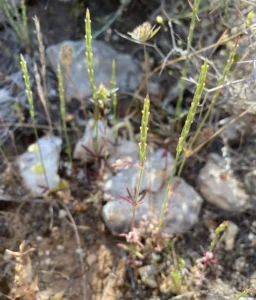
Regarding its preferred terrain and habitats, Crucianella latifolia is well-adapted to dry and often challenging environments. It thrives in stony and dry soils, frequently colonizing rocky surfaces, crevices within rocks, and dry stone walls. It is a common inhabitant of dry, stony, and sandy grasslands, particularly those found within xerothermic (hot and dry) oak forest belts. The plant also finds suitable conditions in pine woods and various types of Mediterranean shrubland, especially the low, open scrub characterized by rosemary and thyme, often referred to as "garigue." Furthermore, as an annual plant, it can opportunistically establish itself in disturbed or cultivated ground. It has also been documented in screes—slopes covered with loose stones, especially those with warm, exposed aspects. This includes scree environments in the Alps and Pyrenees, where it often prefers calcareous substrates. For instance, in Cyprus, where the plant is native, it has been recorded at altitudes ranging from sea level up to 900 meters, showcasing its adaptability to various elevations within its characteristic dry, open, and often calcareous habitats.
Leaves
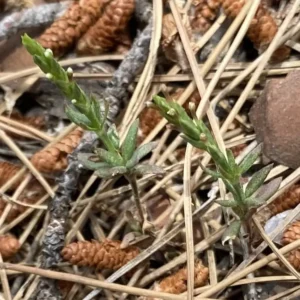
A defining characteristic of Crucianella latifolia lies in its leaf arrangement. The leaves are organized in whorls, with each whorl containing between 4 to 6 leaves, though sometimes up to 10 within the broader genus. The basal leaves tend to be lanceolate to obovate in shape. Moving up the stem, the middle and upper cauline leaves also form whorls and are notable for their revolute margins, meaning the edges are rolled backward. These leaves are generally broad and lanceolate, often exceeding a centimeter in length, and typically present a smooth green texture with clearly visible venation.
Similar leaves of Crucianella latifolia with Crucianella angustifolia
When identifying this species, it's crucial to distinguish it from Crucianella angustifolia, which possesses much narrower, linear leaves that are less than one centimeter long, and has a comparatively wider, quadrangular spike as opposed to the cylindrical spike characteristic of C. latifolia.
Flowers
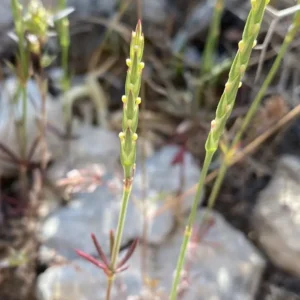
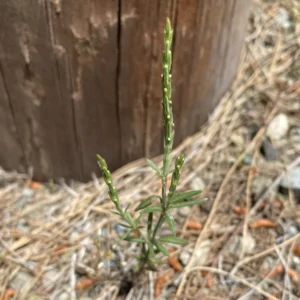
The flowers of Crucianella latifolia are arranged in dense, simple or branched spikes that form at the apex of the stems, presenting a long and narrow, subcylindrical inflorescence. Within these spikes, individual flowers are paired and emerge from the axils of specialized bracts. The corolla of each flower is four-lobed, appearing in shades of pale yellow, yellowish, or greenish cream, and is tubular in form. The corolla tube is typically straight and only marginally longer than the subtending bract, with the petals culminating in a yellowish filament. The calyx is notably absent, and the ovary is inferior. The bracts themselves are ciliate, meaning they are fringed with hairs, and are green with a distinctive white median line and membranous edges.
Fruit
The fruit of Crucianella latifolia is dry and consists of two distinct mericarps that separate at maturity. These mericarps are oblong-ovate, brown, and feature a tuberculate surface, meaning they are covered with small, rounded projections. Alternatively, the fruit can be described as ovate capsules that are striated with yellow markings.
How to recognize Crucianella latifolia
Two species in Cyprus are very confusing to distinguish, especially before their flowering period. These are C. latifolia and C. macrostachya
How to recognize C. latifolia and C. macrostachya before they bloom
Crucianella latifolia: The bracts, even though they grow opposite each other in pairs, are described as being connate (fused) for almost 2 mm above their base. "Fused" means that the two (opposite) bracts in a pair are physically joined together for a length of almost 2 millimeters, starting from where they attach to the stem. Instead of being entirely separate,, their bases grow together into a single structure for a short distance. For C. macrostachya the bracts are free or almost free to the base. This fusion can be a crucial distinguishing feature between species.
How to recognize C. latifolia and C. macrostachya after they bloom
C latifolia's bracts look more appressed on the stem compared to the ones of Crucianella macrostachya that appear loose. Additionally, C. latifolia's corolla slightly extends beyond the subtending bract, or extends for a couple of millimeters. For Crucianella macrostachya, the corolla tube is much longer than the subtending bract, indicating a more noticeable projection.