Date Created: 27.11.2022
Last Modified: 17.10.2026
Bellardia trixago (L.) All., commonly called Mediterranean lineseed, is an annual, upright herb native to Cyprus and the Mediterranean region. It is a hemiparasite: it makes its own food through photosynthesis but also connects its roots to those of nearby plants. In Cyprus it is reported from fields, roadsides and scrubby habitats, flowering mainly from March to May. The Kew taxonomic record accepts the name and describes the plant as a hemiparasitic annual.
Common Cypriot Names
The Cyprus Wild Flowers Database records the Greek botanical name Βελλαρδιά η τρισσόχειλος [vellardía-i-trissócheilos], meaning approximately “Bellardia with the three-lobed lip.” The name reflects the flower’s lower corolla lip, which is divided into three lobes.
Common English Names
- Mediterranean lineseed (ITIS)
- Bellardia (California Invasive Plant Council)
- Southern Bartsia (Cyprus tour report)
- Garden bellardia (California Invasive Plant Council report)
- Trixago bartsia (iNaturalist)
Common names differ among regional references. The scientific name is the clearest label for accurate identification.
Etymology of Bellardia trixago
The name of the genus, "Bellardia", is a tribute to Carlo Antonio Ludovico Bellardi (1741-1826), Italian physician, botanist and plant collector, professor at Turin. The name of the species, "trixago", derives from the Ancient Greek word "θρίξ" [thrix], meaning "hair", and the Latin suffix "-ago" used to indicate a property, and refers to the glandular-hairy characteristic of the plant.
Synonyms
- Alectorolophus trixago (L.) M.Bieb. (1808)
- Euphrasia trixago (L.) Vis. (1847)
- Rhinanthus trixago (L.) L. (1767)
- Bartsia trixago L. (1753)
These are the homotypic synonyms listed by POWO, shown from newest to oldest. The currently accepted combination is Bellardia trixago (L.) All.
Key Characteristics for Diagnostic Identification
- Growth form: An erect annual herb, usually growing as a single stem or with sparse branching. Kew’s flora description records plants reaching about 50 cm; height alone is not a reliable identification character.
- Stem: The stem is upright and may be simple or sparsely branched. It bears glandular hairs, which can give the plant a slightly hairy or sticky feel.
- Leaf arrangement: Leaves are opposite, with a pair arising at each node. This arrangement is useful when the plant is not flowering.
- Leaf shape and margin: Leaves are sessile, narrow lance-shaped to linear-lance-shaped, and have coarsely toothed margins. The leaves remain along much of the stem; those near the flower spike become smaller and blend into the bracts.
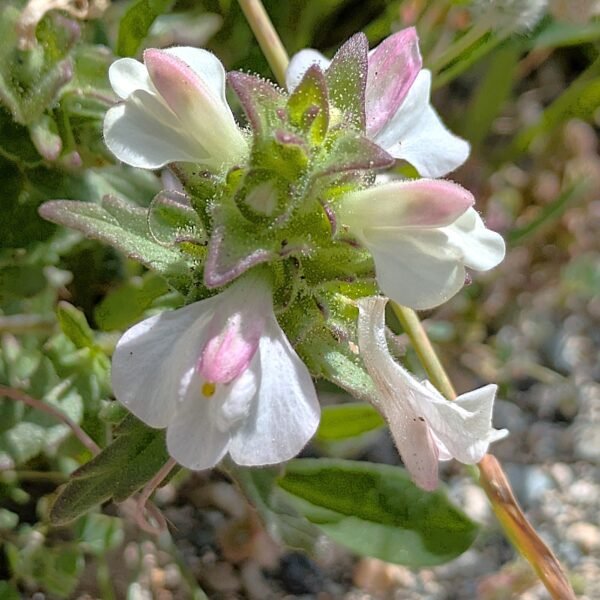
- Indumentum: Leaves, stems and flower bracts are glandular-hairy. The glandular covering is especially apparent around the flowering spike and helps separate the plant from superficially similar, less glandular herbs.
- Inflorescence: Flowers form a dense, terminal, spike-like cluster. The bracts beneath the flowers are leaf-like, smaller than the lower stem leaves and also glandular-pubescent.
- Calyx: The green calyx is bell-shaped and divided unevenly, with a distinctive division into two main lobes. Kew’s description records glandular hairs on the calyx as well.
- Corolla: The tubular corolla is two-lipped and usually white to pinkish in the botanical descriptions consulted. The lower lip has three rounded lobes, while the upper lip forms a hood-like galea. The three-lobed lower lip is a key feature behind the Greek name “τρισσόχειλος.”
- Reproductive parts: The flower has four stamens attached near the top of the corolla tube. The ovary is hairy, and the style curves slightly near its tip.
- Fruit and seeds: The fruit is an ovoid capsule, around 8–9 mm long in Kew’s description. Its small seeds have fine lengthwise and crosswise ridges. These features are most useful in mature fruiting specimens rather than in the field from a distance.
- Parasitic habit: It is a facultative hemiparasite: it photosynthesises but can also obtain water and nutrients through root connections to host plants. This ecological trait is not visible from a pressed specimen alone, but it helps explain why it occurs among other vegetation rather than as a wholly independent crop plant.
Botanical Structure and Floral Details of Bellardia trixago
Annual habit and leaves
This species completes its life cycle as an annual: it grows, flowers and sets seed within a season, then persists through unfavourable conditions as seed. Its lower leaves are longer than the leaves immediately below the spike. The stem leaves are sessile and opposite, with coarse teeth and glandular hairs. These features, rather than plant height or flower colour alone, make a more dependable identification combination. See the measurements and description in Kew’s flora record.
Flower structure
The flowers are bisexual and arranged along the terminal spike. Each flower is supported by a bract and has a green, hairy calyx surrounding a longer, tubular corolla. The corolla’s two lips are unequal: the upper lip forms a hood, and the lower lip is three-lobed. The flowers are often pale or pinkish, though colour can vary across populations and individuals.
Fruit and parasitic roots
After flowering, the ovary develops into a small capsule containing ridged seeds. Below ground, the roots can form connections with roots of neighbouring plants. The plant remains green and photosynthetic, but these connections allow it to supplement its resource uptake. The California Invasive Plant Council describes this hemiparasitic biology and notes that, outside its native range, it can occur in disturbed grasslands and roadsides.
Geographical Distribution and Habitat of Bellardia trixago
The species is native across much of the Mediterranean region and is also recorded in parts of Macaronesia, western Asia and Africa. It has been introduced beyond its native range, including parts of the Americas and Australia.
Distribution in Cyprus
Bellardia trixago is encountered all around the island up to an altitude of 1150 metres. It thrives in both cultivated and uncultivated fields, along roadsides and in ravines along with other low and shrubby vegetation. Its flowering period is between March and May.
Is Bellardia trixago Suitable for Gardens?
It is not a straightforward garden annual because it is a hemiparasite and may depend on suitable neighbouring host plants to thrive. Seeds do appear in commercial Mediterranean wildflower mixes, although availability may vary by seller and season. If grown, it is best suited to a naturalistic meadow or wildlife planting where it can grow among compatible vegetation, rather than a pot or tightly managed flower bed.
Medicinal Properties
Traditional claims and current evidence
A 2025 research paper describes traditional medicinal use of the species and investigates its aerial parts, but its own work is laboratory-based. The researchers measured phenolic compounds, antioxidant activity, enzyme inhibition and effects on cancer cell lines. They reported activity in these assays, including cytotoxicity toward a colon cancer cell line, but cell-line results do not demonstrate that the plant treats cancer or any human disease. The study is indexed with author, publication and institutional details on PubMed.
Fascinating Insights About Bellardia trixago
A plant that feeds itself and borrows resources
Unlike a fully parasitic plant, it retains chlorophyll and photosynthesises. It can also connect its roots to those of nearby plants and take up additional water and nutrients. This combination of self-feeding and root parasitism is why botanists call it a hemiparasite. The California Invasive Plant Council describes the root connections and photosynthetic habit.
The lower lip gives a clue to its Greek name
The Greek database name Βελλαρδιά η τρισσόχειλος draws attention to the flower’s three-lobed lower lip. That feature can be seen more clearly in a close view of a fresh flower than in a distant field photograph; Kew’s morphological account describes the three rounded lobes and hooded upper lip in its flower description.
Its flower spike can vary in colour
White and pinkish flowers are described in taxonomic references, and yellow-flowered individuals have also been reported. That variation matters in the field because yellow forms may be confused with Parentucellia viscosa. Comparing the flower spike, bracts, calyx and corolla tube gives a sounder identification than relying on colour alone; see the comparative botanical notes.