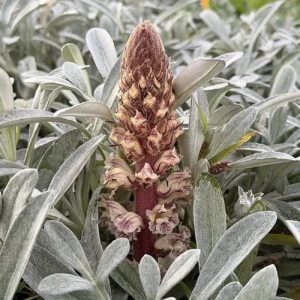
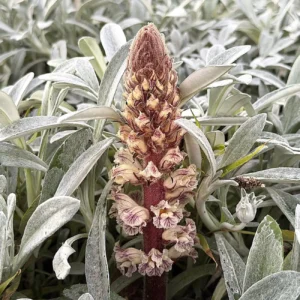
Orobanche crenata, commonly known as the Bean Broomrape, is a fascinating yet destructive parasitic plant that lacks chlorophyll and depends entirely on a host for survival. This species is easily recognized by its tall, robust flowering spikes that emerge from the soil near the base of its host. In Cyprus, it is a significant agricultural concern, particularly within the fertile plains where legumes are cultivated during the winter and spring months.
Cypriot Names
Οροβάγχη η κρενατή
Common English Names
In English, Orobanche creanata is most frequently called the Bean Broomrape due to its preference for infesting broad bean crops. It is also sometimes referred to as the Crenate Broomrape, a name that alludes to the notched or "crenate" appearance of its delicate flower petals. The Bean Broomrape is notorious among farmers for its ability to significantly reduce crop yields by siphoning nutrients.
Etymology of Orobanche crenata
The etymology of the genus name, "Orobanche", derives from the Ancient Greek "ὀροβάγχη", from "ὄροβος" [orovos] meaning "vetch" and the verb "ἄγχω" [ancho] meaning "throttle", hence "the vetch throttler", referring to the effect the Orobanche have on their hosts, as they are aggressive root-parasitic weeds exploiting other plants for water, assimilates, and nutrients from their roots. The species name "crenata" comes from the Latin word for "notched". The term crenate refers to the specific shape of the margins (edges) of the flower's petals. In botany, a "crenate" margin describes an edge that is rounded or has blunt teeth, giving it a wavy, scalloped, or "notched" appearance.
Synonyms and Historical Naming
The Bean Broomrape has been documented under various scientific names as researchers refined its classification within the Orobanchaceae family. It was previously referred to as Orobanche speciosa in some older Mediterranean botanical texts. These names often highlighted the "showy" or "special" appearance of its large, fragrant flowers, which stand in stark contrast to its parasitic lifestyle.
Botanical Structure
Underground Haustorial System
Because it lacks roots in the traditional sense, the Bean Broomrape develops a specialized organ called a haustorium. This structure attaches to the roots of the host plant, creating a physiological bridge to steal water and carbohydrates. This hidden connection is established long before the flowering spike even breaks the surface of the soil, making early detection difficult.
Achrophyllous Flowering Spikes
The plant produces no green leaves, as it does not perform photosynthesis; instead, it features small, scale-like bracts along a thick, fleshy stem. These stems are typically yellowish-white or tinged with purple and can reach heights of up to eighty centimeters. The lack of green pigment is a clear indicator of its total dependence on other living organisms.
Fragrant Bi-Colored Blooms
The flowers of the Orobanche crenata are relatively large and aromatic, arranged in a dense terminal spike. Each blossom features a white or cream-colored corolla with distinct violet or purple veining on the lips. These attractive flowers are designed to lure pollinators, ensuring the production of thousands of microscopic, dust-like seeds that can remain dormant for years.
Geographical Distribution
Mediterranean and Middle Eastern Range
This parasite is widespread across the Mediterranean basin, extending into North Africa and parts of Western Asia. It thrives in temperate climates where its preferred host plants are grown as staple crops. Its distribution follows the historical paths of legume cultivation, making it a well-known presence in ancient agricultural landscapes.
Distribution Across Cyprus
In Cyprus, the Bean Broomrape is common in agricultural regions such as the Mesaoria plain and the fertile valleys of Paphos and Limassol. It is most frequently seen in vegetable gardens and commercial fields where beans and peas are grown. It prefers low to middle altitudes where the soil is disturbed and nutrient-rich from farming activities.
Seasonal Emergence
The flowering spikes usually appear from January to May, coinciding with the peak growth and flowering of its host plants. In the mild Cypriot climate, the Bean Broomrape can emerge quite early in the spring if winter rains have been sufficient. Once the host plant begins to wither, the broomrape quickly sets seed and turns a dark, brittle brown.
Conservation Status
Abundant and Unprotected
Orobanche crenata holds no protective status in Cyprus. In fact, it is often treated as a noxious weed that requires management to protect food security. Its ability to produce millions of seeds per plant ensures its population remains stable and widespread.
Agricultural Impact
The presence of this plant is generally viewed as a negative indicator of crop health. While it is a natural part of the Mediterranean ecosystem, its explosion in monoculture fields can lead to total crop failure. Consequently, it is one of the few wild plants in Cyprus that is actively removed rather than preserved by the local population.
Habitat and Ecology
Parasitic Host Range
The Bean Broomrape is a "holoparasite," meaning it cannot survive without a host. While it is most famous for attacking beans, it can latch onto several different members of the Fabaceae and Apiaceae families. In Cyprus, it commonly parasitizes the following plants:
- Vicia faba (Broad Bean)
- Pisum sativum (Garden Pea)
- Lens culinaris (Lentil)
- Cicer arietinum (Chickpea)
- Vicia sativa (Common Vetch)
- Daucus carota (Wild Carrot)
- Ammi majus (Bullwort)
- Lathyrus odoratus (Sweet Pea)
- Medicago sativa (Alfalfa)
Specialized Seed Germination
The seeds of the Bean Broomrape have an incredible survival strategy; they will only germinate when they detect specific chemical signals, known as strigolactones, excreted by the roots of a nearby host. This ensures that the parasite does not waste its limited energy reserves unless a "victim" is within reach. This chemical warfare is a marvel of evolutionary biology.
Exciting Facts About the Bean Broomrape
An Edible Parasite
Surprisingly, in some parts of the Mediterranean and southern Italy, the young, tender underground shoots of Orobanche crenata are collected and eaten. They are often boiled or pickled and are said to have a slightly bitter, asparagus-like flavor.
The Dust-Seed Strategy
A single spike of the Bean Broomrape can produce upwards of 500,000 seeds. These seeds are so small that they are easily carried by the wind or stuck to the muddy boots of farmers, allowing the parasite to spread rapidly across entire districts. Their microscopic size allows them to slip deep into soil crevices where they can wait for over a decade.
Evolutionary Arms Race
The relationship between the Orobanche crenata and its hosts is a classic evolutionary arms race. Some varieties of fava beans have developed thicker root cell walls to prevent the parasite from attaching, while the broomrape continuously evolves new enzymatic "keys" to unlock the host's defenses. This constant struggle drives the biodiversity of the Mediterranean landscape.