Date Created: 10.05.2025
Last Modified: 22.05.2026
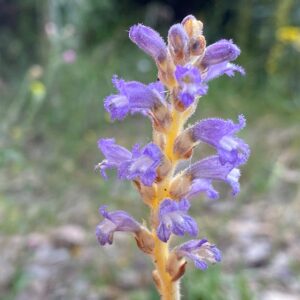
Phelipanche ramosa (traditionally classified as Orobanche ramosa and commonly known as hemp broomrape) is a widespread, highly destructive holoparasitic herb belonging to the Orobanchaceae family. Lacking both leaves and chlorophyll, it relies entirely on a specialized physiological connection to siphon water, mineral nutrients, and carbohydrates from the root systems of various dicotyledonous host plants. It is a highly variable and opportunistic species within the Cypriot flora, often forming conspicuous, bushy colorful clusters in both agricultural zones and natural lowland habitats.
Common Cypriot Names
In Modern Greek, the formal botanical name is Φελιπάνχη η κλαδωτή [Pheli-pan-khi i kla-dhi-tee] or Οροβάγχη η κλαδωτή [Oro-van-khi i kla-dhi-tee], translating directly to "branched broomrape." In the local Cypriot dialect, it shares the widespread vernacular name Λύκος [Ly-kos], meaning "wolf," an evocative historical term reflecting how the parasite silently stalks and saps the vital fluids of surrounding vegetation until the host is severely weakened or destroyed.
Common English Names
- Hemp Broomrape
- Branched Broomrape
- Tobacco Broomrape (in reference to its significant commercial host)
Etymology of Phelipanche ramosa
The genus name Phelipanche honors the French botanist Louis Phelipaux, merged with the Greek suffix "αγχών" [ankhon], meaning "to choke" or "to throttle," a vivid description of its lethal parasitic lifestyle. The specific epithet ramosa is derived from the Latin word for "branched" or "having many branches," highlighting its defining architectural trait. The traditional genus name, Orobanche, originates from the Greek words "όροβος" [orobos], a type of vetch, and "αγχών" [ankhon], alluding to its classical identification on leguminous crops.
Synonyms
- Orobanche ramosa L.
- Kopsia ramosa (L.) Dumort.
- Phelipanche ramosa subsp. ramosa
Key Characteristics for Diagnostic Identification
According to authoritative Mediterranean keys and the definitive structural parameters established in Robert Desmond Meikle’s Flora of Cyprus (Volume 2, 1985), Phelipanche ramosa is diagnosed and differentiated from its regional lookalikes by a precise combination of vegetative architecture and floral proportions:
- Presence of Bracteoles (The Sectional Split vs. Orobanche minor): The critical SOS diagnostic identifier to separate these genera is the floral bracteole arrangement. Each individual flower of Phelipanche ramosa possesses two narrow, linear, membranous bracteoles adnate to the sides of the calyx tube, in addition to the main single subtending bract. This immediately eliminates Orobanche minor, which belongs strictly to the Orobanche section and completely lacks bracteoles. Furthermore, O. minor has an unbranched, purplish-yellow stem and a corolla that is evenly curved along the dorsal line, lacking the blue-violet hue of P. ramosa.
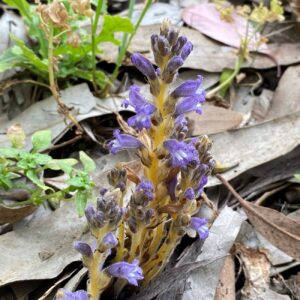
- Stem Branching Architecture (vs. P. nana & P. mutelii): The stem structure of P. ramosa is highly variable; while it is usually branched from near the base to form a multi-stemmed, parallel cluster of 3 to 9 erect flowering axes, it is not uncommon to find completely unbranched, simple individuals. This fluid habit separates it from Phelipanche nana, which remains strictly, invariantly simple and unbranched as a dwarf stem. It also overlaps with Phelipanche mutelii, which characteristically grows as a tall, simple, unbranched column; therefore, when encountering an unbranched specimen, stem architecture alone cannot separate P. ramosa from P. mutelii, forcing a reliance on inflorescence density and flower size.
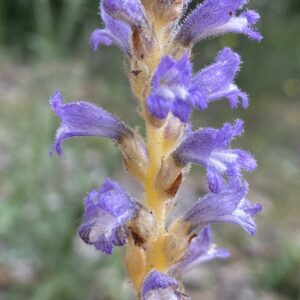
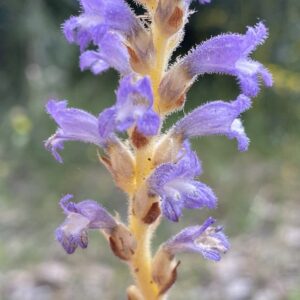
- Inflorescence Layout and Compactness (vs. P. nana & P. mutelii): The flowering spike of P. ramosa is distinctly lax, loose, and highly elongated as the plant matures. The flowers are well-spaced along the axis, leaving wide gaps of bare, light yellow-amber stem visible between the vertical tiers. This is completely opposite to both P. nana and P. mutelii, which feature highly compact, crowded, and congested inflorescences where the dense flower tiers overlap tightly and obscure the upper stem.
- Corolla Tube Size and Profile (vs. P. aegyptiaca & P. mutelii): The individual flowers of P. ramosa are small and slender, with a corolla tube strictly bounded between 12–15 mm long. The tube is held almost horizontally or at a wide angle from the stem. This instantly separates it from Phelipanche aegyptiaca, which boasts a massive corolla tube (20–35 mm long) that is sharply pinched into a narrow "neck" right above the ovary before inflating into a wide mouth. It also distinguishes it from P. mutelii, which features larger corolla tubes (15–20 mm long) that gently, continuously expand into a broad, gaping funnel-shape. While its length overlaps with P. nana (10–14 mm), P. nana corollas are obliquely ascending in a tiny, crowded, head-like cluster.
- Corolla Coloration and Calyx Segments (vs. P. hedypnoidis & P. zosimii): The corolla of P. ramosa is typically pale blue-violet to lavender, fading to a creamy white-yellow at the base of the tube. This separates it from Phelipanche hedypnoidis, which displays an unbranched, highly slender profile with much deeper, dark metallic purple or intense steel-blue flowers combined with elongated, finely tapering calyx teeth. It also isolates it from Phelipanche zosimii, a rare regional endemic that produces dull cream-colored or exceptionally pale, washed-out lilac blossoms.
- Host Specificity and Ecology (Micro-Diagnostic): Phelipanche ramosa is an exceptionally broad, eurytopic generalist that thrives across both natural and anthropogenic habitats in Cyprus. While it is a notorious pest in agricultural fields (attacking Solanaceae and Cucurbitaceae), it is highly frequent in wild maquis, forest openings, and garigue ecosystems, where it effortlessly jumps between diverse wild families. It parasitizes widespread forest and field herbs including native Fabaceae (wild clovers, medicks), Asteraceae (wild daisies, thistles), Brassicaceae, and Oxalidaceae. This wide-open ecological strategy directly separates it from its strict specialist lookalikes: P. hedypnoidis is rigidly bound to Hedypnois rhagadioloides; P. zosimii is an obligate parasite of annual Apiaceae like Zosimia absinthifolia; and while P. nana focuses heavily on dense forest blankets of Oxalis pes-caprae, it remains restricted to a tiny, unbranched, pocketed habit.
Botanical Structure and Floral Details of Phelipanche ramosa
The Calyx and Bracts
Each flower sits in the axil of a single, ovate-lanceolate, yellowish-brown bract that is roughly half as long as the corolla tube. Pressed tightly against the sides of the gamosepalous calyx are two linear, hair-like bracteoles. The calyx tube terminates in 4 or 5 triangular-lanceolate teeth that are covered in fine, short glandular-pubescent hairs, matching the downy texture of the pale yellow main stem.
Anthers and Stigma
Deep within the slender corolla tube sit 4 stamens (didynamous insertion). The anthers are typically glabrous or feature only a few tiny, isolated hairs clustered along the suture line near the base. The style is straight to slightly curved, bearing a prominent, bilayered stigma that is white, cream, or pale blue, providing a clear focal point within the open violet corolla mouth.
Geographical Distribution and Habitat of Phelipanche ramosa
Native to the entire Mediterranean basin, Central Europe, and Western Asia, this highly adaptable species has been inadvertently introduced via commerce to many temperate and subtropical zones worldwide, where it behaves as a serious agricultural weed. It prefers highly nitrophilous environments, ruderal habitats, cultivated fields, and open, low-altitude meadows.
Distribution in Cyprus
Phelipanche ramosa is a fully verified indigenous and widespread species across Cyprus. It is frequently recorded within the agricultural belts of the Mesaoria plain, the lowlands of Nicosia, the disturbed paths of the Akamas peninsula, and coastal fields throughout the Limassol, Larnaca, and Famagusta districts.
Elevation Range in Cyprus
This species is heavily restricted to low-altitude brackets across the island. It occurs abundantly from sea level up to approximately 400 meters. It rarely climbs into the higher mountainous zones, as it tracks the warmer valleys and agricultural flatlands favored by its primary hosts.
Flowering Period in Cyprus
The primary flowering window spans from February to May, perfectly aligning with the peak spring growth of annual weeds and vegetable crops. Under specific irrigation regimes in agricultural fields, sporadic flowering individuals can occasionally be encountered outside this standard window if host roots remain active.
Conservation Status in Cyprus
Evaluated against the criteria of the Red Data Book of the Flora of Cyprus, Phelipanche ramosa is categorized as Least Concern (LC). Due to its highly opportunistic generalist strategy and its preference for anthropogenically altered land, its populations are exceedingly stable, secure, and showing zero signs of regional decline.
Is Phelipanche ramosa Suitable for Gardens?
It is completely unsuitable for gardens and is viewed as an unwanted, hazardous pest. Because it spreads rapidly via thousands of microscopic seeds and lacks any independent root system, introducing it would devastate ornamental plants, vegetable patches, or potted solanaceous plants, severely reducing host vigor and stunting garden productivity.
Toxicity and Safety
No acute chemical toxicity or lethal poisoning events are reported for humans or livestock from interacting with Phelipanche ramosa. Like its close relatives, the vegetative tissues accumulate substantial quantities of bitter tannins and phenylethanoid glycosides. These bitter compounds serve as a natural defense mechanism, making the plant highly unpalatable to grazing animals and preventing mass herbivory.
Medicinal Properties
Traditional Astringent Uses
Historically, crude extracts of branched broomrapes were occasionally incorporated into rural Mediterranean folk remedies as topical washes. The high internal tannin content acted as a natural topical astringent, which helped to dry up external skin abrasions, constrict minor blood vessels, and soothe superficial tissue inflammation when applied as an external wash or poultice.
Modern Pharmacological Screening
In modern laboratory setups, researchers have isolated various active compounds from P. ramosa tissues, including phenylpropanoid glycosides. These specific phytochemical fractions showcase measurable antioxidant and cellular anti-inflammatory responses in vitro. However, these screens remain strictly academic; no clinical drug development has occurred, and the species holds no role in conventional modern pharmacy.
Fascinating Insights About "Phelipanche ramosa"
An Agricultural Nightmare
Unlike its relative Phelipanche nana, which targeting an invasive weed can be seen as an ecological benefit, Phelipanche ramosa is an economically destructive weed. A severe infestation in tomato, tobacco, or eggplant crops can sap so much moisture and energy from the field that crop yields can plummet by 50% to 70%, making it a highly feared organism among Cypriot farmers.
The Chemical Wiretap
The microscopic seeds of P. ramosa can lie completely dormant in the dry Cypriot soil for more than a decade. They are incapable of germinating on their own. Instead, they act like chemical wiretaps, waiting until they detect minute traces of strigolactones—hormones leaked naturally into the soil by the actively growing root tips of a potential host plant. Only when this specific chemical key is detected will the seed awaken and grow toward the host root.
The Subterranean Vampiric Straw
Upon detecting the host root, the germinating seed extends a microscopic tube called a haustorium. This specialized organ physically breaks through the outer cortex of the host root and anchors into the vascular plumbing (the xylem and phloem). Once this structural connection is complete, the broomrape establishes a permanent one-way siphon, draining nutrients and water continuously while remaining completely hidden underground for weeks before finally pushing its colorful purple spike into the open air.