Date Created: 01.04.2022
Last Modified: 12.05.2026
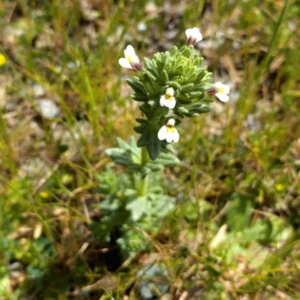
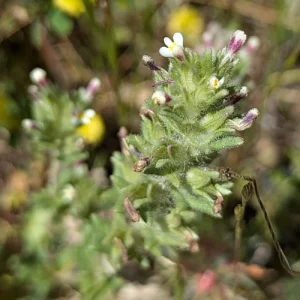
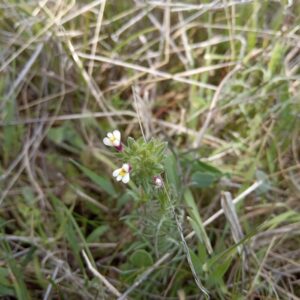
Parentucellia latifolia subsp. latifolia, commonly known as the Red Bartsia, is a small, annual hemiparasitic plant belonging to the Orobanchaceae family. It is widely distributed across Cyprus, gracing rocky hillsides and grasslands with its deep red to purple blossoms during the early spring months.
Common Cypriot Names
The formal translation in Modern Greek is Παραντουτσέλια η πλατύφυλλος [Parandutselia i platifyllos]. In Cyprus, it is locally known as Περδικολινάρι [Perdikolinari], a name derived from the partridge (perdika) which frequently forages in the habitats where this flax-like (linari) plant thrives.
Common English Names
- Red Bartsia
- Broad-leaved Parentucellia
Etymology of Parentucellia latifolia subsp. latifolia
The etymology of the genus name "Parentucellia" derives from Tommaso Parentucelli, the 15th-century Italian scholar who became Pope Nicholas V, honored for founding the Vatican Library and supporting early botanical studies. "Latifolia" derives from the Latin "latus", meaning "broad", and "folium", meaning "leaf", referring to the wider leaves characteristic of this subspecies.
Key Characteristics for Diagnostic Identification
According to the definitive botanical keys established by Robert Desmond Meikle in his comprehensive Flora of Cyprus (Volume 2, 1985), this species is distinguished from other taxa of the genus in Cyprus by the below morphological features:
- Corolla Color: The corolla of Parentucellia latifolia subsp. latifolia is characteristically purplish-red or pink, whereas in the only other genus member in Cyprus, Parentucellia viscosa, the flowers are bright yellow. This distinct color shift is the primary field identifier for separating the two species.
- Indumentum and Viscidity: This taxon is pubescent but not sticky to the touch, while Parentucellia viscosa is densely glandular-viscid (very sticky) throughout its stems, leaves, and inflorescence. The lack of stickiness in the Red Bartsia is an essential diagnostic marker.
- Calyx Teeth: The calyx teeth are short and broadly triangular, measuring significantly less than half the length of the calyx tube. Conversely, in Parentucellia viscosa, the calyx teeth are linear-lanceolate and nearly as long as the tube itself.
- Leaf Morphology: The leaves are ovate to broadly elliptical with few, coarse teeth. This contrasts with Parentucellia viscosa, which possesses narrower, lanceolate leaves that are typically more numerous and feature more serrated margins.
- Plant Height: Parentucellia latifolia subsp. latifolia is typically a dwarf plant, usually growing between 5 to 20 cm tall. In comparison, Parentucellia viscosa is significantly more robust, often reaching heights of 20 to 50 cm in similar environments.
Additional Identification Characteristics
Botanists note that this subspecies often grows in dense, localized colonies, creating a "red carpet" effect. This gregarious habit is less common in its yellow-flowered relative, which tends to grow in more scattered patterns within damp meadows or marshes.
Botanical Structure and Floral Details of Parentucellia latifolia subsp. latifolia
Floral Symmetry
The flowers are zygomorphic, featuring a two-lipped corolla that is typical of the family. The upper lip forms a hood over the stamens, protecting the pollen from rain, while the lower lip provides a platform for small insect pollinators.
Root System
As a hemiparasite, the root system includes specialized structures called haustoria. these organs attach to the roots of neighboring grasses and herbs, allowing the plant to extract water and mineral nutrients while still performing its own photosynthesis.
Geographical Distribution and Habitat of Parentucellia latifolia subsp. latifolia
The Red Bartsia is native to the Mediterranean region, extending into Western Europe and North Africa. It thrives in open habitats such as garrigue, bathas, and dry grasslands, often colonizing disturbed ground where competition from taller perennials is minimal.
Distribution in Cyprus
It is common throughout the island, found in almost all phytogeographical regions. Specific sightings are frequent in the Akamas Peninsula, the Troodos foothills, and the Kyrenia range, where it occupies thin soils over limestone or igneous rock.
Elevation Range in Cyprus
In Cyprus, this subspecies is found from sea level up to approximately 1,600 meters. It is particularly abundant at mid-elevations but can be found even on the higher peaks of the Troodos massif.
Flowering Period in Cyprus
The flowering season in Cyprus typically begins in February and continues through May. The timing is heavily dependent on winter rainfall, with drier years leading to an earlier and more abbreviated bloom.
Conservation Status in Cyprus
According to the Red Data Book of the Flora of Cyprus, Parentucellia latifolia subsp. latifolia is categorized as Least Concern (LC). It remains widespread and abundant, facing no immediate threats of extinction or significant habitat loss.
Is Parentucellia latifolia subsp. latifolia Suitable for Gardens?
This plant is not suitable for traditional gardens due to its obligate hemiparasitic nature, as it requires a host plant to survive. Furthermore, the Cyprus Forest Law restricts the collection of wild seeds, and they are not commercially available in international markets.
Toxicity and Safety
There is no evidence suggesting that this plant is toxic to humans or livestock. Scientific reviews of Mediterranean flora, such as those conducted by the European Food Safety Authority (EFSA), do not list this taxon as a known safety concern in grazing lands.
Medicinal Properties
Traditional Knowledge
Historically, members of the Orobanchaceae family were used in folk medicine for their astringent properties. However, specific medicinal applications for Parentucellia latifolia subsp. latifolia are poorly documented and lack scientific validation in modern ethnobotanical studies.
Antioxidant Potential
Research published in the Journal of Ethnopharmacology suggests that some hemiparasitic species contain iridoid glycosides and phenylethanoids. These compounds often exhibit mild antioxidant and anti-inflammatory activities, though direct studies on this specific subspecies remain scarce.
Fascinating Insights About "Parentucellia latifolia subsp. latifolia"
Stealing for Survival
The Red Bartsia is a master of resource theft. By tapping into the roots of grasses, it can survive in nutrient-poor, rocky soils where other non-parasitic annuals might wither during the sudden heatwaves of a Cypriot spring.
Seed Longevity
The seeds of this species are microscopic and can remain dormant in the soil for several years. They only germinate when they detect chemical signals from potential host roots, ensuring that the seedling emerges in close proximity to a food source.
Pollination Synergy
Despite its small size, the plant's vibrant red color is specifically tuned to the vision of small bees and wasps. These insects are the primary pollinators, drawn by the color and the narrow corolla tube which hides a small amount of nectar.
Indicator of Soil Health
Its presence in large numbers often indicates a balanced ecosystem. Because it parasitizes dominant grasses, it prevents them from outcompeting smaller wildflowers, thereby maintaining the high plant biodiversity seen in the Cypriot phrygana.
```