Date Created: 01.06.2026
Last Modified: 01.06.2026
Phelipanche mutelii, previously widely known as Orobanche mutelii and commonly known as Mutel's Broomrape, is an annual holoparasitic herb belonging to the family Orobanchaceae. This chlorophyll-free specialist derives all water and essential nutrients directly from host root systems. It plays an important role in Mediterranean ecosystems, capitalizing on diverse native and introduced vegetation.
Common Cypriot Names
The official modern botanical name translated into Greek is "Φελιπάνχη του Μουτέλ" [Phelipanchi tou Moutel]. Across the Cypriot countryside, local foragers and farmers traditionally refer to the Phelipanches and Orobanches simply as Λύκος [Lykos], meaning wolf. This name arose because the hidden parasite stealthily chokes host roots, aggressively draining their vitality like a wild predator.
Common English Names
- Mutel's Broomrape
- Mutel's Broom-rape
- Slender Broomrape
Etymology of Phelipanche mutelii
The etymology of the genus name, "Phelipanche" derives from the historical genus name "Phelypaea" honoring Louis Phélypeaux, Count of Pontchartrain, who was a prominent French statesman and a key financial patron of early botanical research, famously funding Joseph Pitton de Tournefort’s historic expeditions to the Levant where these plants were documented, and the Ancient Greek "αγχών" [ankhon], meaning "to choke", hence "Phélypeaux's choker", referring to its parasitic nature. "Mutelii" honors the French botanist and military officer Auguste Mutel (1795–1847), who collected and studied Mediterranean flora.
Synonyms
- Phelipanche mutelii ((F.W.Schultz) Pomel, 1874)
- Kopsia mutelii ((F.W.Schultz) Bég., 1902)
- Phelypaea mutelii ((F.W.Schultz) Reut., 1847)
- Orobanche mutelii (F.W.Schultz, 1835)
Key Characteristics for Diagnostic Identification
According to the definitive botanical keys established by Robert Desmond Meikle in his comprehensive Flora of Cyprus (Volume 2, 1985), augmented by modern taxonomic accounts from contemporary botanists Michael John Y. Foley, Ralf Hand, Stefan Rätzel, and Holger Uhlich, this species is distinguished from other color-resembling or morphologically close taxa in Cyprus by the below features:
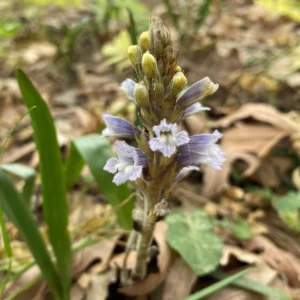
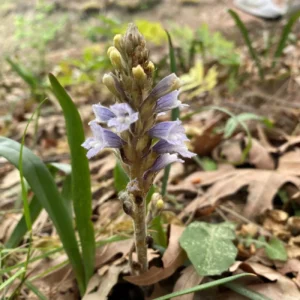
- Flower Color and Corolla Lip Pigmentation: The corolla features deep blue-violet or bluish flowers with dark blue venation on the lips. This trait immediately separates Phelipanche mutelii from Phelipanche zosimii and Phelipanche gussoneana, both of which display conspicuously pale, dull cream-colored or light lilac flowers lacking deep pigment. It contrasts with Phelipanche ramosa, which exhibits a distinctly bicolor appearance with a creamy-yellow tube base turning to a light blue-violet apex. It is distinguished from Phelipanche hedypnoidis, which displays a more uniform, soft pale blue-violet corolla. It also separates cleanly from Phelipanche nana, which shows an intensely bright, saturated blue-violet corolla with very short lobes. Meanwhile, the true broomrape Orobanche minor is easily told apart by its completely yellowish-brown to dull purple flowers.
- Stem Branching Habit and Architecture: The aerial stems are moderately branched from the middle or lower sections, or occasionally simple in smaller specimens. This architecture separates it from Phelipanche ramosa, which displays an extremely robust habit profusely branched from the very base into a dense candle-like cluster of parallel axes. Conversely, it stands distinct from Phelipanche nana, Phelipanche zosimii, and Phelipanche gussoneana, all of which develop strictly simple, solitary, and unbranched stems. It also differs from Orobanche minor, which exhibits a strictly simple, unbranched, robust, and stout stem structure, and Phelipanche hedypnoidis, which remains simple or only weakly split.
- Host Plant Selection: It demonstrates a highly opportunistic ecology, strongly prioritizing Oxalis pes-caprae along with various wild Asteraceae and Fabaceae. This highly generalized or weed-centric selection isolates Phelipanche mutelii from Phelipanche zosimii, which is strictly exclusive to Zosima absinthifolia, and Phelipanche gussoneana, which targets alternative annual Apiaceae. It stands fully distinct from Phelipanche hedypnoidis, which contemporary botanist Ralf Hand notes is strictly restricted to Hedypnois rhagadioloides. It also separates from Phelipanche nana, which, though sharing the Oxalis host, is distinguished by its distinct miniature habit, and Orobanche minor, which predominantly parasitizes Trifolium species and alternative forage Fabaceae. Finally, Phelipanche ramosa differs by strictly targeting intensive agricultural crops like tobacco, potato, and hemp.
- Habitat Preferences: This parasite thrives in cultivated fields, olive groves, vineyards, and anthropogenically disturbed ruderal spaces. This synanthropic preference separates it from Phelipanche zosimii and Phelipanche gussoneana, which are limited to open, undisturbed dry phrygana, degraded maquis, and skeletal calcareous hillsides. It is completely ecologically isolated from Phelipanche hedypnoidis, which is confined to coastal maritime sands, dunes, and coastal terraces. It also differs from Orobanche minor, which populates lowland pastures, artificial clover leys, and managed hay meadows.
- Elevation Ranges inside and outside Cyprus: Within Cyprus, its native distribution is highly eurytopic, ranging comfortably from sea level up to 1050 meters across lowland fields and hillsides. This wide vertical distribution contrasts with Phelipanche hedypnoidis, which remains restricted to a strict coastal strip from 0 to 150 meters elevation. It also sits separate from Phelipanche zosimii, which occupies a narrow inland tier between 300 meters and 700 meters. On a global scale, outside of Cyprus, contemporary records confirm that the elevation range found in other countries for this widespread Mediterranean taxon extends significantly from sea level up to 1800 meters, far outstripping the localized ranges of narrow endemics like Phelipanche nana.
Additional Identification Characteristics
Modern revisions by Foley (2001) state that checking the microscopic gland-tipped hairs on the internal surface of the corolla throat separates this species from lookalikes. Additionally, seed-coat micromorphology under scanning electron microscopy reveals distinct rectangular pitting patterns unique to this specific taxon complex.
Botanical Structure and Floral Details of Phelipanche mutelii
Stamen and Anther Details
The stamens are inserted approximately 4–6 mm above the base of the corolla tube. The filaments are glabrous or weakly puberulent near the attachment point. The anthers are conspicuously woolly or strongly hairy along their sutures, providing an important mechanical structural characteristic.
Stigma Lobes and Style
The style is persistent, glandular-pubescent, and curved gently forward at maturity. The stigma lobes are distinct, deeply divided, and white or translucent cream-colored. They turn slightly bluish or darker after successful pollination occurs in the field.
Geographical Distribution and Habitat of Phelipanche mutelii
This widespread holoparasite occurs abundantly across the entire Mediterranean basin, stretching eastward into Western Asia and the Arabian Peninsula. It tightly follows the distribution of its synanthropic host plants.
Distribution in Cyprus
In Cyprus, it is exceptionally common across virtually all lower phytogeographical divisions. Widespread populations are heavily documented throughout the Mesaoria plain, the Akamas peninsula, the Paphos and Limassol coastal lowlands, and the lower, human-modified foothills of the Troodos and Kyrenia ranges.
Elevation Range in Cyprus
The documented altitudinal distribution across the island is highly extensive, spanning from sea level up to 1050 meters elevation.
Flowering Period in Cyprus
The main flowering window is vernal, extending from February to May. Emergence and rapid spike development are strictly synchronized with the seasonal vegetative surge and peak moisture availability of its annual host plants.
Conservation Status in Cyprus
According to the Red Data Book of the Flora of Cyprus, this species is classified as Least Concern (LC). Because its primary modern host is an abundant, widespread agricultural weed, the plant enjoys secure populations and faces zero risk.
Is Phelipanche mutelii Suitable for Gardens?
This species is completely unsuitable for gardens due to its parasitic lifestyle. No commercial seed sources exist in the international market. Furthermore, introducing Phelipanche mutelii creates a severe biological risk of infecting ornamental plants or cultivating hazardous agricultural weeds.
Toxicity and Safety
No targeted clinical toxicology trials exist for this specific species. However, comprehensive investigations of parasitic Orobanchaceae by Professor Michael Wink at Heidelberg University demonstrate that broomrapes accumulate significant quantities of bitter phenylethanoid glycosides, iridoids, and condensed tannins. These secondary metabolites function as an evolutionary defense mechanism against herbivory. If ingested in quantity by humans or livestock, these active compounds provoke moderate to severe gastrointestinal irritation, nausea, and systemic metabolic upset. Therefore, field handling is entirely safe, but any oral ingestion must be strictly avoided.
Medicinal Properties
Ethnobotanical surveys in Cyprus indicate that this parasite has no traditional history of therapeutic application. However, modern pharmacological evaluations of the genus provide interesting scientific data.
Antioxidant Compounds
Peer-reviewed biochemical profiles published in the Journal of Ethnopharmacology demonstrate that extract fractions from this species are rich in acteoside and echinacoside. These phenylpropanoid glycosides exhibit highly potent radical-scavenging properties and marked anti-inflammatory activities in vitro.
Antimicrobial Potential
Phytochemical studies reveal that the secondary compounds extracted from the flowering spikes possess moderate antimicrobial properties against specific Gram-positive bacterial strains. However, due to a total lack of clinical trials, therapeutic use remains strictly experimental.
Fascinating Insights About "Phelipanche mutelii"
The Invasive Partnership
In Cyprus, this native parasite has formed an opportunistic relationship with *Oxalis pes-caprae*, an aggressive invasive weed from South Africa. By heavily attacking its root systems, the broomrape acts as an inadvertent biological control agent, naturally suppressing the weed's competitive dominance in local olive groves.
Chemical Detection Strategies
The microscopic seeds can remain completely dormant in the soil matrix for over a decade. They only germinate when they detect trace concentrations of strigolactones, which are specific chemical signaling hormones exuded into the soil by the actively growing roots of susceptible host plants.
Evolutionary Gene Shedding
Having completely abandoned photosynthesis, evolutionary geneticists have verified that this species has shed the majority of genes inside its chloroplast genome. It has streamlined its DNA to retain only essential metabolic housekeeping genes, transforming into a highly efficient molecular thief.