Date Created: 22.05.2026
Last Modified: 23.10.2026
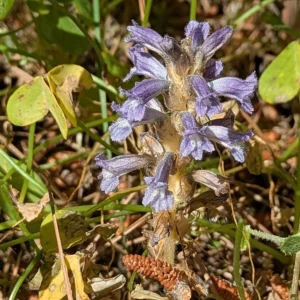
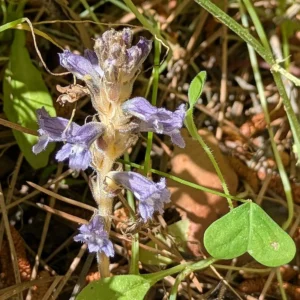
Phelipanche nana (traditionally classified as Orobanche nana) is a diminutive, highly specialized holoparasitic herb belonging to the Orobanchaceae family. Completely devoid of chlorophyll, it leads a strictly parasitic existence, drawing all its water and nutrients directly from the root systems of specific host plants. It is a fascinating component of the vernal flora of Cyprus, appearing as a miniature splash of violet on the forest floor.
Common Cypriot Names
In Modern Greek, the formal botanical name is Φελιπάνχη η νάνα [Phelipankhi i nana] or Οροβάγχη η νάνα [Orovankhi i nana]. Locally in the Cypriot countryside, it shares the generic folksy name Λύκος [Lykos], which translates to "wolf," a historic and highly descriptive term highlighting how the plant subtly sneaks up through the soil to "devour" or sap the life out of its neighboring host plants.
Common English Names
- Dwarf Broomrape
- Midget Broomrape
- Oxalis Broomrape (colloquial, in reference to its common host)
Etymology of Phelipanche nana
The genus name Phelipanche honors the French botanist Louis Phelipaux, combined with the Greek suffix "αγχών" [ankhon], meaning "to choke" or "to throttle," directly describing its parasitic lifestyle. The specific epithet nana stems directly from the Latin word for "dwarf" or "midget," emphasizing its distinctly small, stunted stature compared to its robust relatives.
Synonyms
- Orobanche nana (Noë ex Reut.) Noë ex Beck
- Orobanche ramosa var. nana Noë ex Reut.
- Phelipanche mutelii var. nana (Noë ex Reut.) Soják
Key Characteristics for Diagnostic Identification
According to authoritative botanical frameworks and Mediterranean Orobanchaceae keys, Phelipanche nana is definitively identified and separated from its closest regional lookalikes by a highly specific suite of reproductive, vegetative, and ecological markers:
- Presence of Bracteoles (The Sectional Split vs. Orobanche minor): The most fundamental SOS diagnostic identifier is the presence of bracteoles. Phelipanche nana possesses two narrow, linear bracteoles pressed tightly to the sides of the calyx tube, in addition to the main floral bract. This immediately separates it from Orobanche minor, which belongs to the Orobanche section and completely lacks bracteoles (having only a single bract subtending each flower). Furthermore, O. minor features a yellowish-brown to purple corolla that is evenly curved along the back, completely lacking the distinct blue-violet tones of P. nana.
- Stem Branching Architecture (vs. P. ramosa & P. aegyptiaca): The stem of P. nana emerges from the soil as a strictly simple, unbranched, and dwarf column. This sharply contradicts Phelipanche ramosa and Phelipanche aegyptiaca, both of which are usually conspicuously and profusely branched. P. ramosa typically produces multiple slender lateral branches from the middle of the stem, while P. aegyptiaca forms robust, multi-spiked, bushy clusters. Furthermore, while Phelipanche mutelii is also usually unbranched, it is a much taller, more robust plant (15–25 cm) that can occasionally produce secondary basal branches under optimum conditions.
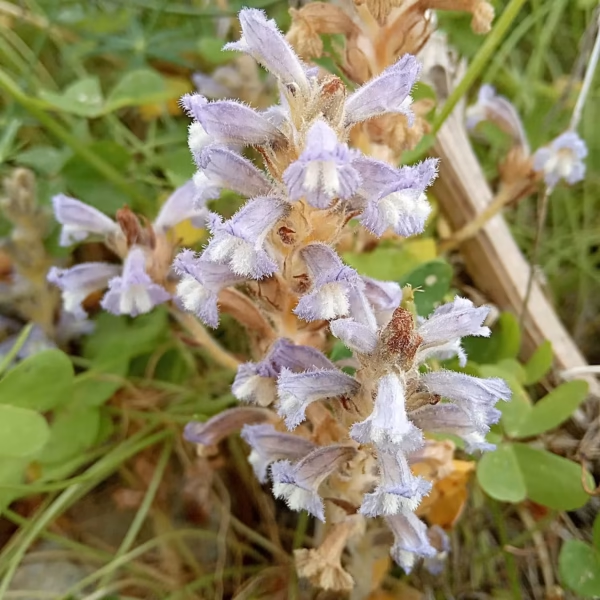
- Inflorescence Compactness and Size (vs. P. ramosa & P. mutelii): The flowering spike of P. nana is extremely short, compact, and few-flowered (pauciflowered), typically bearing only 4 to 10 tightly clustered flowers (typically, not the rule). This layout separates it from P. ramosa, which develops a distinctly lax, loose, and highly elongated inflorescence with wide gaps of bare stem visible between flower tiers. It also contrasts with P. mutelii, which produces a much longer, dense, and many-flowered vertical cylinder.
- Corolla Tube Size and Shape (vs. P. aegyptiaca, P. mutelii, & P. ramosa): The individual flowers of P. nana are small, with a corolla tube measuring strictly 10–14 mm long that is moderately curved and remains relatively narrow/tubular up to the lobes. This separates it from P. aegyptiaca, which features a massive corolla tube (20–35 mm long) that is uniquely and sharply constricted into a narrow "neck" just above the ovary before inflating wildly. It also separates it from P. mutelii, which has larger tubes (15–20 mm long) that continuously and gently widen into a broad, gaping funnel-shaped mouth. While its flower size overlaps with P. ramosa (12–15 mm), P. ramosa flowers are held horizontally on a loose axis, whereas P. nana flowers are obliquely ascending in a tight cluster.
- Corolla Coloration and Calyx Ratios (vs. P. hedypnoidis & P. zosimii): The flowers of P. nana are pale violet-blue with contrasting white-fuzzy patches on the lower lip folds. This distinguishes it from Phelipanche hedypnoidis, which develops a more slender, flexible spike with smaller, much deeper purple or intense steel-blue flowers and significantly longer, finely acuminate calyx teeth. It also separates it from Phelipanche zosimii, a very rare Cypriot endemic that features dull cream-colored or extremely pale lilac flowers that lack the bright violet-blue saturation of P. nana.
- Host Specificity and Ecology (Micro-Diagnostic): Phelipanche nana (and Phelipanche mutelii) demonstrates a powerful ecological affinity for Oxalis pes-caprae (Bermuda buttercup) in Cypriot habitats, systematically colonizing its root masses. It explicitly avoids the specific host dynamics of the lookalikes: P. hedypnoidis is strictly restricted to parasitizing Hedypnois rhagadioloides; P. zosimii selectively targets annual Apiaceae (such as Zosimia absinthifolia); P. ramosa and P. aegyptiaca target large-scale agricultural Solanaceae or Cucurbitaceae crops; and Orobanche minor primarily parasitizes Fabaceae (clovers, alfalfa) and various Asteraceae.
Botanical Structure and Floral Details of Phelipanche nana
The Calyx and Bracts
Each flower sits in the axil of a single, small, ovate-lanceolate brownish bract. Adnate to the sides of the gamosepalous calyx tube are two linear, hair-like bracteoles. The calyx itself is split into 4 or 5 triangular-lanceolate teeth that are glandular-pubescent, giving the base of the dwarf flower a sticky, fuzzy texture under a hand lens.
Anthers and Stigma
Deep within the narrow corolla tube sit 4 stamens. The anthers are typically glabrous or bear only a few fine, sparse hairs at the base along the suture line. The style is short, terminating in a bilayered stigma that is whitish, cream, or pale yellow, standing out visually against the violet background of the inner corolla lobes.
Geographical Distribution and Habitat of Phelipanche nana
Native across the Mediterranean basin, Southern Europe, and parts of Western Asia, this dwarf species thrives in locations where its primary host can establish dense populations. It is highly opportunistic, adapting well to both wild and semi-disturbed habitats.
Distribution in Cyprus
Phelipanche nana is a verified indigenous component of the flora of Cyprus. It is widely distributed across the island's phytogeographical regions, recorded extensively in the Akamas peninsula, the Paphos district, the Limassol lowlands, the Machairas forest, and the lower slopes of the Troodos range area.
Elevation Range in Cyprus
It occupies a distinct mid-to-low altitude bracket across the island, occurring comfortably from near sea level up to approximately 700 meters. It is most frequently spotted at around the 400–500 meter mark where forest edges shade out the blistering sun but allow the host plants to form dense carpets.
Flowering Period in Cyprus
The flowering window is brief and strictly tied to the life cycle of its winter-spring hosts, blooming from February to May. By late May, as the hot Cypriot summer approaches and the ground dries out, the entire aerial spike quickly withers, turns into a brittle brown stick, and disperses millions of microscopic seeds into the soil.
Conservation Status in Cyprus
Following the regional assessments of the Red Data Book of the Flora of Cyprus, Phelipanche nana holds a status of Least Concern (LC). Because its primary modern host, Oxalis pes-caprae, is an aggressive, widespread invasive weed across Cyprus, the broomrape enjoys a virtually unlimited food supply, ensuring its populations remain highly secure and stable.
Is Phelipanche nana Suitable for Gardens?
It is absolutely not suitable for gardens and is impossible to cultivate traditionally. Lacking roots and leaves, it cannot grow in soil on its own. Furthermore, because it acts as a debilitating parasite, introducing it into a garden setting means intentionally harboring and maintaining infestations of host weeds or potentially exposing ornamental plants to parasitic infection.
Toxicity and Safety
There are no documented records of acute chemical toxicity to humans or animals resulting from Phelipanche nana. However, like most members of the broomrape family, the tissues are heavily laden with tannins and bitter phenylethanoid glycosides, rendering the plant highly unpalatable. If consumed in massive quantities by livestock, it could cause mild digestive irritation due to these astringent compounds.
Medicinal Properties
Traditional Astringent and Wound Healing
In historic Mediterranean ethnobotanical practices, extracts from various blue-flowered broomrapes were occasionally utilized as topical washes. The high concentration of tannins gave the plant potent astringent properties, which helped constrict bodily tissues, staunch minor bleeding from surface wounds, and dry up weeping skin irritations when applied as a crude poultice.
Antimicrobial and Antioxidant Research
Modern pharmacological screens of the genus Phelipanche have isolated high levels of phenylpropanoid glycosides. In laboratory settings, these active compounds demonstrate notable antioxidant and anti-inflammatory mechanisms. While promising for potential future biochemical research, no clinical trials have been conducted, and it remains unused in modern conventional medicine.
Fascinating Insights About "Phelipanche nana"
The Miniature Enemy of an Invader
In Cyprus, Phelipanche nana serves as a fascinating example of natural biological pressure. Its primary host, Oxalis pes-caprae, is a South African native that has aggressively invaded Cypriot olive groves, fields, and forests. By heavily parasitizing this weed, this tiny broomrape acts as a native counter-force, draining the energy of the invader and naturally reducing its competitive dominance in local forest ecosystems.
Dust-Like Seed Longevity
A single tiny spike of P. nana can produce tens of thousands of microscopic, dust-like seeds. These seeds are uniquely adapted to remain completely dormant in the Cyprus soil for up to 10 to 20 years. They will refuse to germinate until they detect specific chemical signals—exuded directly by the growing root tips of a matching host plant—triggering them to wake up and attack.
The Thief's Tube
When a seed germinates, it does not grow a root. Instead, it produces a specialized microscopic tube called a haustorium. This structure acts like a biological drill bit, tunneling directly through the cell walls of the Oxalis root until it connects into the host’s vascular plumbing (xylem and phloem), creating a permanent straw through which it siphons food.