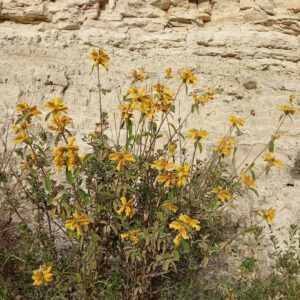
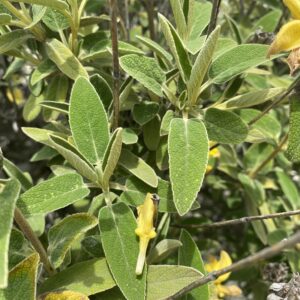
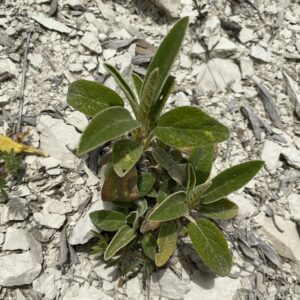
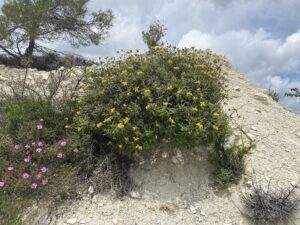
Phlomis brevibracteata Turrill, a distinguished member of the Lamiaceae family, is an endemic shrub of Cyprus known commonly as the Short-bracted Phlomis. This aromatic, grey-leaved perennial is a flagship species of the Cypriot flora, often found clinging to limestone outcrops.
Cypriot names
Φλόμος, Φλομίς η βραχυβράκτια
Common English Names
The most frequent English name is the Short-bracted Phlomis, which refers to the reduced size of the floral bracts compared to its relatives. This name is used primarily in botanical circles to distinguish Phlomis brevibracteata from the more widespread Phlomis cypria.
Etymology of Phlomis brevibracteata
The etymology of the genus name "Phlomis" derives from the Ancient Greek "φλομίς" which means "flame", referring to the appearance of its flowers. The epithet derives from Latin; "brevi-" means "short" and "bracteata" means "having bracts", thus "short-bracted".
Synonyms
No significant botanical synonyms are recorded for this endemic species.
Key Characteristics for Diagnostic Identification
According to Meikle, Phlomis brevibracteata is defined by several unique morphological characters that are essential for accurate field identification:
- Inflorescence Structure: The flowers are arranged in 1–3 remote verticillasters, each containing about 6–10 individual blossoms.
- Bract Size: The bracts are notably short, usually only 4–8 mm long, and do not exceed the length of the calyx.
- Corolla Color: The flowers are a pale, delicate yellow, unlike the deep golden yellow of Phlomis cypria.
- Indumentum: All parts of the plant are covered in a dense, greyish-white felt of stellate (star-shaped) hairs.
- Leaf Shape: The leaves are ovate-oblong with an obtuse apex and a characteristic rugose (wrinkled) surface.
- Calyx Teeth: The calyx features short, subulate teeth that are typically only 1–2 mm in length.
Botanical Structure and Floral Details of Phlomis brevibracteata
Foliage and Surface Texture
The leaves of Phlomis brevibracteata are a soft, silvery-grey, providing a beautiful contrast against the dark limestone rocks it inhabits. The surface is deeply wrinkled, and the margins are finely crenate. This dense hairiness is an adaptation to reduce transpiration and protect the plant from the intense Mediterranean sun.
Floral Architecture and Color
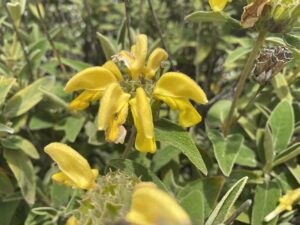
The flowers are zygomorphic, with a hooded upper lip that protects the reproductive organs. In Phlomis brevibracteata, these pale yellow flowers are elegantly held in tiered clusters. The specialized shape of the corolla is perfectly designed to facilitate pollination by long-tongued bees that are active in the Cypriot spring.
Geographical Distribution and Habitat of Phlomis brevibracteata
Global Distribution and Range
Across the world, this species is found nowhere else but on the island of Cyprus. It is a strict endemic, meaning its entire natural population is confined to a specific geographical area. It represents a significant element of the island's unique biological heritage and is protected under local conservation laws.
Distribution in Cyprus
Phlomis brevibracteata is a rare indigenous, endemic plant in Cyprus, strictly protected by law. Phlomis brevibracteata is considered a vulnerable species in Cyprus. It does not appear in the vast Mesaoria region as well as in the Akamas region. It is encountered at an altitude of 50-925 metres. It prefers igneous or limestone slopes, especially where are or used to be pine trees. It is found at least in some areas of the Pentadaktylos mountain range (Kerynia district), in areas of Lefkara, in Kakoratzia near Kofinou village, and Kalavasos (Larnaca district), north of Agios Nikolaos near Mandria village (Pafos district), Trimiklini, and western of the Kouris dam, on Souni village territory, where there used to be a pine forest before the countless wildfires (Limassol district). Its flowering period is around May and June.
Is Phlomis brevibracteata Suitable for Gardens?
When considering "Is Phlomis brevibracteata Suitable for Gardens?", it is an excellent candidate for xeric or "dry" gardens. Its silver foliage remains attractive year-round, and its pale yellow flowers provide a subtle elegance. However, it requires very well-drained, alkaline soil and should be positioned in full sun to mimic its natural limestone habitat.
Fascinating Things About Phlomis brevibracteata
Evolution of an Endemic
The existence of Phlomis brevibracteata as an endemic species is a result of thousands of years of isolation on Cyprus. Over time, it diverged from its mainland ancestors to adapt specifically to the island's limestone microclimates, developing the shorter bracts and pale flower color that define it today.
Traditional Uses of Phlomis
While specific uses for Phlomis brevibracteata are rare due to its restricted range, members of this genus have historically been used by shepherds. The thick, woolly leaves were sometimes used as natural sponges or even as insulation. The plant is often ignored by grazing goats due to its high essential oil content.
Geometric Precision of Verticillasters
The arrangement of the flowers in "verticillasters" (false whorls) is a masterclass in plant geometry. Each cluster is perfectly spaced along the stem to ensure that every flower has access to pollinators. This tiered structure is a common and striking feature of the Lamiaceae family, of which Phlomis brevibracteata is a prime example.
How to identify Phlomis brevibracteata
In the territory controlled by the Republic of Cyprus you will encounter Phlomis brevibracteata, cypria subspecies occidentalis, and lunariifolia, which look similar to the human eye. Their key characteristics that differentiate them are the following:
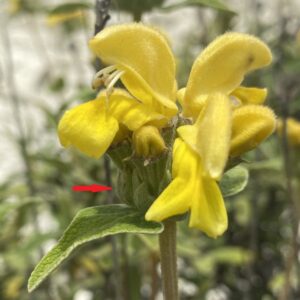
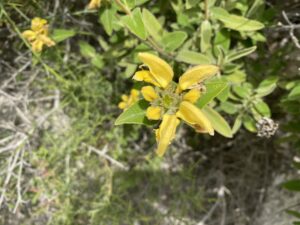
Phlomis brevibracteata can be found in several areas of Cyprus (central-eastern Pafos district, southwestern Larnaca district, and central-southern Limassol district), but still it is endangered. Its bracteoles are very small, only 2-5 mm long, and less than half the length of the calyx (a bracteole is a small leaf of the leaf-like structure directly subtending a flower or inflorescence whose stalk itself is subtended by a bract - see picture below). Additionally, its lips are more or less even in length. The upper and lower side of the leaf are green.
Phlomis cypria subspecies occidentalis is said to exist only in northwestern Pafos, near the village of Lysos. Its bracteoles are more than 5 mm long, usually almost as long as the calyx or a little longer. Its upper lip is shorter, pubescent and curvy; its lower lip is longer and wider but with less pubescence. The upper side of the leaf is green and the lower side is green or almost green.
Phlomis lunariifolia is not an endangered species in Cyprus; logic implies it is more common than the other two. It appears at a lower altitude than the other two, up to 600 metres in western Cyprus only (the others up to 925 and 800 metres respectively). Its bracteoles are more than 5 mm long, usually almost as long as the calyx or a little longer; they are thinly pilose, with hispid-ciliate margins. The apex of the calyx bears 5 spreading, spinous awns 2.5-4 mm long. Its upper lip is shorter than the lower lip. The upper surface of their leaves is vivid green and the lower is white/grey.