Date Created: 14.06.2022
Last Modified: 04.05.2026
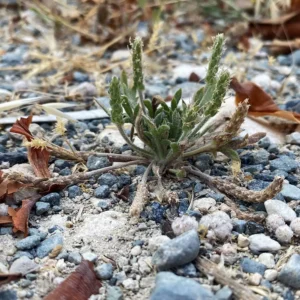
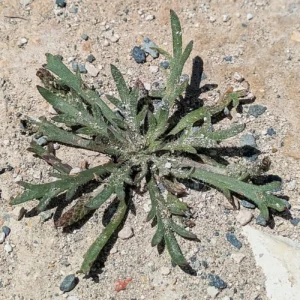
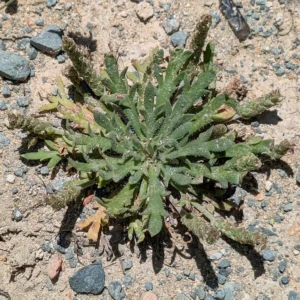
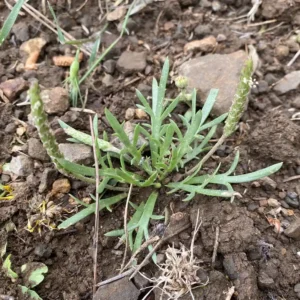
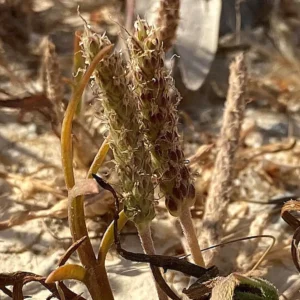
Plantago coronopus subsp. commutata, known as Buck's-horn Plantain, is a resilient annual or biennial herb commonly found in the Mediterranean. This plant is easily identified by its basal rosette of deeply lobed, narrow leaves. It thrives in saline coastal environments, often forming dense mats in areas where other vegetation struggles to survive the sea spray.
Common Cypriot Names
The formal translation is Πλαντάγο το κορωνόπους υποείδος το εναλλάσσον [Plantago-to-koronopous-ypoeidos-to-enallasson]. In Cyprus, it is known as Περδικούδιν [Perdikoudin]. This name was documented by Panayiotis Gennadius in his Lexikon Phytologikon (1914), noting that the name refers to "little partridge" because the plant’s seeds are a preferred food for partridges in the wild.
Common English Names
- Buck's-horn Plantain
- Star of the Earth
- Minutina
- Herb-ivy
Etymology of Plantago coronopus subspecies commutata
The etymology of the genus name "Plantago" derives from the Latin "planta", which means "sole" or "flat", and the suffix "-ago", meaning "resemblance", hence "resembling a sole" alluding to the leaf shape of the original plant that was the reason for the genus to be named as such. . "Coronopus" derives from Ancient Greek "κορωνόπους", and more specifically from "κορώνη", meaning "crow" and "πους", meaning "foot/leg", hence its leaves resemble "the foot of the crow". "Commutata" is Latin meaning "switched, changed", indicating its status as a distinct variation.
Key Characteristics for Diagnostic Identification
According to the definitive botanical keys established by Robert Desmond Meikle in his comprehensive Flora of Cyprus (Volume 2, 1985), this species is distinguished from other taxa of the genus in Cyprus by the below morphological features:
- Leaf Segmentation: The leaves are deeply pinnatifid or dentate with narrow, linear segments. This distinguishes it from P. lanceolata and P. lagopus, which possess entire or very slightly denticulate leaves.
- Sepal Structure: The posterior sepals are prominently keeled and winged along the midrib. This is a vital SOS diagnostic used to separate Plantago coronopus subsp. commutata from P. albicans, which features densely villous sepals without distinct membranous wings.
- Bracts: The bracts are ovate-acuminate and generally equal the length of the sepals. Unlike P. cretica, the bracts here are not elongated into long, spinescent appendages.
- Spike Shape: The flowering spikes are cylindrical and dense. This separates it from P. afra (formerly P. psyllium), which has opposite leaves and shorter, more capitate (head-like) inflorescences.
- Stem Presence: The plant is acaulescent, meaning the leaves arise in a basal rosette. This differentiates it from the caulescent (stemmed) species like P. squarrosa found in similar sandy habitats.
Additional Identification Characteristics
Modern Mediterranean botanists, such as Pignatti, note that Plantago coronopus subsp. commutata often exhibits a more prostrate growth habit and shorter, more compact spikes than the nominate subspecies. It is also more frequently associated with ephemeral saline pans rather than stable grassland, showing higher succulent tendencies in its foliage.
Geographical Distribution and Habitat of Plantago coronopus subspecies commutata
This subspecies is a halophytic specialist, widely distributed across the coastal regions of the Mediterranean and Western Asia. It typically inhabits maritime sands, rocky coastal paths, and the margins of salt marshes, where it tolerates high levels of soil salinity and constant exposure to wind and salt spray.
Distribution in Cyprus
In Cyprus, it is a common sight along the entire coastline. Robust populations are recorded in the Akrotiri and Larnaca salt lake areas, the Akamas peninsula, and the sandy stretches of Ayia Napa. It is particularly well-adapted to the compacted soils of coastal footpaths used by hikers.
Elevation Range in Cyprus
The elevation range for this taxon is strictly limited to the lowlands, typically found from sea level up to 150 metres. It rarely penetrates the inland agricultural plains or mountain foothills.
Flowering Period in Cyprus
The flowering period in Cyprus begins in March and continues through June. The seeds ripen quickly, allowing the plant to complete its reproductive cycle before the extreme heat of the mid-summer months desiccates the shallow coastal soils.
Conservation Status in Cyprus
According to the Red Data Book of the Flora of Cyprus, this plant is classified as Least Concern (LC). It remains widespread and abundant, though some coastal populations are vulnerable to the physical destruction of their habitat through heavy tourist infrastructure development and beach grooming.
Is Plantago coronopus subspecies commutata Suitable for Gardens?
The Buck's-horn Plantain is increasingly popular in gourmet gardening, where it is sold under the name "Minutina." It is highly suitable for coastal gardens with poor, sandy soil. Seeds are widely available in the international market, particularly from heirloom vegetable suppliers, and there are no legal restrictions on its cultivation.
Toxicity and Safety
There are no known toxic effects associated with Plantago coronopus subsp. commutata for humans or domestic animals. It has been consumed as a vegetable for centuries. However, as noted by the European Food Safety Authority (EFSA) regarding wild-collected greens, plants growing in coastal areas may accumulate environmental pollutants if the site is near industrial runoff. Consumers should ensure plants are harvested from clean, non-contaminated sites to avoid secondary ingestion of heavy metals.
Medicinal Properties
Anti-inflammatory Compounds
Research by pharmacognosists such as R. Samuelsen (2000) confirms that the Plantago genus contains high levels of iridoid glycosides, specifically aucubin and catalpol. These compounds provide the plant with significant anti-inflammatory and antimicrobial properties, making it a traditional remedy for minor wounds and skin irritations when used as a poultice.
Mucilage and Digestive Health
The leaves and seeds of Plantago coronopus subsp. commutata are rich in mucilage. According to studies in the Journal of Ethnopharmacology, this mucilage acts as a demulcent, coating the lining of the throat and digestive tract. This property has led to its use in traditional medicine to soothe dry coughs and treat mild gastrointestinal inflammation.
Fascinating Insights About "Plantago coronopus subspecies commutata"
The "Partridge's Bread"
The local Cypriot name "Perdikoudi" highlights a deep ecological link. Field observations by the Cyprus Forestry Department suggest that the nutrient-dense seeds of this plant provide a vital food source for the Chukar Partridge (Alectoris chukar) during the lean spring months, acting as a natural high-protein supplement.
Saline Survivalist
Research into halophytes reveals that this plant can actively manage salt concentrations within its tissues. By sequestering salt in its older leaves, which then wither and drop off, Plantago coronopus subsp. commutata effectively "cleanses" itself of toxic sodium levels, allowing it to thrive in environments that would dehydrate most other herbaceous plants.
A Resurrected Salad Green
While often treated as a weed today, historical texts indicate this plant was a staple "winter salad" in 16th-century Europe. It was valued for its crunchy texture and nutty flavor. Its modern comeback in "fine dining" as Minutina is a rare example of a wild Mediterranean plant successfully transitioning back into commercial agriculture.