Date Created: 27.04.2022
Last Modified: 05.05.2026
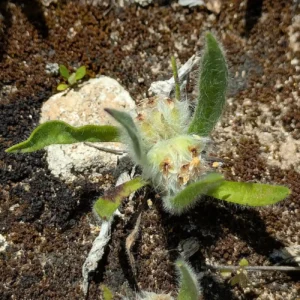
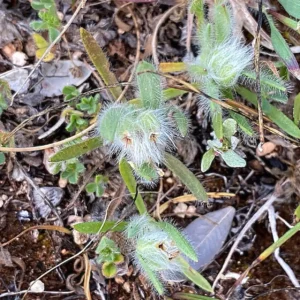
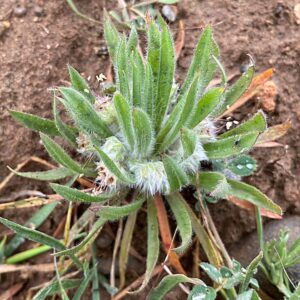
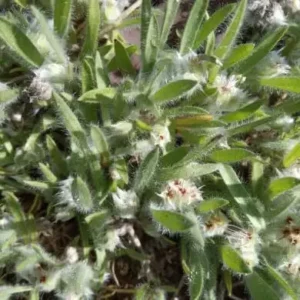
Plantago cretica, known by its common name Crete Plantain, is a fascinating annual herb native to the Eastern Mediterranean. This species is easily recognized by its silvery-hairy foliage and its unique habit of curving its flower stalks toward the ground after pollination, a biological process known as geocarpy that ensures seed survival in harsh terrains.
Common Cypriot Names
The formal translation in Modern Greek is Πλαντάγο το κρητικό [Plantago-to-kritiko]. In Cyprus, it is locally called Περδικούδιν [Perdikoudin]. According to the Lexikon Phytologikon by Panayiotis Gennadius (1914), this name refers to "small partridge," as the nutrient-dense seeds are a primary food source for partridges. This specific nomenclature is verified by the Cyprus Department of Forests in their local floral inventories.
Common English Names
- Crete Plantain
- Cretan Plantain
- Silvery Plantain
Etymology of Plantago cretica
The etymology of the genus name "Plantago" derives from the Latin "planta", which means "sole" or "flat", and the suffix "-ago", meaning "resemblance", hence "resembling a sole" alluding to the leaf shape of the original plant that was the reason for the genus to be named as such. The epithet "cretica'' refers to Crete, the island where it was initially recorded.
Key Characteristics for Diagnostic Identification
According to the definitive botanical keys established by Robert Desmond Meikle in his comprehensive Flora of Cyprus (Volume 2, 1985), this species is distinguished from other taxa of the genus in Cyprus by the below morphological features:
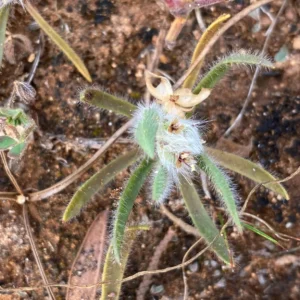
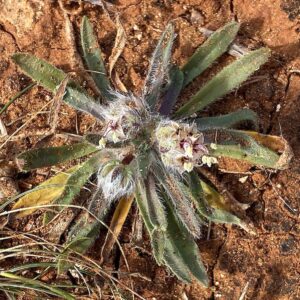
- Flower Heads: Plantago cretica typically bears 1 to 5 dense, globose to ovoid heads. This distinguishes it from Plantago ovata, which produces numerous spikes on a single plant, and Plantago bellardii, which often has more numerous, cylindrical to ovoid spikes.
- Stalk Size and Behavior: The stalks (peduncles) are short (1–5 cm) and exhibit distinct geocarpic behavior, becoming strongly recurved or arched downward to the ground at maturity. In contrast, Plantago bellardii has erect or ascending stalks (2–10 cm) that never curve into the soil, while Plantago notata has decumbent or arched stalks (3–10 cm) that are notably longer.
- Hairiness: The plant is covered in dense, silky-villous, silvery hairs. This differs from Plantago bellardii, which is characterized by very long, spreading, shaggy hairs (hirsute), and Plantago ovata, which is densely pubescent but lacks the long, silky appearance.
- Bracts: The bracts of P. cretica are ovate with a very long, rigid, hair-like awn. This is an SOS diagnostic compared to Plantago notata, which has broadly ovate bracts with very wide, paper-like (scarious) margins, and Plantago ovata, which has suborbicular, mostly hairless (glabrous) bracts with broad scarious edges and no long awn.
- Leaf Pattern: The leaves form a tight basal rosette and are strictly linear. In the middle of the plant, the leaves often show a distinctly channeled (canaliculate) or V-shaped pattern in cross-section. This pattern is less pronounced in Plantago notata, which has flatter, wider leaves with 3–5 distinct veins.
Additional Identification Characteristics
Botanist Arthur Barclay noted that the geocarpic movement of the peduncles is triggered by the increase in weight and cellular changes post-fertilization. Unlike P. lagopus, which relies on wind dispersal, Plantago cretica effectively "plants" its own seeds into the surrounding crevices, making it a specialist of rocky and compacted habitats.
Botanical Structure and Floral Details of P. cretica
Calyx and Corolla
The sepals are approximately 3-4 mm long, featuring a green midrib and broad membranous margins. The corolla is inconspicuous, with small, brownish lobes that remain persistent around the ripening capsule, providing a protective layer against desiccation.
Geographical Distribution and Habitat of Plantago cretica
This species is widespread throughout the Eastern Mediterranean, including Greece, Turkey, and the Levant. It thrives in open, sun-drenched environments such as stony pastures, fallow fields, and coastal garrigue, where it successfully competes in soils that undergo extreme seasonal drying.
Distribution in Cyprus
In Cyprus, it is frequently found in the Mesaoria plain, the Akamas peninsula, and the coastal regions of Limassol and Larnaca. It is particularly common in areas with limestone or igneous outcrops where the ground is disturbed by grazing or light foot traffic.
Elevation Range in Cyprus
The elevation range for this taxon in Cyprus is from sea level up to approximately 900 metres. It is rarely found in the higher pine forests of the Troodos range, as it prefers the thermophilous conditions of the lower hills and plains.
Flowering Period in Cyprus
The flowering period typically occurs between February and May. By early June, the plant usually withers, and the downward-curved stalks have already secured the seeds into the dry soil for the following season.
Conservation Status in Cyprus
According to the Red Data Book of the Flora of Cyprus, this species is listed as Least Concern (LC). It is currently stable and widely distributed, though localized populations may be impacted by intensive urbanization in coastal tourist zones.
Is Plantago cretica Suitable for Gardens?
The Crete Plantain is not commonly used in ornamental gardening due to its modest floral display. While seeds are not generally restricted by international law, they are rarely found in the commercial market. It is best suited for specialist rock gardens or "wild" restoration projects that focus on Mediterranean biodiversity.
Toxicity and Safety
There are no recorded instances of acute toxicity for Plantago cretica in humans. However, members of the Plantago genus contain high levels of mucilage and tannins. According to research by the European Medicines Agency (EMA), excessive ingestion of related species can cause temporary gastrointestinal discomfort or a feeling of bloating. Owners of domestic pets should be cautious, as high fiber content in wild greens can occasionally cause dietary upset in small animals if consumed in large quantities.
Medicinal Properties
Anti-inflammatory Potential
Traditional Mediterranean medicine has utilized various plantains for their cooling and anti-inflammatory properties. Studies by pharmacognosist Dr. Joan Vallès suggest that the presence of iridoid glycosides, such as aucubin, in Plantago cretica may contribute to its historical use as a topical treatment for minor skin irritations and insect bites.
Demulcent Action
The high mucilage content in the seeds and leaves of Plantago cretica acts as a demulcent. Academic studies on the ethnobotany of the Aegean islands indicate that infusions were traditionally used to soothe irritated throats, though modern clinical evidence specifically for this species remains limited compared to its relative, P. psyllium.
Fascinating Insights About "Plantago cretica"
Active Geocarpy
The most remarkable feature of the Crete Plantain is its active geocarpy. Unlike most plants that release seeds into the air, this species literally "bends its knees" after flowering. This ensures that the seeds are deposited directly into the parent plant's safe micro-habitat, protecting them from being eaten by birds or washed away by rare torrential rains.
Archaeobotanical Marker
Seeds of this plant have been discovered in Eastern Mediterranean archaeological sites dating back to the Bronze Age. Research published in the Journal of Archaeological Science suggests that its presence often indicates ancient pastoral activity, as the plant thrives in the nitrogen-rich, compacted soils surrounding historic livestock enclosures.
Drought Adaptation
The silver, silky hairs that cover the plant are an evolutionary marvel. They reflect excess ultraviolet radiation and create a "boundary layer" of still air near the leaf surface. This reduces water loss through transpiration, allowing it to survive in the intense heat of the Cypriot sun long after other annuals have perished.