Date Created: 08.04.2026
Last Modified: 08.04.2026
Plantago sarcophylla Zohary is the Latin name for the Fleshy-leaved Plantain, a specialized annual herb belonging to the Plantaginaceae family.
Cypriot Names
Πλαντάγο το σαρκόφυλλο
Common English Names
- Fleshy-leaved Plantain
- Sarcophyllous Plantain
- Fleshy Beach Plantain
Etymology of Plantago sarcophylla
The name "Plantago" derives from the Latin "planta", which means "sole" or "flat", and the suffix "-ago", meaning "resemblance", hence "resembling a sole" alluding to the leaf shape of the original plant that was the reason for the genus to be named as such.The species name sarcophylla comes from Ancient Greek σάρξ [sárx] meaning "flesh" and φύλλον [fýllon] meaning "leaf," describing the remarkably thick and succulent nature of its foliage.
Synonyms
- Plantago squarrosa var. brachystachys Boiss.
- Psyllium sarcophyllum (Zohary) Holub
Key Characteristics for Diagnostic Identification
According to the definitive botanical keys established by Robert Desmond Meikle (1923–2021) in his comprehensive Flora of Cyprus, this species is distinguished by several specific morphological features:
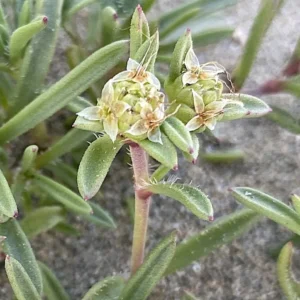
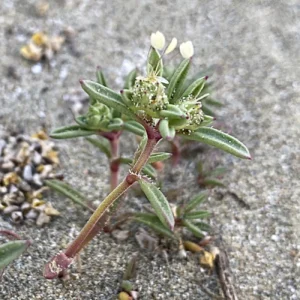
- Inflorescence Size: The spikes are remarkably small and globose, measuring only 4–8 mm in length, which distinguishes it from the longer spikes of P. squarrosa.
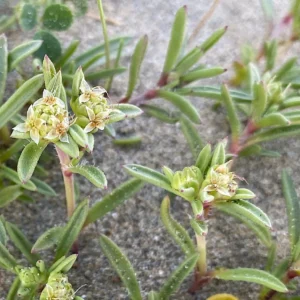
- Bract Length: The lowermost bracts are foliaceous and conspicuous, typically as long as or longer than the entire flowering spike, providing a "leafy" appearance to the head.
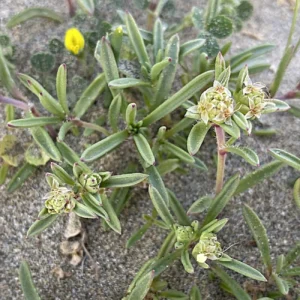
- Leaf Succulence: The leaves are distinctly fleshy (sarcophyllous), linear-oblong, and often covered in short, dense, spreading hairs that trap moisture and protect against salt spray.
- Seed Structure: The capsule contains two boat-shaped (cymbiform) seeds with a deep longitudinal groove, a characteristic shared by the subgenus Psyllium to which this species belongs.
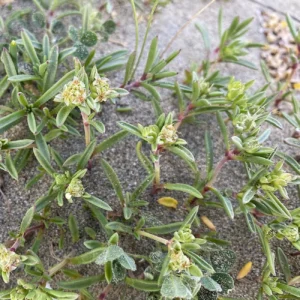
- Growth Habit: This species is a small, branched annual that often forms compact, low-lying mats on the sand, an adaptation to high-wind coastal environments.
Distinguishing Plantago sarcophylla from similar Plantago squarrosa
According to authoritative botanical sources such as Flora Europaea, species within the genus Plantago can be reliably distinguished through consistent morphological traits observed in the field. The following identification characteristics are widely accepted by botanists and taxonomic experts:
Plantago sarcophylla
- Leaves thick, fleshy (succulent), adapted to coastal/saline habitats
- Leaf surface smooth, often somewhat glossy
- Rosette compact, with broader leaves
- Scapes (flower stalks) relatively stout
- Spikes dense, cylindrical, often shorter and thicker
- Bracts not strongly protruding
- Typically found on sandy or rocky seashores
Plantago squarrosa
- Leaves thin, not succulent, more herbaceous
- Leaf surface rougher, often with visible hairs
- Rosette looser, with narrower leaves
- Scapes more slender
- Spikes longer, more slender, often appearing looser
- Bracts distinctly protruding (“squarrose” appearance)
- Usually found in inland disturbed habitats, fields, or dry soils
Botanical Structure and Floral Details of Plantago sarcophylla
The Flowering Spike
The most identifying feature is the tiny, rounded flowering head. Unlike the long "candles" of common plantains, these are small buttons of flowers nestled among relatively large, protective bracts. This structure minimizes the surface area exposed to the drying effects of the Mediterranean sea breeze.
Floral Organs
Each flower is minute, with four sepals that are slightly unequal in size. The corolla is papery and translucent, with four small lobes that spread open to release the stamens. Like its relatives, it is wind-pollinated, relying on the constant coastal air movement to carry its pollen.
Leaf Anatomy
The leaves are designed for water storage. Under the microscope, the cells are large and vacuolated, allowing the plant to survive in the "physiological drought" of the saline beach. The greyish-green color is a result of both the thick cuticle and the dense hair covering.
Geographical Distribution and Habitat of Plantago sarcophylla
This species is a specialist of the Eastern Mediterranean. It is found on the maritime sands of Cyprus, Egypt, Israel, and Palestine. It is strictly limited to the littoral zone, where it inhabits the "white dunes" and stabilized sandy flats just beyond the high-tide mark.
Distribution in Cyprus
In Cyprus, Plantago sarcophylla is an indigenous species. It is primarily recorded in coastal areas such as Akrotiri, Larnaca, and the sandy stretches of the Famagusta district. It is a true psammophile (sand-lover), occurring only at sea level (0 meters altitude).
Flowering Period in Cyprus
In the coastal sands of Cyprus, the flowering period for this species is relatively brief, typically occurring from February to May. The plant responds rapidly to the spring warmth and moisture, setting its seeds before the sand surface temperatures become too extreme in the summer.
Conservation Status in Cyprus
This species is not included in the Red Data Book of the Flora of Cyprus. It is categorized as "Least Concern" (LC) by the local checklist (2026), as it maintains stable populations in its specific, albeit restricted, coastal habitats across the southern and eastern shores.
Is Plantago sarcophylla Suitable for Gardens?
While not a traditional ornamental, it is a fascinating choice for a specialized "maritime micro-garden" or a sand-bed rockery. Its extreme succulence and compact form make it a conversation piece. It requires absolute full sun and a substrate composed almost entirely of coarse sand or grit.
Medicinal and Practical Uses
There is no widespread record of this specific species being used in commercial medicine, but it belongs to the same group as the plants used for Psyllium fiber. The seeds produce a significant amount of mucilage when wet, which is a characteristic common to the Plantago genus.
Ecologically, the Fleshy-leaved Plantain is an important "sand-binder." Along with other coastal pioneers, its root system helps to anchor the surface layer of the dunes. This prevents the wind from blowing the sand inland, effectively protecting the more sensitive vegetation that grows further from the shore.
Fascinating Facts About Plantago sarcophylla
The Sarcophyllous Adaptation
The name "sarcophylla" is one of the most descriptive in botany. In the harsh environment of the Cyprus coast, where the "soil" is essentially ground-up rock and salt, having "fleshy leaves" is the only way for an annual to stay hydrated long enough to flower.
Extreme Miniature
Among the various plantains found in Cyprus, this is one of the smallest in terms of its flowering architecture. The fact that the entire reproductive "spike" is often smaller than a single leaf of a garden plantain shows how much the species has sacrificed size for survival.
Salt Specialist
Most plants die when salt water touches their roots because the salt "sucks" the water out of the cells. Plantago sarcophylla has evolved to balance its internal chemistry, allowing it to actually pull water out of the salty sand—a feat of biological engineering.
Seed Rhythms
The seeds are released only when the capsule is completely dry. In the humid air of the coast, this often means they are shed during the hottest, driest parts of the day. This timing ensures they are ready to be buried by shifting sands before the next rain.
A Piece of the Coastal Puzzle
While it might look like a "minor" plant, it is part of a complex community that includes Silene colorata and Medicago littoralis. Together, these plants form the first line of defense for the Cypriot coastline, turning a barren beach into a living ecosystem.