Date Created: 31.07.2022
Last Modified: 14.10.2026
Thymbra capitata (L.) Cav., commonly called conehead thyme, is an aromatic, evergreen subshrub of the mint family, Lamiaceae. Native to the Mediterranean region, it grows wild in Cyprus, where its compact woody branches, tiny scented leaves and dense pinkish flower heads are familiar features of sunny, dry landscapes. Kew’s POWO record accepts the name used here; older Cypriot accounts often file the plant under Thymus capitatus.
Common Cypriot Names
The formal Modern Greek name is Θύμπρα η κεφαλωτή [thýmbra-i-kefalotí], literally, “headed Thymbra.” A widely recorded Cypriot vernacular name is θρουμπίν [throumbín]; Polignosi also records the dialect forms δρουμπίν and γρουμπίν. The name is associated with the plant’s aromatic character and its historical use in Cyprus.
Common English Names
- Greek thyme
- Cyprus thyme
- Conehead thyme
- Capitate thyme
- Headed thyme
- Spanish oregano
- Spanish origanum
- Spanish thyme
- Cretan thyme
Etymology of Thymbra capitata
The etymology of the genus name Thymbra traces to Ancient Greek θύμβρα, an old name for an aromatic plant; the deeper origin of that Greek word is uncertain. The Latin epithet capitata means “headed” or “having a head,” referring to the dense, head-like clusters of flowers at the ends of the shoots. The sense of the Latin is confirmed by Lewis and Short’s Latin dictionary.
Synonyms
Plants of the World Online (POWO) lists the following homotypic synonyms, ordered from newest to oldest. The names share the same nomenclatural type; Thymus creticus is marked illegitimate by POWO.
- Origanum capitatum (L.) Kuntze (1891)
- Coridothymus capitatus (L.) Rchb.f. (1857)
- Thymus capitatus (L.) Hoffmanns. & Link (1809)
- Thymus creticus Brot. (1804), nom. illeg.
- Satureja capitata L. (1753)
Key Characteristics for Diagnostic Identification
R. D. Meikle’s Flora of Cyprus, Volume 2 (1985), is a foundational island flora and the relevant volume for consulting Cyprus plant identifications; the volume is documented by University of Chicago Press, which distributes it for the Royal Botanic Gardens, Kew. The features below are drawn from a Cyprus plant description and botanical descriptions of the species.
- Growth form: A low, much-branched, evergreen, aromatic subshrub, recorded in Cyprus at up to about 50 cm tall. The base and older branches become woody; young shoots are greyish and hairy. These traits are described in the Cyprus plant account.
- Leaves: The leaves are small, narrow and linear, with no obvious stalk. Lower leaves may appear in whorls, while upper leaves are opposite. Dark oil-gland marks and fine hairs are visible on the leaf surfaces; a strong aromatic scent is released when foliage is rubbed.
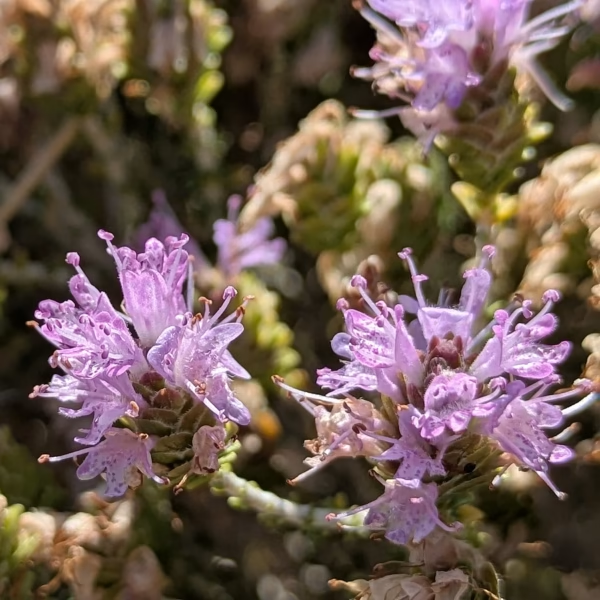
- Inflorescence: Flowers are grouped into dense, rounded or short-conical heads at shoot tips. This compact arrangement is the principal visual clue behind the epithet capitata and separates the plant’s overall appearance from thyme-like plants with more open flower spikes.
- Calyx: The tubular calyx is dorsally flattened and has 20–22 veins, a useful technical character in botanical identification. This feature is described in the taxonomic treatment in Flora Iberica.
- Corolla and stamens: The small, two-lipped flowers are commonly pink, lilac or pale purple, though the Cyprus description also records whitish flowers. There are four unequal stamens; the flower’s two-lipped shape and unequal stamens are consistent with the local account and the mint family.
- Identification caution: The older name Thymus capitatus remains common in historical texts and some local records. It refers to this same accepted species, not to a second Cyprus taxon of Thymbra; POWO gives the nomenclatural history.
Additional Identification Characteristics
In the field, look for the combined pattern rather than relying on scent or flower colour alone: a woody, rounded shrub; narrow gland-dotted leaves; and compact terminal flower heads. Cyprus photographs and descriptions also show the head-like canopy and the hairy grey young stems. Flower colour can vary from white through pale lilac to pink, so it is not a safe character to use by itself. Compare specimens with a botanical key when a confirmed identification matters.
Botanical Structure and Floral Details of Thymbra capitata
Stems and foliage
The plant’s many branches form a compact shrub. Young stems are nearly cylindrical, though faintly squared, and covered with fine hairs; older stems turn brownish or grey-brown and become woody. Its leaves are simple and sessile, attached directly to the stem, with glands that contain aromatic volatile compounds. The local morphological description is given by Savvas Tryfonos.
Flowers and fruit
The flowers are fragrant and bilaterally symmetrical, with a two-lipped corolla and four unequal stamens. They are borne in terminal heads and attract insect pollinators. After flowering, the plant develops a small dry, indehiscent fruit, described in the Cyprus account as a nutlet-like achene. That source reports flowering from May to October, sometimes into November.
Geographical Distribution and Habitat of Thymbra capitata
POWO records the species as native across the Mediterranean, including Cyprus, and classifies it as a subshrub of subtropical biomes. Across the region it is associated with open, warm and dry habitats.
Distribution in Cyprus
The species is documented as native to Cyprus by Kew’s POWO database and occurs in several island habitats, including semi-arid shrubland. Polignosi describes it as a characteristic low-growing plant of the Cypriot countryside that grows spontaneously on poor or infertile ground.
Flowering Period in Cyprus
A Cyprus plant account records flowering from May through October, sometimes November.
Conservation Status in Cyprus
Thymbra capitata is considered a common plant in Cyprus, facing no danger.
Is Thymbra capitata Suitable for Gardens?
Yes. Its compact evergreen growth, fragrant leaves and tolerance of hot, dry conditions make it suitable for sunny Mediterranean-style gardens, rock gardens and containers with excellent drainage. Use a lean, gritty or stony growing medium, water young plants while they establish, and avoid persistently wet soil. Commercial seed is available from international sellers.
Toxicity and Safety
The plant is used as an aromatic culinary herb in the Mediterranean, and the Cyprus encyclopedia records its historical use for flavouring smoked sausages. That food use should be distinguished from taking concentrated essential oil. Essential-oil composition can vary substantially: studies report carvacrol-rich samples, including a study measuring roughly 60–66% carvacrol. A concentrated oil is not equivalent to the plant used in food, and laboratory antimicrobial activity does not establish a safe or effective home dose.
Do not swallow undiluted essential oil or apply it neat to skin or mucous membranes. The 2020 review by researchers affiliated with the University of Crete discusses the active compounds and safety considerations, but it is not a dosing guideline for self-treatment. Anyone considering medicinal use, especially children, pregnant or breastfeeding people, or someone taking regular medicines, should speak with a qualified health professional or pharmacist. Regulatory acceptance of certain constituents as food flavourings applies under specified food-use conditions; it does not establish that undiluted oil is safe to ingest. See the pharmacology review.
Medicinal Properties
Traditional use in Cyprus
A review of ethnobotanical and ethnopharmacological literature reports that aerial parts of the plant were traditionally used in Cyprus for respiratory complaints, including catarrh and the common cold. This is evidence of recorded traditional practice, not proof that the plant treats or prevents those conditions. The review identifies the source as Lardos’s ethnobotanical work.
What laboratory research shows and does not show
Many experimental studies investigate the essential oil and its constituents, particularly carvacrol. In vitro work has reported antibacterial and antifungal activity, and a review discusses possible mechanisms involving microbial membranes and other biological targets. These findings are useful for research, but tests on cultures or isolated compounds do not demonstrate that a tea, tincture or oil safely cures an infection in people.
The Frontiers review by Pirintsos and colleagues, whose authors include university biology, medicine and clinical virology researchers, surveyed literature on traditional uses, phytochemistry and translational development. It documents traditional reports and experimental findings, while also showing that clinical evidence for the plant itself is limited. No established treatment dose or proven clinical indication for self-medication follows from the cited laboratory work. The distinction between traditional use, preclinical evidence and a demonstrated therapy is essential; consult the full research review.
Fascinating Insights About “Thymbra capitata”
A plant with a history of name changes
Older botanical and Cypriot sources may call the plant Thymus capitatus or Coridothymus capitatus. Modern POWO accepts Thymbra capitata, while retaining several earlier combinations as homotypic synonyms. This explains why historical records can appear to describe a different species even when they refer to the same plant. The nomenclatural record is maintained by Kew POWO.
Its branches shaped Cypriot food traditions
Polignosi describes an older method for smoking sausages: the sausages were hung above burning branches of the plant, whose smoke cooked and scented them. The same encyclopedia records that its hard branches were used by silkworms when forming cocoons, and that people once gathered and sold bundles of the shrub. These are details of rural history preserved in the Cypriot encyclopedia.
A valued plant for bees and honey
Polignosi calls it an important honey plant and describes its flowers as abundant. That local account connects the shrub with Cypriot thyme honey; it also reports that flowering can continue from spring into autumn. The plant’s dense, fragrant flower heads make the connection between a small wild shrub and a much larger pollination and food tradition.
The oil is chemically variable
Essential oil is not a single fixed substance: proportions of volatile compounds can vary among samples and studies. A published analysis found carvacrol-rich oil, while wider reviews discuss several constituents and the biological activity reported for them. This variation is one reason research results cannot automatically be translated into a predictable medicinal dose. The chemical profile has been studied in laboratory research and summarized in a scholarly review.