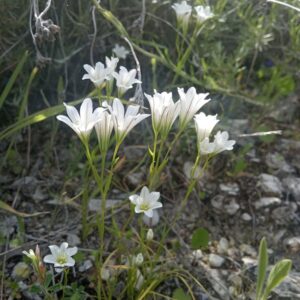
Gagea graeca is a delicate, bulbous perennial belonging to the Lily family. Native to the rocky slopes and dry grasslands of Greece, Cyprus, and the Eastern Mediterranean, this plant is celebrated for its elegant, minimalist beauty. It typically signals the arrival of spring in rugged, sun-drenched landscapes.
Cypriot names
Γαγέα η ελληνική
Etymology of Gagea graeca
The etymology of the genus "Gagea" is derived from the name of the English naturalist Sir Thomas Gage (1791-1820). Latin ''graeca" means "Greek", because the species was initially discovered in Greece.
Botanical Characteristics
Small-Scale Structure
The plant is relatively small, usually reaching heights between 5 and 20 centimeters. Gagea graeca grows from a tiny, egg-shaped bulb protected by fibrous tunics. This compact size allows it to thrive in shallow soil pockets where larger Mediterranean plants would struggle to find adequate anchorage.
Foliage Details
The leaves of Gagea graeca are narrow, linear, and grass-like, often appearing slightly channeled. Usually, two or three basal leaves emerge from the bulb, followed by smaller bract-like leaves further up the stem. These thin leaves help the plant minimize water loss in its often-arid environment.
Floral Appearance
The flowers of Gagea graeca are funnel-shaped and distinctively white, rather than the yellow typical of most other Gagea species. Each of the six tepals features delicate, longitudinal purple or violet veins. These blossoms are arranged in loose, attractive clusters at the top of the slender stem.
Habitat and Distribution
Environmental Preferences
You will most often find Gagea graeca nestled in rocky crevices, abandoned terraces, or open pine forests. It prefers well-drained, alkaline soils and thrives in full sun. It is remarkably adapted to the "Mediterranean cycle," remaining dormant underground during the long, dry summer months.
Geographic Range
As the name suggests, Gagea graeca is a staple of the Greek flora, including the Aegean islands and Crete. Its range extends eastward into Turkey and Cyprus. In these regions, it is a common sight in early spring, often carpeting hillsides before the summer heat sets in.
Gagea graeca in Cyprus
Among the six Gagea species that exist in the Cypriot habitat, this is the only one with white flowers. It does not appear on the Troodos mountain range and the Western Mesaoria region (Morfou and surroundings), and certainly not at an altitude higher than 600 metres. An uncommon plant, it grows on dry grasslands, rocky slopes and fallow fields. Its short flowering period is around March and April.
Ecological Importance
Pollinator Relationships
Despite its small size, Gagea graeca provides a vital nectar source for early-season insects. Solitary bees and small flies are particularly attracted to its bright white flowers. By blooming early, it avoids competition with more flamboyant summer species, ensuring a dedicated window for successful pollination.
Life Cycle and Dormancy
The life cycle of Gagea graeca is a masterclass in timing. It sprouts rapidly after winter rains, flowers in early spring, and quickly sets seed. Once the heat intensifies, the above-ground parts wither, and Gagea graeca retreats into its bulb to survive the drought.
Gardening and Observation
Cultivation Challenges
For enthusiasts, Gagea graeca is a prized addition to alpine houses or specialized rock gardens. It requires a "dry summer rest" to mimic its natural environment. Growing it in pots with extremely gritty compost is essential, as any excess moisture during dormancy can cause the bulb to rot.
Identifying the Species
A key identifying feature of Gagea graeca is the presence of fine hairs on the stem and leaf edges. While many similar-looking white bulbs exist in the Mediterranean, these tiny hairs and the specific purple veining on the tepals make this species relatively easy for botanists to confirm.
Conservation Status
In most of its native range, Gagea graeca is considered common and not currently under threat. However, habitat loss due to coastal development and intensive agriculture can impact local populations. Protecting the rocky "phrygana" landscapes ensures that this delicate spring flower continues to thrive.
Comparative Botany
Differences from Other Gagea
While the majority of the Gagea genus produces bright yellow flowers, Gagea graeca is a notable exception with its white blooms. This color shift suggests an evolutionary adaptation to different pollinators or perhaps a specific niche within the diverse Mediterranean floral community.
Related Mediterranean Bulbs
Gagea graeca is often found growing alongside other spring bulbs like Ornithogalum or Romulea. However, the funnel-shaped flower structure and the specific arrangement of its basal leaves set it apart. It remains one of the most charming representatives of the region's diverse bulbous flora.
Seasonal Timing
The peak flowering time for Gagea graeca is typically between February and April. This short window makes it a fleeting but memorable part of the Mediterranean spring. Its appearance is often used by local populations as a natural indicator that the coldest winter days have passed.