Date Created: 29.10.2022
Last Modified: 16.10.2026
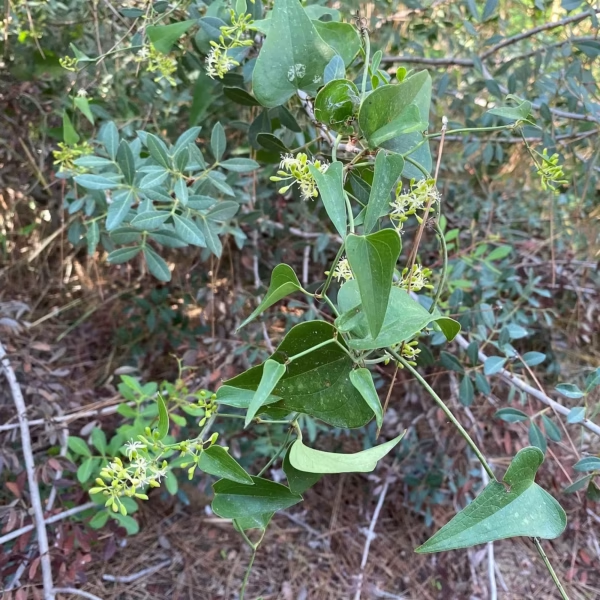
Smilax aspera L., the Mediterranean smilax, is an evergreen, woody climber in the family Smilacaceae, native to Cyprus and much of the Mediterranean region. Its flexible stems, leathery leaves and paired tendrils help it scramble over shrubs and trees, while sharp prickles on the stems and leaves make it easy to recognise. It is the only wild representative of the genus Smilax recorded in Cyprus, according to the Cyprus Forestry Department.
Common Cypriot Names
The formal Modern Greek rendering of the scientific name is Σμίλαξ η τραχεία [smilax it rácheia], meaning “the rough or harsh smilax”; the government’s plant profile explains that aspera refers to the small prickles on its stems. Cypriot sources record Αρκόβατος [arkóvatos], Ζουλόβατος [zoulóvatos] or Αντζιουλόβατος [antzioulóvatos] and Σμιλάγγι [smilángi]. The Cypriot lexicon Polignosi suggests that “Αντζ(ι)ουλόβατος” may refer to the berries’ resemblance to αντζουλουβάρκα, a kind of necklace; this is presented as a possible explanation, not a confirmed derivation. These vernacular names and the explanation come from Cyprus Forestry and the Cyprus-based Polignosi lexicon.
Common English Names
- Common smilax (USDA GRIN)
- Rough bindweed (NCBI Taxonomy)
- Prickly ivy (pharmacognosy study)
- Mediterranean smilax (World Flora Online)
- Sarsaparille (pharmacognosy study)
English vernacular names vary across floras and reference works; some names containing “sarsaparilla” are also used for other species in the genus, so the scientific name is the clearest way to identify this plant.
Etymology of Smilax aspera
The etymology of the genus, "Smilax", comes from the Ancient Greek "σμῖλαξ" [smilax], which derives from "σμίλη"+the suffix "-αξ", meaning "chisel, moil, cutter", probably because of the thorns of various sizes that exist (at least on the species aspera and officinalis) on the stem and petioles. Latin "aspera" means "pointed, sharp" and refers, as well, to the presence of many small, sharp prickles.
Synonyms
Plants of the World Online (POWO) accepts Smilax aspera L. and lists heterotypic synonyms. Its displayed synonym list does not provide a homotypic synonym, so none is included here.
Key Characteristics for Diagnostic Identification
According to the botanical treatment in Robert Desmond Meikle’s Flora of Cyprus, Volume 2 (1985), this species can be identified in the Cypriot flora by the combination of its evergreen climbing habit, tendril-bearing leaf stalks, prickles and distinctive net-veined leaves. Since it is the only wild Smilax in Cyprus, there is no second Cypriot species of the genus to contrast against it. The following characters are useful for recognising the plant and checking an identification.
- Growth form: An evergreen, perennial woody climber that scrambles through shrubs or climbs into trees. Stems may become long and zigzagging, rather than forming a self-supporting upright shrub.
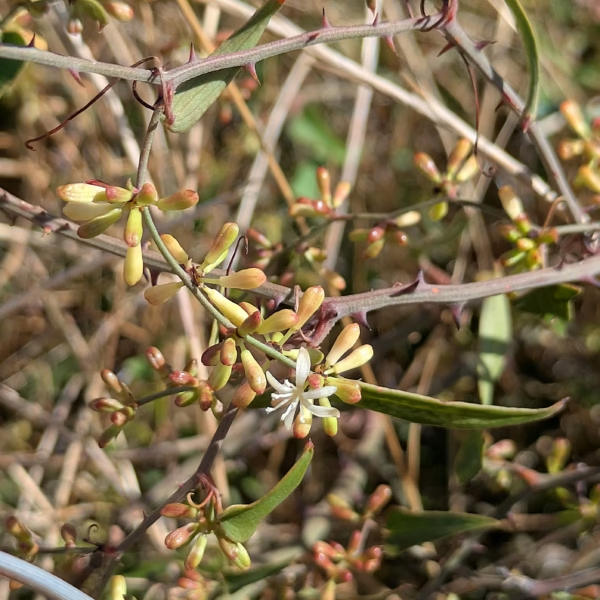
- Stems and prickles: The flexible stems are often angled and may bear short, sharp prickles. Their presence is highly useful in the field, although the number and distribution of prickles can vary along a plant.
- Leaf arrangement and texture: Leaves are alternate and usually firm, leathery and evergreen. Their shapes vary considerably, from heart-shaped or triangular to more elongated forms, so leaf outline should not be used alone for identification.
- Leaf venation: Look for several prominent longitudinal veins together with fine net-like venation. This combination is distinctive and contrasts with the parallel-veined leaves typical of many monocots.
- Leaf base and tendrils: A pair of tendrils arises near the base of the leaf stalk. The tendrils help the vine attach to nearby vegetation. Their position is a particularly useful character when flowers or fruits are absent.
- Prickles on leaves: Prickles may occur on the leaf stalk, leaf margin and underside of the main veins. Carefully check the underside and stalk; do not handle the plant without protection.
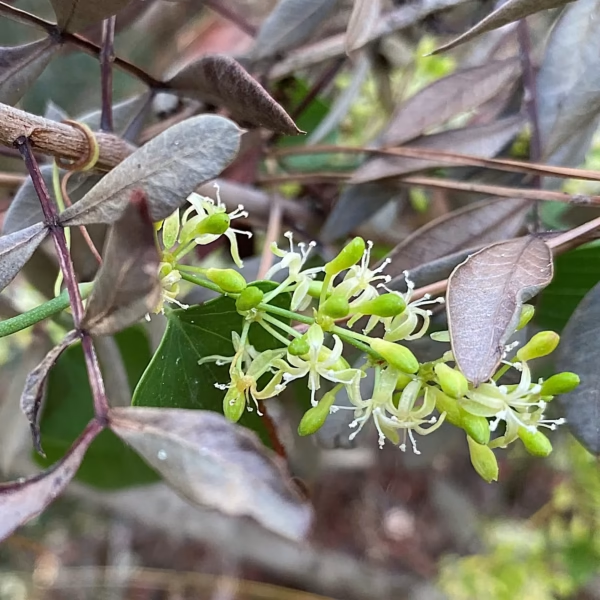
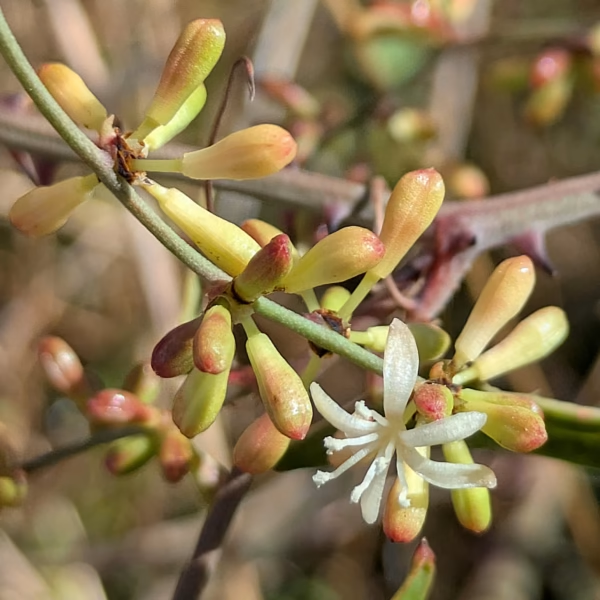
- Flowers: The small flowers are borne in clusters in the leaf axils, on an elongated flowering axis. They are usually greenish, yellowish or cream-coloured and may be fragrant. Individual flowers are small, with six perianth segments.
- Separate male and female plants: The species is dioecious: male and female flowers occur on different plants. Male flowers have six stamens; female flowers have a small ovary and six reduced staminodes. A plant without fruit may therefore be male, or a female plant that has not been pollinated.
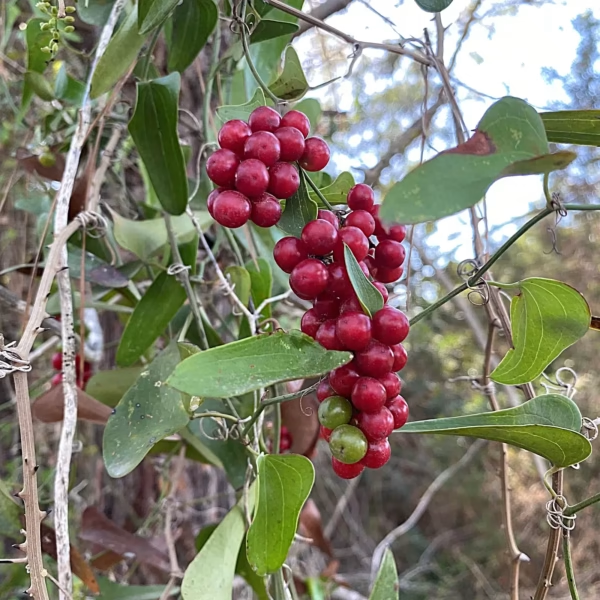
- Fruit: Female plants produce rounded berries, typically red when ripe; dried or aging fruits may darken. Each berry generally contains up to three seeds. Fruit colour and the plant’s climbing habit help distinguish it from unrelated prickly shrubs, but berries should not be used as the sole identification character.
Additional Identification Characteristics
The leaves are notably variable in both size and outline, and some have pale markings on the upper surface. For that reason, botanists identify the plant from a combination of characters: tendrils at the leaf-stalk base, net-veined leathery leaves, prickles, climbing stems and axillary flower clusters. The Kew description documents this variation and the flower and fruit characters.
Botanical Structure and Floral Details of Smilax aspera
Stems and leaves
The plant’s stems twine and scramble through surrounding vegetation; mature stems can extend well beyond the height of the plant that supports them. The alternate leaves are leathery, and their strong lengthwise veins are joined by finer net-like veins. A pair of tendrils near each leaf stalk’s base assists climbing. Prickles can occur on the stems and on parts of the leaves, including the stalk, margins and veins below. These features are described in Kew’s morphology record.
Flowers and fruit
The species bears small, unisexual flowers in clusters on axillary axes. Male and female flowers occur on separate plants. After pollination, female plants develop rounded berries that are red at maturity and may later become dark. The berries provide a food resource for birds, which can disperse the seeds; this relationship is noted in the University of Oxford’s plant profile.
Geographical Distribution and Habitat of Smilax aspera
This is a broadly distributed climber native across Macaronesia, the Mediterranean and parts of Africa and Asia.
Distribution in Cyprus
Smilax aspera exists all around the island and can be found up to an altitude of 1375 metres. Its preferable habitats are garrigue, phrygana, shrub and bushy places. Its flowering period in Cyprus is between August and November.
Conservation Status in Cyprus
Smilax aspera is listed as Vulnerable (VU) in the Red Data Book of the Flora of Cyprus. The IUCN Species Survival Commission’s specialist group page reports that the Cyprus assessment used criterion D2, associated with a restricted distribution or small number of locations that can make a species vulnerable to rapid decline if a threat occurs. This is a national assessment and should not be confused with a global assessment. The Red Data Book was edited by Tsintides, Christodoulou, Delipetrou and Georghiou (2007); the status is also stated by the IUCN/SSC Medicinal Plant Specialist Group.
Is Smilax aspera Suitable for Gardens?
It can be grown as an ornamental climber where a vigorous, evergreen plant is wanted, but its prickles and scrambling stems make it unsuitable beside narrow paths, play areas or places where it could snag clothing or skin. Seeds are offered by international specialist sellers, including listings that specify a Cyprus source; availability can change, so buyers should confirm the seed’s provenance and current import requirements before ordering. Because the species is assessed as Vulnerable in Cyprus, use legally cultivated nursery stock and do not collect plants, seeds or cuttings from the wild. The Cyprus Department of Forests warns that cutting, uprooting and collecting flora from nature is prohibited.
Toxicity and Safety
The sources reviewed do not establish that this species is poisonous to people. Avoid consuming a wild plant unless its identity is certain and the part and preparation are supported by a reliable edible-plant reference. The University of Oxford profile notes that the fruits are not generally eaten, while shoots have been cooked like asparagus.
The clearest practical hazard is mechanical injury: sharp prickles can puncture or scratch skin, particularly when handling stems or clearing a thicket. Wear gloves and protective clothing when pruning or working near the vine, and keep it away from routes used by children and pets. Medical literature recognises thorns and spines as mechanical plant irritants capable of injuring skin; see this review of plant dermatitis. If a puncture becomes inflamed, painful or infected, seek medical advice.
Medicinal Properties
Traditional use and evidence limits
The common drug name “sarsaparilla” is applied to roots from several Smilax species, so traditional claims about sarsaparilla cannot automatically be assigned to this Cypriot species. For Smilax aspera itself, research has identified plant constituents and explored extracts in laboratory settings, but that is not proof that a preparation treats disease in people. A 2024 study examined chemical constituents and antibacterial effects of leaf and fruit extracts against plant pathogens; its results concern crop-protection research, not human treatment. Read the 2024 extract study in that context.
What research has found
A peer-reviewed phytochemical study isolated steroidal saponins and other compounds from the rhizomes and tested compounds for cytotoxic effects in vitro. Cell-culture findings are early-stage laboratory evidence; they do not show that consuming the plant is safe or effective against cancer or any other illness. The study is indexed by PubMed. A pharmacognostic paper describes the plant as an herbal-drug candidate, but botanical and chemical characterisation alone does not establish clinical benefit.
Practical medical guidance
No well-established human clinical evidence was identified here that supports using this plant to treat a medical condition. Do not substitute it for prescribed treatment or use homemade extracts for self-medication. Because sarsaparilla products may be made from different species and plant parts, a product’s label matters; consult a qualified health professional before using any herbal preparation, especially during pregnancy, while breastfeeding, or alongside medicines. A recent review of the genus notes that systematic preclinical and clinical validation remains limited (genus review).
Fascinating Insights About Smilax aspera
A climbing monocot with tendrils
Its leaves may look unlike the parallel-veined leaves many people associate with monocots: they have conspicuous net-like venation. The climbing tendrils are also botanically unusual. In Smilax, paired tendrils develop from stipules at the base of the leaf stalk, helping the plant grip nearby vegetation. The University of Oxford describes these structural features as notable within flowering plants.
Female plants feed seed-dispersing birds
Because male and female flowers grow on separate plants, only female individuals can produce berries. Their red-to-dark fruits attract birds, which consume them and disperse seeds. The berries therefore link the plant’s reproduction to local wildlife, as described in the Oxford plant profile.
A traditional Cypriot spring food
Υoung shoots were traditionally cooked like asparagus, including frying them with eggs. This is a local ethnobotanical note, not an endorsement to gather shoots from wild plants.