Ευφορβία η παράλιος
Etymology of Euphorbia paralias
The genus etymology, "Euphorbia", was named for "Euphorbus", a Greek physician to Juba II - King of Mauretania of Numibia. In 12 BC, Juba named a species of this genus after his physician. In 1753, Carolus Linnaeus, the great taxonomist, assigned the name Euphorbia to the entire genus. The specific epithet "paralias" in Euphorbia paralias derives from the Greek epithet "paralios" [παράλιος], which translates to "coastal". This botanical name accurately reflects its preferred natural habitat: sandy shores, coastal dunes, and other seaside environments, where it is commonly found.
Introduction to Euphorbia paralias
Euphorbia paralias, commonly known as sea spurge, is a fascinating flowering plant belonging to the family Euphorbiaceae, also known as the spurge family. This species is native to coastal regions of Europe, northern Africa, and western Asia. It is particularly well-adapted to sandy shorelines and coastal dunes, where it often forms dense stands. While a natural part of its native ecosystems, it has become widely naturalized and considered an invasive environmental weed in many parts of Australia and other areas, impacting local flora and fauna.
Characteristics and Morphology of Euphorbia paralias
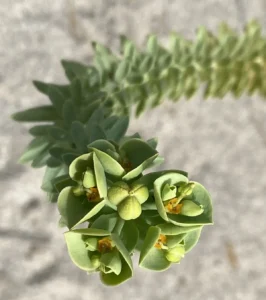
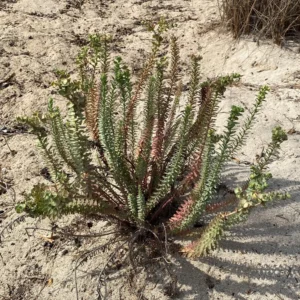
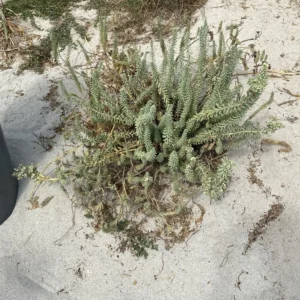
Euphorbia paralias is typically a small, upright, multi-stemmed perennial shrub, usually growing between 20 and 70 centimeters tall, though it can reach up to 1 meter. Its stems are somewhat fleshy, often branching near their tips, and contain a milky, toxic sap that can irritate skin and eyes upon contact. The distinctive blue-green leaves are fleshy, tightly packed along the stem, and vary in shape from elliptic-ovate to more rounded, becoming larger towards the stem tips. The flowers are small, yellow-green, and cup-shaped, appearing on the ends of the stems from spring to fall in their native range. The fruit is a capsule, typically 3-5 mm long, containing smooth, pale-grey, oval or rounded seeds. These seeds are buoyant and can remain viable in seawater for several years, aiding in long-distance dispersal by ocean currents. The plant is anchored by a long-lived, woody root crown and a deep taproot, which helps it survive in dynamic coastal environments.
Habitat and Ecological Role
As its common name suggests, Euphorbia paralias thrives in coastal habitats. It prefers sandy, free-draining soils and is remarkably tolerant of salt. It is predominantly found along beaches, from the high-water mark to the rear dunes, and can also colonize estuaries, rocky foreshores, and coastal lakes. Its ability to grow on bare sand and its deep root system allow it to stabilize dunes and reduce erosion in its native range.
However, where it has been introduced, particularly in Australia, sea spurge can become highly invasive. It quickly establishes large and dense infestations, displacing native species and altering the natural structure and dynamics of sand dune systems. This can significantly reduce the availability of nesting sites for threatened shorebirds that rely on open sand areas. The plant's prolific seed production and the long-distance dispersal of its buoyant seeds by ocean currents contribute to its rapid spread.
Traditional Uses and Toxicity of Euphorbia paralias
Historically, Euphorbia paralias has been used in traditional medicine for its anti-inflammatory, purgative, and local anesthetic properties. However, it is crucial to note that like many Euphorbia species, sea spurge contains a milky sap (latex) that is toxic. This sap can cause severe irritation to the skin and eyes, and if ingested, can damage the liver and kidneys. Due to its toxicity, any traditional medicinal applications should be approached with extreme caution and are not recommended for self-treatment. The plant's poisonous nature is an evolutionary defence mechanism against herbivores.
Euphorbia paralias in Cyprus
In Cyprus, Euphorbia paralias is a native and widespread coastal species, found primarily on sandy beaches and coastal dunes around the island. It thrives only on or near beaches (zero elevation). In the limits controlled by the Republic of Cyprus, it is found only in the northwestern and southeastern parts. It is considered a rare, endangered species in Cyprus. It blooms almost all year long. It is a quite large plant with a fleshy appearance, making it easily identifiable in its coastal habitats.