Date Created: 16.05.2026
Last Modified: 16.05.2026
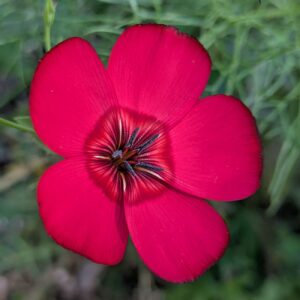
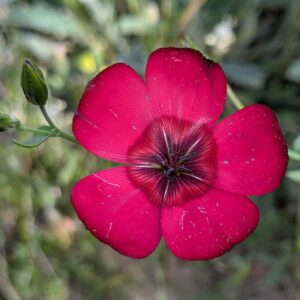
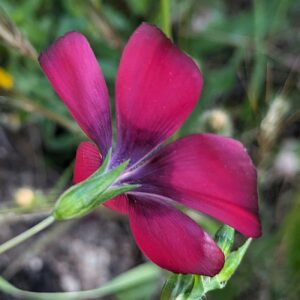
Linum grandiflorum Desf., commonly known as the Scarlet Flax, is an erect, elegant annual herb belonging to the Linaceae family. Renowned for its vibrant, satiny blood-red blossoms, this Mediterranean native has naturalized within coastal grasslands and open waste fields across Cyprus, providing a dramatic blast of color during the early spring months.
Common Cypriot Names
The formal translation of the botanical name in Modern Greek is Λίνον το μεγανθές [Linon-to-meganthes]. Locally in Cyprus, it is called Κοκκινολινάρι [Kokkinolinari] according to Cypriot agricultural records. This name is given because of its distinctive scarlet petals, which separate it visually from the blue-flowered or yellow-flowered wild flaxes found across the island.
Common English Names
- Scarlet Flax
- Flowering Flax
- Crimson Flax
- Red Flax
Etymology of Linum grandiflorum
The etymology of the genus name "Linum" derives from the Ancient Greek "λίνον" [linon], meaning "flax" or "thread," referring to the fibrous stems used since antiquity for weaving linen cloth. "Grandiflorum" is the neutral Latin for "large-flowered," referring to the remarkably grand and conspicuous size of the blossoms compared to other species within the genus.
Synonyms
- Adenolinum grandiflorum (Desf.) W.A.Weber (1984)
Key Characteristics for Diagnostic Identification
According to the definitive botanical keys established by Robert Desmond Meikle in his comprehensive Flora of Cyprus (Volume 1, 1977), this species is distinguished from other taxa of the genus in Cyprus by the below morphological features:
- Petal Color and Size: The most striking diagnostic is that the petals are brilliant red or scarlet, measuring 2.0–3.0 cm long. This is unique to Linum grandiflorum because no other native or naturalized Linum in Cyprus features red petals. For comparison, L. wilderness / L. pubescens has pink petals, L. bienne has pale blue petals 0.7–0.8 cm long, and L. usitatissimum has blue or white petals 1.3–1.8 cm long. Conversely, L. strictum, L. corymbulosum, L. trigynum, L. nodiflorum, and L. maritimum all possess yellow petals under 1.2 cm long.
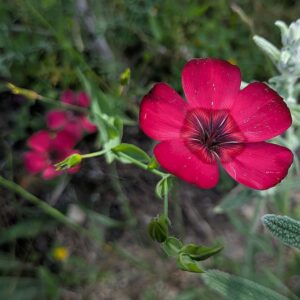
- Leaf Form and Width: The leaves are lanceolate to oblong, measuring 1.5–3.0 cm long and 5–8 mm wide, and are completely glabrous. While L. usitatissimum also features glabrous leaves, they are narrower, measuring only 1.5–3 mm wide. This character sets it apart from L. pubescens, which has densely pubescent leaves. Furthermore, L. strictum, L. corymbulosum, and L. nodiflorum exhibit linear leaves only 0.5–2 mm wide with rough, scabridulous margins.
- Sepal Margins and Size: The sepals are ovate-lanceolate, measuring 8–10 mm long with ciliate margins. This character is shared with L. pubescens, though its sepals are longer, up to 12 mm. In contrast, L. bienne and L. usitatissimum have smaller, glabrous sepals measuring 4–6 mm long, and L. nodiflorum displays smooth, linear-subulate sepals measuring 10–15 mm long.
- Stigmas and Style: The stigmas are elongated and clavate to linear. This structure is also found in L. usitatissimum and L. maritimum. However, it completely separates the taxon from L. strictum, L. corymbulosum, and L. trigynum, which possess capitate or shortly clavate stigmas under 0.5 mm.
Additional Identification Characteristics
Field botanists often check the pollen grains under magnification; this species produces distinctive light-blue pollen, a rare trait among Mediterranean annuals. Its mature capsule is globose, 5–7 mm wide, and completely non-dehiscent or tardily dehiscent, separating it from the readily explosive fruit structures of wild blue flaxes.
Botanical Structure and Floral Details of Linum grandiflorum
Stem Structure
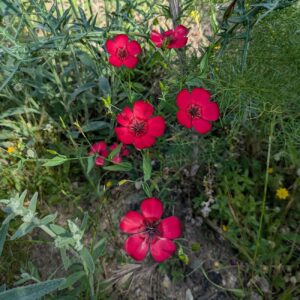
The stems are erect, typically measuring 30–50 cm in height, and are highly branched in the upper half. They are smooth, pale green, and slightly glaucous, providing a strong structural support for the terminal cymes without any tracking pubescence.
Geographical Distribution and Habitat of Linum grandiflorum
This species is natively distributed across North Africa, particularly in Algeria and Tunisia. As an introduced and naturalized ornamental, it has expanded into Southern Europe and parts of the Middle East, favoring open, sunny, and disturbed habitats.
Distribution in Cyprus
In Cyprus, it is verified as a naturalized, non-invasive alien plant. It has been documented chiefly in Division 1 (Paphos district) and near Syngrasis in the Famagusta district, spreading slowly along roadside verges, edge lands, and traditional cottage gardens.
Elevation Range in Cyprus
This taxon occurs along a narrow altitudinal range on the island, primarily recorded from sea level up to 450 meters (the pictures below were photographed at Pano Kyvides village, Limassol district).
Flowering Period in Cyprus
The flowering period for the Scarlet Flax in Cyprus is strictly concentrated in the spring, spanning from March to April, though late blooms can sometimes persist into May.
Conservation Status in Cyprus
Because it is a naturalized alien species rather than an indigenous taxon, it is not evaluated (NE) or categorized within the official Red Data Book of the Flora of Cyprus. It faces no conservation threats, as it is widely propagated by gardeners.
Is Linum grandiflorum Suitable for Gardens?
Yes, it is exceptionally well-suited for Mediterranean gardens due to its low water requirements. Seeds are widely available in the international commercial market under varieties like 'Rubrum'. There are no legal restrictions or forestry bans regarding its domestic cultivation or seed trade in Cyprus.
Toxicity and Safety
According to comprehensive veterinary and toxicological data managed by the North Carolina Extension Gardener Plant Toolbox, members of the genus *Linum* contain cyanogenic glycosides (such as linamarin). If consumed in high quantities, these compounds can release toxic hydrogen cyanide. While the primary risk targets grazing livestock, caution should be exercised around pets and young children. Dermatological evaluations also note that handling the plant occasionally triggers mild contact dermatitis in highly sensitive individuals due to trace sap compounds.
Medicinal Properties
Industrial Linolenic Profiles
While Linum grandiflorum is grown mostly for aesthetics, pharmacological assessments of its seeds show a high concentration of alpha-linolenic acid (ALA). A comparative study by Svetlova et al. (2009) notes that while its oil contains beneficial omega-3 fatty acids similar to common flax, it is not industrially processed for human therapeutic supplements due to its lower oil yield per acre.
Traditional Mucilage Applications
Ethnobotanical records from North African traditional medicine indicate that seed poultices were historically applied to soothe localized skin inflammations and boils. The seed coat produces a thick mucilage when soaked in warm water. This gel acts as a demulcent, though modern clinical validation by bodies like the European Medicines Agency (EMA) is currently absent for this specific species.
Fascinating Insights About "Linum grandiflorum"
Heterostyly and Reproductive Blocks
Research published in the Annals of Botany demonstrates that Linum grandiflorum exhibits a complex genetic system known as distyly. Individual plants possess either "pin" flowers with long styles or "thrum" flowers with short styles. This mechanical arrangement acts as an evolutionary mechanism to enforce cross-pollination and completely prevent self-fertilization, ensuring high genetic diversity.
The Ephemeral Twelve-Hour Bloom
Physiological studies on Mediterranean annuals show that each individual flower opens at dawn and drops its petals by mid-afternoon, lasting less than twelve hours. However, the plant compensates by producing a continuous succession of new buds over its multi-week flowering phase. This rapid flower turnover minimizes water loss from open petals during hot spring days.