Date Created: 08.04.2023
Last Modified: 01.05.2026
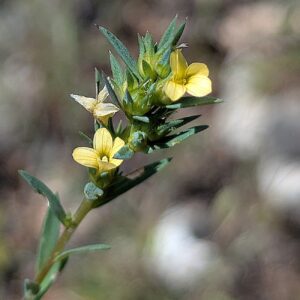
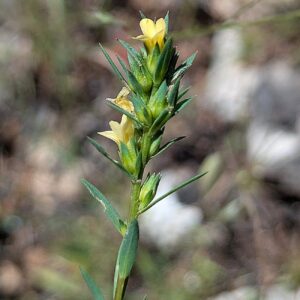
Linum strictum subsp. spicatum, commonly known as Spiked Flax, is a stiff, upright annual herb native to the Mediterranean. It belongs to the Linaceae family and is easily recognized by its rigid stems and small, bright yellow flowers. This subspecies is a frequent sight in the sun-drenched, rocky landscapes and dry grasslands of Cyprus.
Common Cypriot Names
The formal Modern Greek translation is Λίνο το δύσκαμπτο το σταχυώδες [Lino-to-diskambto-to-stachiotes]. Locally, it is known as Λινούιν [Linouin], which is a diminutive form of flax, referring to its slender, delicate stature.
Common English Names
- Spiked Flax
- Upright Flax
- Strict Flax
- Yellow Flax
Etymology of Linum strictum subsp. spicatum
The etymology of the genus name "Linum" derives from the Ancient Greek "λίνον" [linon], which was later adopted into Latin as "linum," meaning "flax" or "thread." This refers to the historical use of plants in this genus for producing fibers. "Strictum" is Latin for "straight" or "stiff," describing the plant's rigid, unbranched growth habit.
The subspecific name "spicatum" comes from the Latin "spica," meaning "ear of grain" or "spike." This refers to the condensed inflorescence where the flowers are packed closely together along the upper part of the stem. This spiked appearance is the primary visual characteristic that separates this subspecies from the more diffused type subspecies.
Synonyms
- Linum strictum subsp. spicatum (Pers.) Nyman (1878)
- Linum strictum var. spicatum (Pers.) Rice (1821)
- Linum spicatum Pers. (1805)
- Linum sessiliflorum Lam. (1779)
Key Characteristics for Diagnostic Identification
According to the definitive botanical keys established by Robert Desmond Meikle in his comprehensive Flora of Cyprus (Volume 1, 1977), this species is distinguished from other taxa of the genus in Cyprus by the below morphological features:
- Inflorescence: The most prominent diagnostic is the dense, spike-like arrangement of the flowers. This distinguishes it from Linum corymbulosum and Linum trigynum, which have flowers in loose, spreading cymes.
- Flower Pedicels: The flowers are nearly sessile or have extremely short stalks. This is a major SOS indicator that separates it from Linum bienne and Linum usitatissimum, which both possess long, slender flower stalks.
- Sepal Morphology: The sepals are glandular-ciliate and significantly longer than the mature fruit capsule. In contrast, Linum nodiflorum has sepals that are generally shorter or just equal to the capsule size.
- Leaf Texture: The leaves are linear-lanceolate and scabrid (rough to the touch) along the margins. This rough texture is much more pronounced than in the smooth-leaved Linum tauricum or Linum mucronatum.
- Stem Habit: The stem is strictly erect, stiff, and typically unbranched at the base. This "strict" habit is a key identifier when comparing it to the prostrate or ascending stems of Linum decumbens.
Additional Identification Characteristics
Botanists like Tsintides (2002) note that Spiked Flax often exhibits yellow petals that barely exceed the length of the sepals. This gives the flower a "pinched" appearance, as if it never fully opens, which is a helpful field characteristic when differentiating it from the larger-flowered flax species.
Botanical Structure and Floral Details of Linum strictum subsp. spicatum
Leaf Arrangement
The leaves are alternate and very closely spaced on the upper stem. They are typically 1-nerved and acute. This dense leafing contributes to the plant's robust, spike-like silhouette before the actual floral spikes emerge, providing a unique architectural profile among Cypriot annuals.
Geographical Distribution and Habitat of Linum strictum subsp. spicatum
This taxon is native to the Mediterranean Basin, spanning Southern Europe (Portugal, Spain, Italy, Greece), North Africa, and Western Asia (Turkey, the Levant, and Iran). It thrives in dry, open habitats such as garigue, maquis, and limestone slopes. It often colonizes disturbed soils, fallow fields, and sun-drenched rocky outcrops as a pioneer species.
Distribution in Cyprus
It is extremely common throughout the island. Records confirm its presence in the Akamas Peninsula, the Mesaoria plain, the Troodos foothills, and the Pentadaktylos range. It is well-documented in almost all botanical divisions of Cyprus, showing a high degree of ecological versatility.
Elevation Range in Cyprus
The Spiked Flax is primarily a lowland and mid-altitude species. It is found from sea level up to approximately 1,100 meters. While it is abundant in the hilly central regions, its frequency decreases as one ascends into the higher montane forests of the Troodos central massif.
Flowering Period in Cyprus
The flowering season is relatively short, typically spanning from March to May. The yellow petals are highly ephemeral and often shed by midday. Consequently, the plant is most easily identified by its persistent, spiked sepals and developing fruit capsules during the late spring months.
Conservation Status in Cyprus
According to the Red Data Book of the Flora of Cyprus, this subspecies is categorized as Least Concern (LC). It is not considered threatened because it is widespread and locally abundant. Its ability to thrive in disturbed habitats provides it with a level of resilience against minor environmental changes.
Is Linum strictum subsp. spicatum Suitable for Gardens?
Although it has a unique architectural form, it is rarely used in horticulture. There are no specific legal restrictions on its seeds, but they are not commercially available in the international market. In Cyprus, wild collection is discouraged to protect the local gene pool and comply with conservation guidelines.
Toxicity and Safety
While no specific human fatalities are linked to this subspecies, many Linum species contain cyanogenic glycosides, specifically linamarin. According to Dr. James Duke’s Handbook of Phytochemical Constituents, these compounds are concentrated in the seeds and can release cyanide upon digestion if consumed in very large quantities.
Livestock grazing on wild flax may also be at risk if the plant is a dominant part of their diet. However, for humans, accidental contact or minor exposure is generally considered safe. It is advisable to avoid consuming any wild flax seeds without expert verification to prevent potential gastrointestinal or toxic reactions.
Medicinal Properties
Traditional Digestive Aid
In traditional Mediterranean herbalism, wild flax species were often used as mild laxatives. This effect is due to the high mucilage content in the seed coats. When soaked, the seeds produce a gel-like substance that acts as a bulk-forming agent, a practice documented in regional ethnobotanical surveys.
Phytochemical Potential
Modern research, including studies published in the Journal of Ethnopharmacology, suggests that the genus Linum is rich in lignans and phenolic acids. While L. usitatissimum is the primary medicinal source, this wild subspecies likely contains similar antioxidant compounds. However, no clinical trials have specifically validated its use for modern medical treatments.
Fascinating Insights About Linum strictum subsp. spicatum
The "Strict" Architectural Strategy
The rigid, unbranched stem of Linum strictum subsp. spicatum is an evolutionary adaptation for wind dispersal. By maintaining a stiff, vertical posture even when dried, the plant acts as a "pepper shaker," allowing the wind to shake seeds out of the capsules from a higher vantage point above the ground.
UV Protection in Yellow Petals
Research into Mediterranean yellow-flowered annuals indicates that their petals contain high levels of flavonoids that act as a biological sunscreen. This is particularly important for this subspecies, which often grows in exposed limestone habitats where UV radiation is intense during the peak of the Cypriot spring.
Ancient Fiber Relatives
Although not used for commercial linen today, archeological evidence from the Levant suggests that wild flax relatives were gathered by Pre-Pottery Neolithic communities. Studies on fiber remains indicate that humans experimented with the stems of various Linum species long before the formal domestication of the common flax plant.
The Midday Drop
The flowers of this subspecies are known for their extreme sensitivity to heat and light. To conserve metabolic resources, the plant often drops its petals within hours of sunrise once pollination is achieved. This "flash-flowering" strategy is a specialized survival mechanism for annuals living in arid, high-temperature environments.
Pioneer Colonization
This plant is a master of "gap-filling." In the wild, it quickly colonizes the small pockets of soil between rocks created by winter erosion. By stabilizing these micro-habitats, it prevents further soil loss, effectively acting as a natural engineer for the fragile Mediterranean topsoil in mountainous regions.